
back

|
 |
Back From Afghanistan
By Judy Lerner
January 2004
On December 3rd, 2003 I arrived in Kabul, Afghanistan with my friend and compatriot Barbara Bick. How I happened to go there, and more importantly why, is something that I will try to deal with here.
As a feminist and peace activist for decades, the call for help and support of Afghan women seemed to resonate with me. The cruelty and the abuse of women by the Taliban cried out for a response.
I first got involved with two Afghan women through my work at the United Nations. As an NGO representative and chair of the International Committee for Peace Action (a national peace organization) I began to read and to listen to reports from women in and out of Afghanistan. But meeting with Nasrine Gross and Shoukria Haidar did it for me. These two courageous women traveled far and wide to get their message across. Shoukria formed a group called NEGAR, based in Paris, France and Nasrine moved back to Kabul from the USA to help the women in that beleaguered country. They planned to have conferences with Afghan women and to prepare them for the upcoming Loya Jirga meeting of Afghan legislators who were beginning discussions for a new constitution for the Islamic Republic of Afghanistan.
They asked me to join them, and I did!
NEGAR had taken the lead in the struggle to see that women were included in the new constitution that was to be debated in early December. For almost 5 years, Shoukria and Nasrine have been writing, conferencing, and gathering signatures from all over the world on a statement called “The Support for the Declaration of the Essential Rights of Afghan Women.” They had lobbied many governments, the USA included. They went back to Afghanistan and organized women, and as many men as they could find, to join them in their struggle. They organized 6 conferences, and this one would be the last before the meeting of the Loya Jirga.
On Dec. 4 - 6, for three days, 2,000 women came to Kabul. They came not only from the city, but also from at least 10 of the 32 provinces. They left their burqas at home and filed into the poorly ventilated and poorly lit Park Cinema (one that had been closed down by the Taliban). But their resolve lit up that theatre in a way that only people determined to be heard can. They came to debate the recently released draft of the constitution and to propose changes that would guarantee the rights of women as full citizens.
“The word woman must be inserted into the Constitution,” they said. “No oblique reference, like all citizens.” The stakes for these women were high.
The theatre was alive with talk and questions. They demonstrated that democracy can indeed work if the will is there. They took to the microphones and poured out their hearts.
“We need the right to health care, to education, the right to vote, to abolish arranged marriages with teenaged girls, the right to decision-making equal to men.” And on and on it went .The final draft was then voted on and was presented to the Loya Jirga who were just starting their deliberations. Will they be heard? Will their demands be met? Who knows? But they are in a different place now. These women learned the hard way to speak out. My sense sitting there in the darkened theatre is that they will not be deterred.
During this period the Taliban, wherever they were, issued a decree stating that “anyone who attends the Loya Jirga deserves to die.” Scary for those of us in the Cinema? I suppose so, but we were not stopped by this decree. Yes, there were soldiers all around the streets of Kabul.
But somehow people carried on through the dirt, the destruction of the city, and the endless traffic, to continue their daily lives. We went to some of their homes and found that the Afghans, certainly in Kabul, seemed determined to win this battle, not with guns and threats, but with talk!
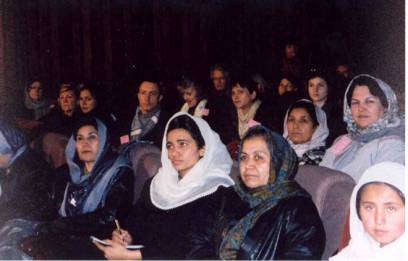
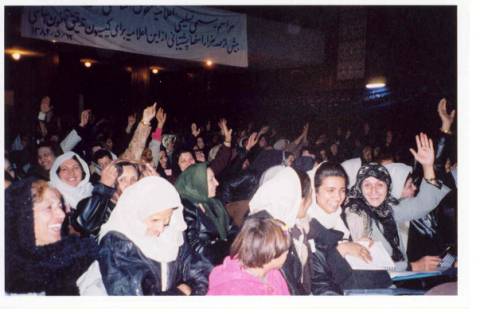
What an extraordinary event: 2,000 women demanding equality under the law. The three days meeting was mind-blowing in a country that forbade its women to be seen - literally, hidden behind the blue burqa, the black chodor. It seemed to me that for women to speak out in this setting was almost impossible. But speak out they did! Hand raised, fingers pointing, raised voices, demanding, demanding….
The three days conference ended with shouts of laughter, and tears of joy. They had come together at great risk to themselves and their families to demand change, to demand equality, and to demand that those poised at the Loya Jirga would hear them, and respect their demands.
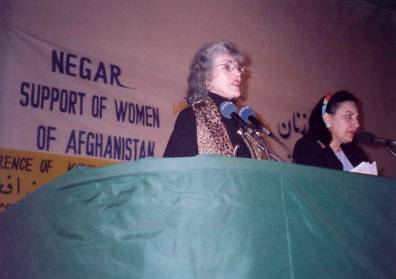
The high point for me at this meeting was the chance to address these women. As one of three American women at the conference, and as an NGO representative at the United Nations who had struggled with them to get their message across in the United States, I could barely contain my joy as I stood before them. I told the Afghan women assembled here about the American activist Susan B. Anthony and her struggle at the end of the 19th century for the right of American women to vote. Her charge to American women was that “Failure is impossible.” I left that podium knowing that it holds true for the Afghan women as well.
I am 82 years old, and I know that my activist days are not over. If I could handle Afghanistan, anything is possible.
Copyright © 2002
Global Action on Aging
Terms of
Use | Privacy
Policy | Contact Us
|




