|
|
Gov't Needs Better Healthcare for Elderly
The Chosun Ilbo
South Korea
October 7, 2004
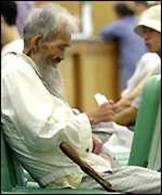
A 92-year-old man hung himself after strangling his 93-year-old wife who was suffering from Alzheimer's disease. The man left the W2.5 million he had painstakingly saved for a funeral and also left a suicide note to his children, saying that he was a vicious husband for killing his wife with whom he had lived with for 78 years. It is unimaginable how he may have felt while he suffocated his wife. It is not only heartbreaking to think about his decision to depart this world together, but also terrifying to think about the horrible disease that is dementia, which drove the elderly couple to this dead end. Dementia is a disease that cannot be overcome even by the love of a 78-year-old marriage or by the filial devotion of children.
The Health and Welfare Ministry estimates that 8.3 percent of those over 65, or 350,000 elderly people, are suffering from dementia and that the number will increase to 8.6 percent, or 460,000, by 2010 and 9 percent, or 570,000, by 2020. Considering the number of families that hide the fact that they have family members with dementia, the actual percentage may be much higher than the reported figure. According to another estimate, one out of 10 households has someone with dementia and the number will increase to one out of 5 households by 2020. This means that many families will fall apart, running out of money and patience while trying to take care of the sick.
What is worse, with the increase in nuclear and double-income families, families have a more difficult time in taking care of elderly people with dementia, while social support remains at a lamentable level. Out of 600,000 elderly people who need long-term medical treatment due to dementia or stroke, only 3 percent are admitted to welfare facilities. Dementia is a national problem that the government should take the initiative on. To the contrary, the government delayed the introduction of the Medicare health plan from 2007 to 2010 -- the plan will subsidize some nursing costs for patients with dementia or stroke. The government should make an effort to push up the introduction of the health plan. And before the plan is finalized, it should create supplemental plans to extensively cover the cost of the existing health insurance system.
By 2007, a budget of W2.6 trillion will be allocated for care and treatment of the elderly with serious diseases. The government should, if necessary, re-coordinate the budget allocation to help throughout old age. It is the government's obligation to help those who have lived through difficult times to die with dignity.
|
|