|
|
|
|
||
|
||
|
|
||
| SEARCH | SUBSCRIBE | ||
|
 |
Fighting
Hate, Across Cultures and Generations
By
Corey Kil Gannon, the
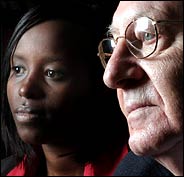
Jacqueline Murekatete and David
Gewirtzman often speak with students, to describe their experiences
escaping mass killings in David Gewirtzman and Jacqueline Murekatete
stood before a restless group of students at By the time they had finished, however, the
only sound that could be heard in the room was the faint hum of a
radiator. Mr. Gewirtzman, a 75-year-old retired
pharmacist who lives in Great Neck, N.Y., on Now, he visits local schools, hoping that by
telling of his experiences, he can educate students and help to prevent a
killing like the Holocaust from happening again. When he spoke at a high school in "I finally found someone who understood
what I went through because he went through the same thing," said Ms.
Murekatete, now 19 and a freshman at the Mr. Gewirtzman met the teenager, heard her
story and suggested she begin speaking to groups with him. It would not bring her family back, he said,
but it might save other families from potential genocide. It would also
help to heal her own pain. "We are as different as can be,"
he told the students. "She's black, I'm white; she's young,
I'm old; she's African and Christian and I'm a Jew from Now they appear regularly together, hoping
that they can bring experience and relevance to a harsh subject. But
neither expected the impression they would have on each other, and how
deep their friendship would grow with the only apparent bond being death. Elaine Weiss, a history teacher at the high
school who directs its social science research center, said she asked them
to speak because "the kids can identify with an 18-year-old girl
better than they can with a 75-year-old man." She said, "Our kids read theories about
racism and genocide in books. But when they hear similar real-life stories
from a white European man and a black African teenager 55 years apart in
age, who lived through events 50 years apart in history, it's not a theory
anymore. It's alive." Mr. Gewirtzman grew up in a small village in
Day after day in the hole, they would argue
whether to surrender to the Nazis, he recalled. "At times my father would yell at me,
'Why did you lead us here? We should have gone to Treblinka and gotten it
over with,'" Mr. Gewirtzman said. "I'd tell him, 'You may want
to die, but don't you want your children to live?' Then he would snap out
of it." "We thought there wasn't a Jew in They did not escape until Mr. Gewirtzman and his family lived in He and his wife have two grown sons and he
also volunteers at the As Mr. Gewirtzman spoke, the students became
spellbound. Some still held back tears as Ms. Murekatete began telling how
she grew up as the second oldest of seven children on a family farm in The day they reached her village, Ms.
Murekatete was visiting her grandmother Magdalene Mukasharangabo in a
nearby village. Her grandmother saved her by taking her to an orphanage. After two months, she learned from surviving
cousins that her family - her mother, father, two sisters, and four
brothers - had been tortured and hacked to pieces with machetes. Most of
her other relatives were also killed, including her grandmother. She was brought to She said she still sees her family in her
dreams. Other times, though, she is chased by the men with machetes. "I've never gone to a counselor or a
therapist," she said. "At first, I guess I hoped it might just
go away." She said, "Some of my friends are
afraid to ask me about it and I'm not a person who talks about my
problems." Ms. Murekatete is currently writing a book
about her recollections of the genocide in She also said that last September, she met
the human rights advocate Elie Wiesel at an International Day of Peace
ceremony at the United Nations. After hearing her story, he hugged her and
said he would help her publish it. With many cousins, aunts and uncles killed
and only a few relatives left, Ms. Murekatete has grown close to Mr.
Gewirtzman and his wife, Lillian, a Polish Jew, who had been sent with her
family to "I didn't know what to do with my
experience and he showed me," she said when asked about that day. Mr. Gewirtzman said, "In a way, we've
become sort of parents to her." "We both went through a traumatic
experience," he said, "but instead of remaining bitter and angry
and seeking revenge, we both resolved to spend the anger in a positive
manner, to prevent this from ever happening again." Ms. Murekatete shows listeners that racial
hatred has outlived the Holocaust, and that genocide was not just
something that happened to an old Jewish man from "When I go to an inner-city school, the
kids might think they have nothing in common with some Jews 60 years ago,
or me with slavery," he said. "But when they see both of us, they see
the problem is the same," he said. "It transcends race and
ethnicity. People are still being taught hatred and it is hatred that we
are fighting." Ms. Murekatete said, "Sometimes, students ask if they can help, and I say, The best thing you can do for me is to educate yourselves so this doesn't continue to happen." Copyright © 2002
Global Action on Aging |