|
|
Research: Senior Citizens Online
European Union
Telematics Applications Programme (TAP)
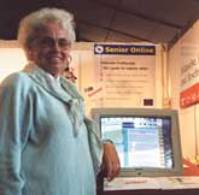
Nearly a quarter of the population of the EU is 55 years of age or older. The vast majority of these older people are retired and their situation is not always easy. Inactivity, distance from former work colleagues, loss of a partner or friends, and lack of contact with their children are all factors which can make elderly people feel excluded or even depressed. In some cases, their loneliness is accentuated by a lack of mobility which makes it more difficult to form new relationships.
And yet the Internet age makes it so easy to communicate, obtain information, and broaden one's horizons. The new technologies could help the elderly to discover new activities, overcome their isolation and generally improve their quality of life. But although the solution may be simple in theory it is much less so in practice. Many elderly people are unaware of the possibilities opened up by these new developments and are often ill at ease when faced with computer tools that are difficult for them to use. Little effort has been made in Europe compared with the United States to help them enter the information era.
Integrating elderly people
To address this problem, in October 1998 fifteen or so European bodies came up with the idea of launching the Senior Online project. The participants include telecommunications specialists, experts in the study of old age, and groups with social goals. 'Our objective is twofold,' explains Michele Carenini, the project coordinator. Sociologically, its aim is to improve the integration of elderly people in society by encouraging them to use the new technologies, in particular the Internet, to communicate, obtain information and derive entertainment.
Technologically, Senior Online aims to develop a communication protocol integrating different group work systems so as to arrive at a single tool that is both efficient and easy to use.'
The partners' first task was to determine senior citizens' expectations and requirements in order to offer them appropriate solutions. 'We have worked directly with several user groups,' explains Margit Lutowski, of Public Voice Labour, Vienna (Austria). 'As a result of many meetings, discussions and questionnaires, we have identified the main difficulties encountered by elderly people when using information technology. In this way, we have been able to draw up a precise list of improvements to be made to modern communication tools.'
Tailor-made tools
And the list is a long one. Web pages should, for example, be simpler and, in particular, they should be immediately visible on screen in full. All technical terminology should be replaced by simple and clear expressions. Last but not least, it would seem that most elderly people are unable to use a mouse correctly. So the idea has been put forward of building a mouse into the keyboard, to make it easier to use. On the basis of these pointers, the partners developed a pilot communication platform specially designed for their target group.
Based on the use of existing technologies such as the HTML and Java languages, and the Web4Group software (developed by the European project of the same name between 1995 and 1998), the Senior Online network offers many possibilities. For example, it makes it possible to communicate by e-mail, take part in discussion forums, and surf the web more easily by means of privileged access to carefully chosen services (travel, health, gardening, home, etc.).
'All these services will be available in the user's language,' says Michele Carenini. 'A translation system will also enable senior citizens to converse in their mother tongue with correspondents all over the world. In addition, written messages can be converted into voice messages for elderly people with reading difficulties.' The services of Senior Online will be accessible via a PC linked up to the Internet, or an ordinary telephone for people without Internet access.
What the users think
According to Margit Lutowsky, 'The user-friendliness and the quality of these tools are evaluated by the target population as the project progresses. We regularly invite pilot users to test our products and we film them and take notes while they do so. This enables us to make improvements where necessary.'
The results are in line with the expectations. When it was presented at the IST (Information Society Technology) Days in Helsinki in November 1999 the project aroused considerable attention and enthusiasm. Some of the Senior Online partners in fact plan to continue to work together to develop and market the Web4Groups software while adapting it to senior citizens.
|
|