
back

|
 |
Orphans Burden Elderly, Blind Women
By Chrispin Inambao and Katima Mulilo, New Era (Windhoek)
March 12, 2004
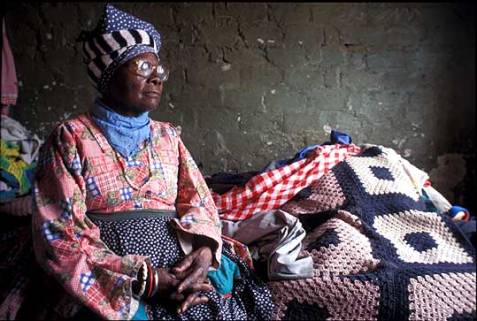
Age and mere hardship have exacted a heavy toll on Nkuze Mowa, an elderly blind villager who whiles away her days basking in the sun at a village at Ngoma some 60 km outside Katima Mulilo.
Mowa, whose sight was robbed by cataracts a decade ago, says she does not know the date and year when she was born.
She lives at Masilani Village where a number of huts are on the verge of falling apart because they are badly in need of repair.
Despite her disabilities, the frail-looking, grey-haired granny has to look after 12 grandchildren whose mothers and fathers were either deceased by the liberation war or by disease.
Due to the grinding poverty at Masilani, some of Mowa's grandchildren now also have children of their own and this is placing an unbearable strain on the already limited resources in her household.
Since she has no other sources of income, she mainly depends on a monthly state pension of N$250.
With 12 grandchildren, who are orphans, to look after, she barely survives on this amount.
Mowa mainly survives on credit as a 12,5 kg bag of maize meal costs N$45. At times the smallest of her grandchildren wail when there is no food and when they can no longer withstand the hunger pangs.
At times she subsists on handouts parcelled out by Good Samaritans. At the worst of times Mowa and her parentless grandchildren have gone without food for up to four days at a time.
"If hunger can kill in four days we could all have starved to death," whispered the elderly woman who is a mirror reflection of hardship.
Mowa says apart from food she urgently needs blankets as her blankets and the bedding material of her grandchildren have been reduced to tattered pieces of cloth through wear and tear.
Eighty-four year old Enius Mwale Songa is trapped in a similar situation, as she has to look after 11 grandchildren orphaned by Namibia's liberation war, disease and tragic accidents.
At the time New Era visited her hut Songa, who was dressed in a white dress, sprawled on a rickety, iron-and-wood bed.
A sturdy walking stick that she obviously uses when she occasionally ventures out was placed against a mud wall while two of her many dependants Nsozi Sibungo, 7, and Namvula Malumo, 10, eagerly looked at their grandmother as she narrated her tale.
For a start the elderly woman said she and her school-going grandchildren had not eaten for three days simply because there was no food to be had.
Villagers in the Caprivi are expected to have a bumper harvest this year because of the heavy rains that fell in the region, but Songa says due to her frailty she cannot do much on her communal field.
She had seen better days before her husband Sibungo Simataa, who was a prominent businessman died in 1976.
The plight of these two elderly women has already been reported to the regional office of the Ministry of Women Affairs and Child Welfare at Katima Mulilo.
Helena Andjamba, the Acting Deputy Director at Child Welfare Services at the Ministry of Women Affairs and Child Welfare, says if the orphans are 17 years or under they qualify for grants.
She said they should apply for foster care grants as they appear to "qualify" for these grants of up to N$200 per child.
Monthly the Ministry of Women Affairs and Child Welfare forks out N$2,9 million on child foster grants, said the acting deputy director.
Shirley Magazi, the HIV/AIDS Co-ordinator at the Namibia Red Cross Society (NRCS) says the humanitarian agency normally buys school uniforms for orphans and it refers them to the relevant ministry.
Last year the organisation registered 1 950 orphans, of which 450 were assisted with school uniforms in the Ohangwena, Khomas and Otjozondjupa regions, said the HIV/AIDS
Co-ordinator.
Copyright © 2004
Global Action on Aging
Terms of
Use | Privacy
Policy | Contact Us
|




