|
|
Learning the PC Starts At 60
By Brigitte Rozario, The Star Online
Malaysia
June 10, 2004
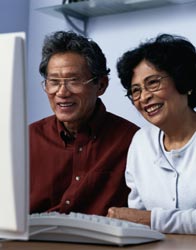
YOU HAVE just turned 70 and you find that you are single again. The kids have all married and moved out; some have even settled down overseas.
What's a senior citizen to do?
You could twiddle your thumbs everyday. You could reminisce the old days? But how many times do the grandchildren want to listen to grandfather's tales?
Or you could do what is the latest cool activity for old people: Learn to use the computer.
The PC which office workers can't do without is often seen as the "enemy" by senior citizens: It's a frightening machine that seems to be able to help others communicate with the outside world, and yet is daunting to master. Any wrong press of a key, or a wrong click, takes the unfamiliar user to a blank screen or causes the computer to hang. What then? Is it broken? How do you fix it?
Afraid of "spoiling" the machine, more often than not senior citizens choose not to touch it. They know that it's capable of interesting things, but the risk is too great that they will press the wrong button and then they'll need to call in an expert for help.
In most cases, the experts are usually sons and daughters who have to take time away from their busy schedules to go to their parent's home just to reset the PC or perhaps do what is a simple 10-second task to them. With the thought of having to face an irritated son or daughter foremost in their minds, most senior citizens would rather not use the computer and risk annoying their children.
Seniors are taking action
We're now in the 21st century and thankfully, more and more senior citizens are confronting their fear of the computer.
Old folks are learning to use it. Not only does it keep them busy, but it is also enables them to communicate with family members who live far away.
Under a programme called SeniorNet Malaysia, the pilot project - called Warga Emas Networks - has been implemented under the provision of the former Ministry of National Unity and Social Development. It involves setting up Pilot Learning Centres in Petaling Jaya, Klang and Kota Baru, Kelantan, to help introduce the digital world to senior citizens.
The Warga Emas Networks which was launched in August 2003, ends next month.
In Petaling Jaya, the Warga Emas Networks' Pilot Learning Centre was set up at the National Council of Senior Citizens Organisation of Malaysia (Nacscom) office. Nacscom members attend classes at the office. There they learn how to boot-up their PCs as well as use the mouse, drag-and-drop files in Windows, type a letter using a wordprocessor, surf the Internet, send e-mail, use chat programs, and even how to use a scanner.
To anyone below 50, these are likely basic stuff and easy to learn, but to a senior citizen, it is like going to school all over again. But this time, they are no longer young and their memory may not be as good as it once was.
Teacher S. Kumar, 24, from Multimedia & DigitalWorks Sdn Bhd admits that it takes a lot of patience to teach senior citizens because after showing them how to do something, they often ask him how to again and again.
"Absent-minded," says Khoo Lan Eng, 68, from Kuala Lumpur. "Today we learn, tomorrow we ask (the teacher) the same question."
Khoo has a son in Melbourne, Australia. She says that learning to use the computer helps her keep in touch with her son.
"This is my fourth class. It is not that hard to learn, but I am very absent-minded.
"I decided to take up the class because now I am quite free and we are now in the computer age.
"My son asks me why I don't learn to e-mail. I prefer to write, you see," she says smiling.
Khoo has a computer at home which her late husband used. Since his death, the computer sits idle in her house.
"Sometimes I'm scared to (switch it on)."
Ng Chau Hen, 70, speaking in Mandarin, says she never got a chance to learn English when she was young. It was a time when educating girls was not seen as a priority, and in fact it was deemed a waste of time (because most families believed that a woman's place was in the home).
Her task of learning to use the computer is more difficult because the programs and icons are all in English. As she has no computer at home, Ng requests for extra classes. She is lucky that teacher Kumar speaks Mandarin.
She takes notes which have to be more detailed as she can't read English. And the notes are followed carefully each time she wants to start up her PC and send an e-mail.
Her son conducts computer classes, she explains. However, since he lives out of town and doesn't have much time, he has encouraged Ng to attend the computer lessons at Nacscom.
Kumar says that in the beginning it was hard for Ng to understand and pick up the lessons but through her sheer determination to learn, she is slowly but surely learning to use the computer.
Says Ng: "There's nothing else to do, so I learn to use the computer. It is good to keep the mind working.
"Slowly we can learn.
"Others take one month (to learn), I take one year. You must have the patience to learn."
Kumar says he has a total of 71 students at the PJ Nacscom office. He teaches two sessions a day. Students typically go for one hour of theory and one hour of practical lessons every week.
His oldest student right now is 70 years old.
Future plans
According to Lum Kin Tuck, president of Nacscom, response to the computer classes has been good. "Now you see a lot of old people with grandchildren overseas. The way to contact them if you know how to use it is via the computer. It is easy and not so costly."
Currently the computer classes are only open to the organisation's members.
However, Lum says that if there is financial support, the organisation may open the classes to the public as well.
DigitalWorks' managing director Adam Din says his company is working with Microsoft Malaysia and hopes to find a way to sustain the classes, perhaps by getting the senior citizens who have become adept to teach the beginners.
Keeping active
"(Learning to use the computer) is a good way to keep senior citizens busy, otherwise they may start to feel lonely," says Lum. "Loneliness creates a lot of health problems. Once they don't feel that they are a part of the community, they will feel miserable."
Ng puts it more bluntly. She says it is important for old people to keep busy; otherwise they might go "crazy."
Senior citizens can certainly benefit a lot from learning to use the computer.
Being old, they are not as mobile as they used to be. But being confined to the house does not necessarily mean being cut off from the world.
Through the Internet, a whole world opens up to them. The possibilities are endless. Not only will they be able to communicate with their family and friends, but they can also make new friends, obtain information on their interests and even contribute to society by sharing their thoughts on the Net.
The computer is not only a means for senior citizens to reach out to the world. It also provides the world with an avenue to its senior citizens, to gain from their accumulated knowledge and experience.
|
|