|
|
Role Reversal
When an Elderly Parent Becomes the One Who Needs Help, Instead of the One Who Gives it, the Emotional and Physical Demands on Everyone are Daunting.
Joanne Richard, The Free Press
September 13, 2004
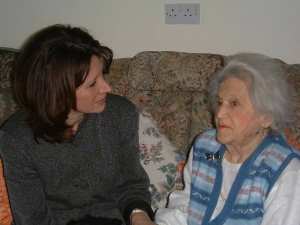
Caroline Tapp-McDougall found herself overwhelmed and desperate for answers following her mother's stroke. Although she publishes Solutions, a magazine dedicated to the wellness of seniors, their caregivers and their family, she was unprepared for the challenges and dizzying demands of hands-on caregiving.
It was a rude awakening: "Roles reverse and suddenly I was the parent and in charge," says Tapp-McDougall, whose 78-year-old mom, Margaret, suffered a stroke four years ago, leaving her partially paralysed, wheelchair-bound, unable to speak and totally dependent 24/7.
Tapp-McDougall, a mom and full-time businesswoman, admits she was hopelessly inexperienced and went into crisis-mode -- making decisions on the fly, rushing daily to the hospital and later rehab, obsessing over every little detail and juggling her children, husband and career. She was exhausted, struggling and completely frazzled within months.
"Caring was not something I could opt out of. It wasn't a matter of choice," says the Toronto resident, who decided to take her mother home following seven months of rehab.
Within six weeks, it was apparent the crisis was far from over and home care was inadequate. "It was terrible -- I even dropped her and we ended up in emergency."
Turmoil and heartbreak ensued as plans moved forward to place her stroke-disabled mother in a long-term care facility. "It ripped me apart -- she didn't want to go. She cried and I cried," says Tapp-McDougall. "I felt very guilty and that I had failed miserably."
In the last two years, life adjustments have been made and a new course charted, but it requires Tapp-McDougall to contribute an extra $1,000 a month.
Now the veteran coper wants to help ease the burden and the anxieties, as the crushing responsibility of eldercare is front and centre for aging Canadian baby boomers.
"It's not a matter of if, it's a matter of when."
A full 70 per cent of Canadian boomers expect to care for a family member in the near future.
The number of caregiver households has tripled since 1987 and is projected to almost double again by 2007, says Tapp-McDougall, who has written a straightforward, no- nonsense reference guide for people who facing an eldercare crisis and for those planning ahead.
The Complete Canadian Eldercare Guide (Wiley, $26.99) provides advice on making tough decisions about the care of aging loved ones, including independence, medical needs, housing, finances and lots more. The book also offers guidance for caregivers struggling to maintain balance, alleviate stress and anxiety and avoid burnout.
Although it seemed scary at times, "It's manageable -- but without a plan you're fried," says Tapp-McDougall. "You need a purpose, goal and a plan."
Eldercare comes with "inherent superhero responsibilities" that require time-consuming commitment and endless resources.
"Providing eldercare while holding down a busy job and active home life is a recipe for burnout," she says, adding that it's the worst climate in which to make thoughtful, informed decisions that have significant impact on the quality of life of an aging parent.
Research shows that families are, for the most part, unprepared for the eldercare challenges that lie ahead.
Tapp-McDougall, who has an extensive background in working with rehabilitation professionals, says there are two important factors in a successful care program: A high degree of participation by the person receiving the care and the education and involvement of informal care from family and friends is essential.
Carol Edwards agrees. She's a geriatric care manager and runs Careable, a company offering multiple services to help caregivers look after loved ones, at home or in a health-care facility.
"Initially there's a feeling of hopelessness when you realize the type of care you want is not there," says Edwards, who helps people find workable and affordable solutions and access limited services by collaborating with the system.
"I become like a surrogate daughter -- I do a lot of handholding, get everything in place and often continually monitor things as well," says Edwards, who has an RN background.
She is bent on demystifying the scariness and helping people "be proactive rather than reactive."
Edwards is truly a Jill of all trades: She helps caregivers get the most out of the health-care system, educates them about options and makes recommendations about service providers and suitable accommodations.
Edwards' own personal experience led her to set up Careable a few years ago. As the primary caregiver for her aging and ailing parents, "There were many occasions when I felt completely alone with no help."
It's an emotional roller-coaster. Andrew Niedzwiecki of Ottawa is a long-distance caregiver for his 96-year-old uncle, who lives in a Toronto apartment and wants to remain there until he dies.
But at $14,000 a month for living and round-the-clock care expenses, the aging man's finances are being rapidly depleted and other living arrangements must be made.
"The cost is astronomical and has become too much," says Niedzwiecki, who has turned to Edwards to find an affordable and adequate solution.
"It's a big responsibility and I can't be there, but I want to keep him happy and comfortable," he adds.
"You can't allow someone to go off and die somewhere alone just because they're old."
SURVIVAL TIPS
You have to take care of yourself in order to take care of others. Here are 10 eldercare survival tips courtesy of Toronto author Caroline Tapp-McDougall:
Play the hand you're dealt: Come to terms with your situation, be clear regarding your objectives and set out to make the best of it.
Think positive: Never underestimate the power of a positive outlook; from it will come the determination and strength to triumph over daily challenges.
Make things happen: Seek solutions, logically and realistically.
Set goals: Goal setting facilitates clear communication and helps prioritize limited time and resources.
Prioritize: Recognize and choose whether your role is to achieve short-term stability in your parents' life or to accept a new longer-term and more significant caregiving role.
Ask for help: Sharing care responsibilities reduces the risk of burnout; be creative and involve others wherever possible.
Overcome your fear: Try not to get overwhelmed. Take it one step at a time.
Be good to yourself: Treat yourself well (including taking respite, fitness and wellness breaks) and you will have the inner strength to better care for others.
Watch what you eat and respect your body: Ensure your body is up to the task of looking after someone else.
Live for today: Don't zap your energy fretting about your parents' loss of strength, independence or vitality. Focus on finding ways for everyone to enjoy today.
THE COST OF CARE
- 3.5 million Canadians are over age 65. By the year 2020, that number will more than double.
- 70 per cent of adult Canadians expect to care for a family member in the near future.
- Less than one-third of adult Canadians have discussed future health care plans with their parents.
- Five million Canadians (one in four) are currently caregivers.
- More than 70 per cent of adult sons and daughters aged 30-60 are caregivers.
- Women make up 61 per cent of caregivers; 64 per cent of female caregivers work full time; 42 per cent are raising children under 18 years old and balancing other activities.
- 80 per cent provide care seven days a week. As a family caregiver, four in 10 spend $100 to $300 a month of their own money.
Source: The Complete Canadian Eldercare Guide
|
|