|
|
Women Marrying Women to Circumvent Violence
Susan Mwangi, African Woman and Child Feature Service
Tanzania
November 25, 2004
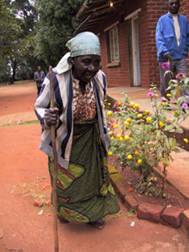
The setting is in Kiangata Village, Musoma, Tanzania and the short feature film is about Nyumba Ntobhu translated, 'women marrying women'.
The film depicts women who opted to marry other women to circumvent violence.
How they arrived at their decisions is as varied as the individual stories of the women.
Bi Mukami, now past her menopause has two wives with a child each. She was married to a violent drunk who would beat her for the slightest transgression.
When their only surviving daughter was murdered, he beat her unconscious blaming her for the deaths of all his children and left her for dead, naked in the bush. Her father-in-law sheltered her as she nursed deep knife wounds and other horrific injuries.
When she returned to her matrimonial home, the violence continued and Bi Mukami, who was pregnant escaped into Kenya where she found a safe haven in Nairobi's Korogocho slums.
After her daughter's birth she returned to Tanzania but her husband would not accept the daughter he called a 'bastard' child.
Bi Mukami packed her bags once more and left him, having had enough of the violence and afraid he would kill her. After all he had killed a seven-year-old boy before. She did not flee across the border into Kenya but dug her heels in her homeland.
She began selling traditional beers to help support herself and her daughter, who today is all grown up and sells food to make ends meet.
The work was overwhelming and as she got older she realized she needed someone to help her with the work and to look after her.
She married Wankyo, a young woman and paid 16 cows for her dowry. As good as any man would pay. This was an acceptable arrangement for Wankyo, who had decided quite early in her life that a woman would marry her after witnessing the violence at home between her father and his wives.
She already had three children before the marriage, although she lost two of them in their infancy. Her marriage to Bi Mukami has no comparison to her own parents' marriage. She can boast that no man has ever laid a hand on her and even her boyfriend who is now married was as gentle as a lamb.
Bi Mukami paid four cows for Wankyo's co-wife Kihenga. Kihenga chose to be married by a woman rather than a man because she did not want to end up like her own mother who was flogged mercilessly by her father, resulting in hearing impairment.
The three women say they have prospered from their marital arrangement and there is no fear of domestic violence. Instead they work hard to complement one another's efforts.
However, Nyabwire has a different story from her experience of being married to another women. Her father married her off to her aunt for the sum of 22 cows. She was warned that she would be bewitched if she refused the arrangement.
She is now old and blind and her 'mother- in-law' has taken back the woman she married who was supposed to have taken care of her in her old age.
But how do these relationships work? When a woman is married to another woman the younger one is expected to take care of the elder in her old age and to bear her children especially if she is barren. The younger woman is free to have sexual relations with any man of her choice as long as she bears children for the other woman.
Initially, the culture of women marrying women was practiced as an option for barren women. It enabled them to claim the children born by the other woman as their own thus creating a hedge of security for their well being in their old age.
However, not all community members favor this culture. A young man in the feature film says that people are reluctant to inherit widows because of the increased risks of spreading HIV. People are also concerned about the welfare of children growing up in these female-headed households.
He says that young men are being denied opportunities to marry young women because the latter continue to be promiscuous knowing that they can choose to be married by older women.
He is optimistic that the practice will end when men turn away from violence and start treating their wives well: "Women want to be free," he says, "but too much freedom is also dangerous," he laments.
The films are productions of GreenHope and Foundation Help, organisations of young people in Mwanza and Dar es Salaam, Tanzania who are addressing gender violence in families. They want to highlight the repercussions gender violence within families is having on communities.
|
|