|
|
Nation Must Adapt to Support Elderly
Workers
By Kentaro Nakajima, Yomiuri Shimbun
Japan
June 9, 2005
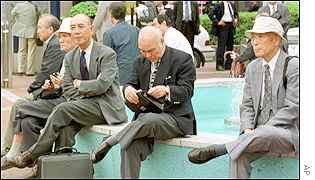
Measures should be implemented to help provide jobs for an increasing number of people who are still motivated to work after reaching retirement age.
The number of people aged 65 or older reached a record 24.88 million, or 19.5 percent, of the total population of 127.69 million, as of Oct. 1, according to the Annual Report on the Aging Society 2005.
The Cabinet Office report also estimated that one out of every four people would be 65 or older in 2015, and the figure would rise to one out of every three in 2040.
"[The latest figure for the rapid aging of the population] shows the need to seriously think about what kinds of policies should be adopted," Health, Labor and Welfare Minister Hidehisa Otsuji said at a press conference Friday.
The government predicts that the rapid decline in the nation's birthrate will reduce the population after it reaches its peak in 2006.
As the number of people aged 65 or older is expected to rise, it is expected that more and more older people will continue to work due to longer life spans.
People aged 65 or older accounted for 7.4 percent of the total population in 2004, and the rate is expected to reach 11 percent after 2015, when the generation of baby boomers reaches the age bracket.
Other data show senior citizens are still eager to work beyond retirement age.
According to a survey conducted by the Health, Labor and Welfare Ministry in 2000, 51.6 percent of men aged between 65 and 69 and 28.7 percent of women in the age group had jobs. The percentage of jobless people in the age bracket who wanted to work reached about 40 percent for men and about 20 percent for women.
Elderly people, however, do not find jobs easily. Only 26.9 percent of companies accepted job applications from people aged up to 65 in all of their recruitment conditions in 2004.
Is it possible for motivated senior citizens to continue to work?
Most salaried workers have knowledge and expertise acquired throughout their career.
In a survey that asked companies to list the areas in which elderly workers contributed most in the workplace, external negotiations was the most common option, at 34.6 percent, followed by technology and skills, at 33.8 percent.
"Elderly people don't need to be employed on a permanent basis. They can group together and establish a company. They can make use of the technology and networks they have come to know and work in their own style," Recruit Works Institute General Manager Yukio Okubo said. "Senior people are skilled in counselling younger workers and passing on their knowledge, such as negotiating skills. There is potential demand for such people. The government should encourage elderly entrepreneurs through setting up a legal framework in this area."
About 30 percent of men and women aged 65 or older who said they wanted to continue working wished to do so to maintain their health rather than earn a living, according to a survey by the Internal Affairs and Communications Ministry in 2002. The survey suggests that senior citizens view work as a valuable component of their lives rather than a means to livelihood.
"We need to form a program to support those who want to work rather than forcing them into late retirement," said Yoshio Higuchi, a Keio University professor who specializes in the labor economy. He called for a variety of employment styles that will allow elderly people to work within their own limits, such as providing more choices on when to begin pension payments.
The government's outline for measures to deal with the aging society aims to establish an environment in which elderly people actively contribute to the economy and society through their knowledge and experience. But more specific measures are needed to support and motivate older people who wish to remain part of the workforce.
|
|