|
|
Dancing Robot is Strictly Ballroom
CNN
Japan
June 7, 2005
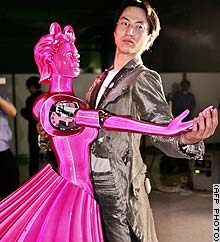
Photo by AFP
The world's first ballroom-dancing robot is set to take to the floor for its first public performance this week at the World Expo 2005 in Aichi, Japan.
Developed by scientists at Tokhuro (Tohoku: corrected by GAA) University, the Partner Ballroom Dance Robot (PBDR) is able to predict the steps of a human partner based on body movement and react accordingly on its three wheels.
The 1.65 meter robot has a female face, wears a ballgown and comes in bright pink and pastel blue plastic. A male version is also being developed.
Although it can match the movements of a human partner's upper body, Professor Kazuhiro Kosuge, who led the team behind PBDR, said it could not yet perform dance steps.
The machine forms part of the 10-day Prototype Robot Exhibition, starting June 9, which gives robotics companies and academic departments the chance to showcase their visions of a future in which robots are a part of everyday life.
A model home from 2020 includes machines designed to do the housekeeping and to provide company to elderly people or children, while other exhibitions showcase robots performing tasks ranging from microsurgery to slugging baseballs.
Kosuge said that robots such as PBDR were a step towards developing responsive robots that could provide care for the sick and elderly.
"Machines or robots would be able to pre-empt trouble if they can find what their partners want from them what is heard and seen," he told AFP.
But Kosuge said roboticists were still a long way from building machines capable of providing reliable assistance to the elderly.
Robotics expert Henrik Lund told the New Scientist magazine that there was a burgeoning market for home-based helper robots in Japan, where it is predicted that more than 35 percent of the population will be over 65 by 2050.
|
|