|
|
Elderly can Be Better Cared for
in Community
The Scotsman
Scotland
May 26, 2005
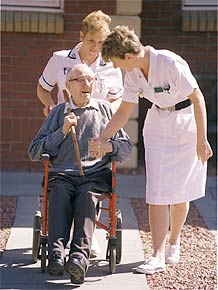
Co-ordinated care: The old and frail should expect help from a local care team.
Photo by Paul Raeburn
Scots are living longer than ever. That is good news. But as we live longer, so our NHS needs to adapt to meet this new challenge.
Patients expect that their care will be personal to their needs, as local as possible, as specialised as necessary and of the highest quality. That's what we are committed to.
We want to continue to cut waiting times, reduce health inequalities, deliver the right services in the right place, recruit the right staff and reward them well. But providing a health service which responds to the challenges of an ageing population and the need to improve treatment and care needs a bold and confident vision.
That's why Professor David Kerr's framework published yesterday points the way ahead, not just for next year, but for the next decade.
A year ago, we asked Prof Kerr to look at long-term planning across the whole range of health services. The work isn't just about hospitals. No less than 90 per cent of our contact with the health service is in local communities, through staff such as health visitors, practice nurses, pharmacists and family doctors.
His report reflects the fact that we can make the biggest improvements to people's health in their local communities, the local health centre or, indeed, in their own homes.
I am grateful to Prof Kerr going out on the road to meet the public and staff, and to shape his report around their questions. I should like to add my thanks to the people who turned out to those public meetings around the country to offer their opinions and make their points.
Prof Kerr points out three key factors. The first is the growth in the number of frail older people. The second is the emergence of chronic disease as the main challenge facing the health service. The third is the growth in emergency admissions.
That is why, in responding to the report, we will give priority to identifying those patients with long-term conditions who are most at risk of hospitalisation so that health boards can provide them with proactive, co-ordinated care in the community.
Our aim should be to improve the quality of life, deliver more co-ordinated care in the community, and reduce avoidable hospital admissions for the increasing numbers of frail older people who, through no fault of their own, currently go in and out of hospital all too frequently. We need to provide care for these older people that enables them to stay at home wherever possible and supports them in the community.
We will support this work with patients with long-term conditions such as asthma and diabetes by further enabling "self care". This involves people taking action, supported by the health service, to maintain health and help manage their conditions. Self-care initiatives such as Stirling's Braveheart project for people with chronic heart disease already provide great results.
Prof Kerr also suggests that we can get faster treatment for everyone if we divide up care between planned and emergency care. The planned care units can get on with work in an ordered fashion, leaving emergency units to tackle unforeseen cases.
The report confirms that a large proportion of emergency care can best be delivered by teams working in local "community casualty units". These would be a valuable part of local services enabling 24-hour care for the vast majority of needs.
And for more specialist advice and support, we can use new telemedicine technology to link these units to specialists in larger hospitals.
And finally, we will tackle health problems of the future. It is a national disgrace that someone born in the east end of Glasgow can expect to die 13 years before someone born in north-east Fife. By investing now we can help people improve their own health, and enjoy longer, healthier lives. It will take many years, but that is no reason not to do it.
So how will this vision look in practice?
You are more likely to have your care provided locally by GPs and other practitioners with special interests.
If you are old and frail, you will get co-ordinated care provided from your local care team. If you stay in a deprived area, your care team will provide preventative care. If you have a long-term condition, support will be available so that you can help manage that condition yourself.
If you have an urgent need for care, you will get quicker access because you will see the right person, with the right skills, first time.
If you need complex treatment then you will get access to the right person - even if you have to travel.
If you stay in a remote or rural area, the health service will take that into account, including providing a core set of services in rural general hospitals.
If you do have to go into hospital, you will get quicker access, the tests will be done locally where possible, and your length of stay will be planned and shorter.
Your appointment will be less likely to be cancelled because of an emergency or because the tests are not available.
This report, alongside our ongoing work, can help achieve what we all want - the NHS in Scotland to be better, quicker, closer and safer. That's good news for everyone.
|
|