|
|
Aging Korea On Course for Massive Problems
Chosun Ilbo
South Korea
August 11, 2005
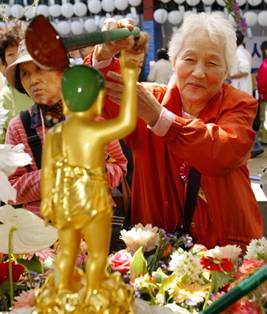
Korea is aging faster than almost any other country, according to the Ministry of Health and Welfare. Korea's elderly over 65 years of age numbered 4.18 million in 2004 or 8.7 percent of a population of 48 million. That percentage is expected to skyrocket, hitting 24.1 percent in 2030 and 37.3 percent in 2050.
That is more than twice the global averages of 7.3 percent, 11.8 percent and 15.9 percent for the same years, mainly because the country's low birthrate will lead to a decrease in the overall population while the elderly population is growing due to longer life expectancy.
The economically active population that will take care of the elderly is decreasing apace. The old-age dependency ratio -- the percentage of the over 65s to people of working age -- will surge exponentially from 12.6 percent this year to 14.9 percent in 2010, 37.3 percent in 2030 and 69.4 percent in 2050.
That would mean that for every 10 economically active individuals, there would be seven elderly individuals to be taken care of.
The number of the elderly who have to look after themselves without help from children will also increase rapidly.
According to data announced in July by the Korea Institute for Health and Social Affairs (KIHASA), single-person households will increase to 21.5 percent of total households by 2020. Of those, 40.5 percent are expected to be elderly.
A May survey of Koreans between 55 and 79 by the National Statistical Office showed the average working period for Koreans was 20 years and 10 months -- 23 years and three months for men, 18 years and eight months for women. The average retirement age was 53 -- 55 for men and 52 for women.
But the average life expectancy was 78 years. In other words, Koreans have to get by for some 25 years after retirement. Yet according to a KIHASA survey, only 23.8 percent of those over the age of 65 saved for their retirement, meaning nearly eight out of 10 made no provisions at all.
"Korea's elderly spent almost all the money they made preparing for their children's education and wedding
costs," KIHASA researcher Choi Byung-ho said. "But if the children they counted on for their old age don't properly take care of them, they will be sucked into
poverty."
|
|