|
|
Fellowship of the Old
Communal Living Attracting
More Elderly People
By Saori Kan, Daily Yomiuri
Japan
February 4, 2005
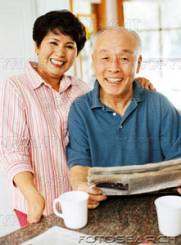
Single people may enjoy the freedom to do whatever they like, but many of them probably feel lonely while sick in bed, wishing there was somebody living with them.
These days, more elderly people choose to spend their golden years neither alone nor in old age homes, but rather in a community residence. In such arrangements, a group of people live in separate rooms and look after themselves, but also share a common space. The number of landlords who have remodeled their houses for such communal living is on the increase.
One such place, Group House Keyaki, opened seven years ago making it Kanagawa Prefecture's first facility of its kind. It has six apartments, about 26 square meters each, which all have a bathroom, a closet, and a kitchenette. The common space in the house includes a larger kitchen, a dining room and a larger bathroom.
It is managed by Hiroko Iwasaki, 61, and her husband, Kenichi, 64. The couple's house is next door.
How a community residence operates depends on the managers. The house rent and key money also vary.
Keyaki residents pay 95,000 yen per month, which covers rent, food and maintenance. They also have to pay 500,000 yen key money, plus another 500,000 yen every two years.
Keyaki residents usually share breakfast and dinner, prepared by the landlady, but are on their own for lunch. They must be physically and mentally independent, which basically means healthy enough to take care of themselves in daily activities, such as cooking, bathing and walking.
They can ask the house owners for help when they are sick, but they are required to move out and enter a hospital if a doctor recommends it.
Recreation for the residents includes occasional events, such as jazz concerts and Christmas parties.
Former Tokyo resident Yasuko Hata, 77, moved in shortly after Keyaki opened.
"I had been living alone for a very long time. But after the man I'd been dating for 50 years died, I felt so lonely. I wanted to move somewhere where I could be with other people," she said. "I had never heard of group living or anything like it, but one day I saw a TV program featuring Keyaki, and it looked like a comfortable place to live. I visited the place the next day and decided to move in one week later."
Hatsue Katayama, 83, entered the facility three years ago. She had lived alone for more than 10 years in Yachiyo, Chiba Prefecture, after her husband died.
She has two sons and a daughter in their 50s and 60s, who live in Tokyo and Kanagawa Prefecture. They had planned to take her in, but she preferred life with others her own age and "did not want to depend on my children."
A poll conducted in December by The Yomiuri Shimbun asked about 1,800 people what they thought the ideal family structure should be. More than 60 percent of respondents mentioned "a big family, in which grandparents and grandchildren live together," while about 26 percent wanted to live in a nuclear family.
However, the statistics are reversed when compared to reality, with about 26 percent of all respondents living in big "ideal" families and about 70 percent living in nuclear families.
The percentage of Japan's population aged 65 and older is expected to rise to 25 percent by 2015. The number of elderly people who live alone or only with their partners, and not with their children, is rapidly increasing.
"In Japan, people really started paying attention to such communal living spaces after the Great Hanshin Earthquake when they really needed the help of others," said Ikuko Koyabe, professor of housing and architecture at Japan Women's University in Tokyo.
Iwasaki said, "Of course, there's been trouble here among residents, as the elderly tend to be inflexible in their thinking and attitudes. A few people who complained about everything moved out as they couldn't get along with other residents."
Hata said, "When I was verbally abused by another resident, I cried for a week. But I like this place and I want to live here while I'm healthy."
Effects of intergenerational life
While there are many community residences only for the elderly, Keyaki is also open to young people. Among the six women who currently live there, two are students at Tokai University in the prefecture. The rent for students is cheaper.
Katayama said, "I like young people, so it's enjoyable for me to live near them. Chatting with them is a lot of fun."
Kaori Yako, 18, a freshman at the university who is studying psychology, said, "It's interesting for me to talk to Mrs. Katayama, as she is a person of varied interests. We sometimes borrow CDs or video tapes from each other. I plan to go to see a movie with her during my spring vacation next month."
Iwasaki said Yako "is liked by all the residents because she has a very cheerful disposition and is very friendly."
Residents can freely invite their friends and relatives to come over.
Yako said, "When I told my classmates about my life in community housing, some of them appeared to be surprised. But a friend who visited me said, 'You look happy here.'"
Many modern young people are reportedly reluctant to live with their own grandparents, so why did the young students choose to live with comparative strangers at the facility?
Yako, from Chuetsu, Niigata Prefecture, explained: "Honestly speaking, the main reason was that my parents wanted me to live in this type of arrangement to be sure I would eat properly. But I like living among older people because there were many friendly old men and women in my neighborhood where I grew up and I liked them."
Koyabe said, "With young people, a community generally becomes much more activated."
NPOs provide information
A number of organizations have been set up to meet the informational needs of those wanting to live in or manage such facilities.
For instance, Geshukuya Bank, a nonprofit organization in Yokohama, promotes group living for senior citizens. Geshukuya means a rooming house.
Sanae Sakino decided to establish the NPO after a hospital stay brought on by working too hard to earn money to raise her child after her husband died.
"At the hospital, I imagined how lonely elderly people must feel if they live alone," she recalled. And that was why she established Geshukuya Bank.
In December, the organization opened a facility called Geshuku Jaya for the elderly in the city. It utilizes an old Japanese-style house with a space for tea ceremony.
"We'll open another house this year, remodeling an existing house at the same site. We plan to make it the sort of a place for international cultural exchange, where residents, including foreigners, can live and communicate in English or other languages."
|
|