|
|
Portugal Fires Could Speed Flight from Interior
By Axel Bugge, Reuters
Portugal
August 25, 2005
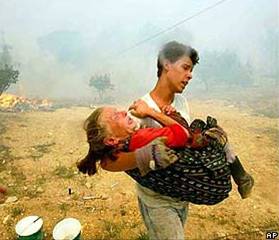
This year's Portuguese forest fires, among the worst in decades, will likely hasten an exodus from the countryside and leave the land more vulnerable to future blazes, officials and residents said.
Even as fires waned around the rugged terrain of the hamlet of Vila Nova on Thursday, residents in similar crumbling villages feared the flames may continue to feed migration to the cities and land abandonment.
Portugal's interior, one of the poorest parts of western Europe, has steadily emptied in the last two decades.
From northern mountains to southern farmlands, the region is increasingly home only to timber grown for the pulp industry, crumbling farmsteads and villages of old people, a combination fire fighters say has helped blazes spread.
"The relation between the abandonment of farming and human exodus from the interior is directly related to the growing size and worsening of the fires. This is undeniable," said Cassiano Costa, head of an 85-village forest association.
"Twenty years ago you had 80 percent of people in a village working on the land. Now if you've got three or four, that's a lot."
More than 600 firefighters and aircraft from European Union countries worked around the clock this week to contain vast fires near Vila Nova, about 180 km (110 miles) north of Lisbon.
FEW SIGNS OF LIFE
Belying its name, which means "New Town" in Portuguese, the once-bustling farming village showed almost no signs of life at midday on Thursday.
"Here there are only old people," said 73-year-old villager Jose Lopes, pointing out dozens of abandoned houses along the main street.
"Many people sold their homes, many have died."
The parish of Vila Nova had 1,092 people in 2001, down 16 percent from 1991, according to the census. Locals put the hamlet's current population at around 150.
"There are no jobs, there is nothing," said Erlindo Nunes, 54.
In some parts of the country, analysts say a decades-old policy of planting single species such as eucalyptus for the pulp industry had replaced more fire-resistant native forests.
Portugal's worst drought on record has already devastated crops, and now the fires, spreading through dry forests, are threatening villages. Some have burnt and many have been evacuated since blazes started in May.
About 75 percent of the Iberian nation's 10 million people now live within 40 km (25 miles) of the Atlantic coast.
"Major economic damage, environmental damage and people's feeling of insecurity are going to speed up the departure of people living in rural areas," said Joao Dinis, an aide to the board of the National Confederation of Agriculture.
Some small interior towns are offering couples bonuses to have babies in a bid to gain population.
The government estimates that about 180,000 hectares (450,000 acres) of woodland have burned this year, the second-biggest annual figure since 1980.
At least 14 people have died in fires this year, according to the Lusa news agency.
|
|