|
|
Asean Told to Prepare for a 'Greyer' Future
By Anjira Assavanonda, Bangkok Post
September 8, 2005
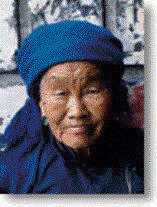
The governments of countries in the Association of Southeast Asian Nations (Asean) need to establish policies to prepare to care for an ageing population, Minister for Social Development and Human Security Watana Muangsook said yesterday.
Mr Watana said the proportion of elderly people in Asia and the Pacific is expected to rapidly increase over the next 50 years.
''The proportion of elderly people has increased from 7% of total population in 1950 to 9.4% in 2000. This share is expected to rise sharply to 15.4% by 2025 and 23.5% by 2050,'' Mr Watana told a forum of the Asean Plus Three Symposium on Older Persons yesterday.
To cope with the transition, Mr Watana said countries need to adopt policies and an action plan to prepare health services and social welfare systems for the increasing number of elderly people.
Sutthichai Jitapunkul from Chulalongkorn University's faculty of medicine said policies suitable for an increasingly ageing population should look to maintain the igrity and stability of the elderly, and maintain their contribution and productivity within society. They should also aim to gain the support of families, friends and local communities to support the elderly, as well as those responsible for growing health care costs.
Dr Suttichai said an effective community-based health service system is required that can facilitate self-care for the elderly, promote the ''active ageing'' concept and independence for the elderly as much as possible.
Unfortunately, while the idea of a community-based health service system has been promoted within developing members of Asean, in practice it has not yet been effectively organised. One major problem that remains is governments' perspective on the issue. ''When determining priorities, most governments have paid little attention to issues regarding elderly people and ageing, as the impact seemed a long way off. Politicians usually regard the issue as being of little importance and feel it can have little effect on their popularity,'' he said.
Although over half of Thailand's elderly live in rural communities, urgent action first needs to take place for the elderly population in Bangkok as the city is rapidly undergoing urbanisation and experiencing a shift in family structures. ''Rapid urbanisation usually creates an unfriendly environment for older people. In some extreme cases, elderly people may have to face the prospect of having nobody to take care of them,'' Dr Sutthichai said.
|
|