|
|
Helping Elderly People
Asahi Shimbun
Japan
May 24, 2005
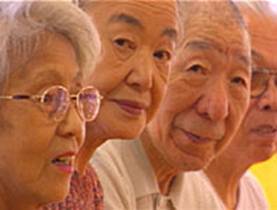
The memory-method approach proves effective.
In the town of Shikatsu, Aichi Prefecture, an effective method has been adopted to prevent senile dementia. It is called a "memory-method approach," and involves elderly people discussing their memories among themselves.
The once-a-week "memory-method school" is being implemented on a town-wide basis.
About 10 senior citizens got together at a "composite welfare center" of the town to relay stories of the days gone by. Three coordinators, all volunteers, joined the meeting. The subject of discussion on one day was "our school."
One of the participants said, "We went to school with a handmade cloth bag on our backs." Another said, "We called a pencil box 'fudezutsu.'"
They talked without interruption, switching from one subject to another, from umbrellas to school records and lunches. Their memories were surprisingly vivid, and the coordinators paid attention so that every participant talked.
The memory-method approach stabilizes the elderly people's state of the mind. They remember things relatively well even if they suffer from cognitive disease. They scrape together their memories and, in their minds, return to the course they have taken. By practicing that procedure, they reinvigorate their brain and gain the courage to meet the current circumstances they face.
The memory school was opened four years ago. The town's museum of folklore, in which about 100,000 pieces of houseware and toys, such as washtubs, folding dining tables and traditional cooking stoves commonly used in the Showa Era (1926-1989), are crammed, played a large part in establishing the school. The fact that elderly people who visited the museum became lively at seeing the articles being shown offered important suggestions to the planners.
Specialists in welfare and medical services, as well as local government officials and townspeople, set up a committee to discuss how to run the school.
The committee decided to hold a memory-method school once a week for a total of eight weeks; to have a small number of elderly people get together every time it is held; and to use the exhibits at the museum as instruments for jogging their memory.
Even officials of the town government directly in charge of the school harbored doubts that the method would help to prevent or slow the development of cognitive disease. But the school's effectiveness was proved surprisingly soon.
The participants' look became lively. And their family members reported that their elderly relatives were relaxed on days when they attended the school.
Hidetoshi Endo, director of consultations at the National Center for Geriatrics and Gerontology in Obu, Aichi Prefecture, and other specialists used mathematical figures to measure the severity of the participants' symptoms.
Two years ago, the school was also opened to healthy senior citizens, who have been happy to attend. To prevent the weakening of the mind and body, it is essential for elderly people to go outdoors in good spirits. After they graduate from the memory-method school, they are asked to work there as volunteers.
The memory method is being adopted by other local governments as well. The memory method offers a marvellous opportunity, particularly if it helps in doing away with the need for nursing care in the early stages of the disease. The costs for administering such schools are reasonable, and ordinary citizens can help to run schools after training.
The central part of Akechi-machi in Gifu Prefecture is called "Nihon Taisho-mura (Taisho village in Japan)" because it retains the vestiges of the Taisho Era (1912-1926).
Earlier this month, a memory-method center was opened by transforming an old wooden building that had been used as an obstetrics and gynecology hospital.
Elderly people make up 40 percent of the town's population. The town government plans to use the center to prevent the development of diseases that require nursing care. It also intends to invite participants from other cities and towns to help out.
Senior citizens in the town are so enthusiastic about the center that they want to run it on their own.
|
|