|
|
Cover Story: Age Issue
The Asahi Shimbun
Japan
July 15, 2005
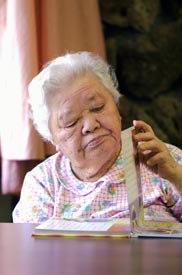
Kaoru Sato is outraged.
She says she deserves to be admitted to Gunma University's medical school and that she has the entrance scores to prove it. She scored 561.5-10.3 points higher than the average passing score of 551.2.
Having done well on her written tests, she was nevertheless dumped in the screening process that also involved writing an essay and an interview.
Why? Sato thinks it's because of her age. She is 55.
Sato is now suing the university for discrimination, specifically "unjust treatment; disqualifying a candidate based on age."
Sato filed the suit last month to request she be admitted.
The university has declined to comment on the suit. An official would only say, "Things will be made clear at court."
But the official did say: "(Sato) was not accepted because there was an exceptional flaw in her interview. ... Age was definitely not the reason."
But that's not what another official at the university told her, confidentially.
Sato, a homemaker who had studied three years to pass the entrance exam, was crushed when she was notified that she wouldn't be accepted.
When she first asked the university for an explanation, an official gave her a standard reply: "There is always a possibility that applicants are not accepted, if found extremely lacking in any of the screening processes, including the standardized University Testing Center Examination scores, individual written exams, essays, interviews or school records."
The official said that in Sato's case, "The decision was a comprehensive one."
Sato asked whether it was her interview-not included in the revealed test scores-that was the reason for her non-admission.
She was told that nothing could be revealed pertaining to candidate interviews.
Sato persisted. According to Sato, she managed to draw out an explanation from the official in charge, who told her it was "only a private view."
She was told: "National universities are tasked with the responsibility to educate, train and nurture doctors, who will be able to serve the community. The process takes many long years. In your case, when we consider your age at graduation, there remains the question as to whether you would be able to serve the community, realistically speaking."
In a roundabout way, it says the same thing on the university's Web site: "There is no age limit. Having said that, candidates should be well aware that the medical student is required to go through six years of course work, and then 10 years of ongoing training, including two years of clinical training as an intern, before establishing oneself as an active member of the medical community."
Age discrimination is not uncommon in Japan. Age limits can be found in various settings-when applying for jobs in both the government and private sectors, and for college entrance exams. There are also age limits for mandatory retirement and so on.
But that is slowly changing.
Nationwide, several movements are afoot to abolish age discrimination in the higher education system and job market.
The school of medicine at Tokai University in Isehara, Kanagawa Prefecture, decided to do away with its under-40 age limit that had been in place for admission exams for transfer students, starting from the 2004 academic year.
"It is wrong to disqualify a candidate solely on age. Everyone has a right to receive medical training," said an official at the Tokai University entrance examination center.
And Hiroshima University has set up special quotas for seniors only, though not for its medical school.
Starting from the entrance exam for the 2001 academic year, Hiroshima University has been offering a "Phoenix entrance system" aimed at senior citizens.
The two faculties of science and letters accept candidates aged 50 and older; the faculty of applied biological science, 55 and older; while the faculties of education, law and economics invite candidates aged 60 and older.
While the number of such admissions for all these faculties is set at "a few," more than 40 seniors have taken advantage of this option to enter Hiroshima University.
The university implemented the same measure for its graduate school and has even welcomed a freshman who is close to 80 years old.
Employment-wise, the government of Ichikawa, Chiba Prefecture, abolished its "up to 28 only" age limit, in fiscal 2004. The new aim is to recruit a wide range of talent and people experienced in various fields.
The city hired 41 recruits in fiscal 2005. Of those, 17 were over 29. They would not have been considered when the age limit was in place. The oldest fresh recruit was 50.
Japan's aging population, coupled with its mandatory retirement ages, has many retirees looking for second careers. Many are seeking satisfying work that fulfills a need in the community.
Sato began considering a career in medicine when her father died four years ago.
Each time her father was hospitalized for pneumonia, he was smothered with over-the-top nursing care, and he began losing the skills to look after himself.
Sato could not stop thinking about what ideal medical care for the elderly should be.
In summer 2002, Sato was inspired by a newspaper story about a 62-year-old medical intern. Her days of cramming to get into medical school began.
Sato had graduated with an engineering degree from Keio University, but it had been more than 30 years since she took her last entrance exam.
Sato studied in moments stolen from her household chore routine. She would often sit in the kitchen working on her exercise book while a batch of oden stew boiled on the stove, for example.
She failed the entrance exams at Gunma University two years in a row.
This spring was her third, and she told herself, final try. If she failed to make it this year, she vowed to give up on her dream to become a doctor.
"If the school was going to refuse admission, based on my age, they should have made it clear in the application guidelines, putting the age requirement in writing."
|
|