|
|
Fiscal Growth in Latin Lands Fails to Fill Social Needs
By Juan Forero, The New York Times
Latin America
April 25, 2005
Last year, Ecuador's economy grew at an astounding 6.6 percent, its inflation rate was the lowest in 30 years, and foreign investment surged. Wall Street celebrated, with a New York-based analyst of Latin American economies, LatinSource, praising Ecuador for "outperforming even the most optimistic scenarios."
But those rosy numbers did not translate into better lives for Ecuador's poor or political support for Lucio Gutiérrez, who took power 28 months ago, was removed from power by Ecuador's Congress on Wednesday and left Sunday for asylum in Brazil.
Though his interference with the judiciary was ostensibly the reason for his fall, many Ecuadoreans had become deeply disillusioned with his government, saying little had changed despite promises of more jobs, better schools and health care.
At the shabby, 57-year-old Baca Ortiz public hospital in Quito, considered the country's leading children's hospital, patients have to bring their own medicine, and doctors say they lack clean facilities, decent living wages and even the most rudimentary equipment.
"The last thing the state cares about is education and health care," said José Acosta, a staff doctor. "If the state doesn't provide medicine, doesn't provide funding, how are we supposed to provide good care?"
The discontent over a lack of state attention to basic social needs, despite increasingly positive macro-economic figures, is being played out across Latin America.
Economic growth for the region hit 5.5 percent last year, the best in a generation, inflation is down, foreign reserves are growing, and credit ratings are solid. But the positive economic news has not translated into housing for the poor, more teachers, better hospitals or social peace.
After years of fiscal prudence, privatizations and other market reforms prescribed by Washington, unjobless and poverty rates have hardly budged. Poverty remains pervasive, engulfing 44 percent of the population.
"The growth rate is not always an accurate benchmark for a country's authentic prosperity," said Larry Birns, director of the Washington-based Council on Hemispheric Affairs, which tracks social and economic trends in Latin America. "Expectations have risen, and they've risen faster than the growth rate."
The high price of oil and other commodities provided by these countries is fueling the solid economic growth across Latin America. Wall Street is particularly bullish about Peru, which has had strong long-term growth. The economy of Bolivia, one of the region's poorest countries, grew by nearly 4 percent last year, while Mexico topped 4 percent and Brazil, Latin America's largest economy, registered 5.2 percent growth.
But Peru's president, Alejandro Toledo, remains the least popular leader in Latin America, and President Carlos Mesa in Bolivia has been battered by public protests. Vicente Fox's administration in Mexico is lacking popular support for its initiatives, and in Brazil many among the legions of poor believe they have been abandoned by President Luiz Inácio Lula da Silva, who embraced policies of fiscal restraint despite his leftist credentials.
The reasons for the lack of gains are myriad, from corruption to ineptitude to poorly organized social systems. But many experts also say fiscal restraints, coupled with large public debts, are a chokehold on governments like Mr. Gutiérrez's. The public debt in many countries tops 40 percent of economic output.
The cynicism among Latin Americans who feel shortchanged is palpable. Mónica Patiño, 44, and other parents at the 23 of May Elementary School in the poor southern part of Quito pool money to pay for blackboards, classroom benches, paint jobs and even the salaries of English and computer science teachers. Her son, Armando Estrella, 6, "is beaten by a mile compared to a private school boy," she said, noting that the poorly paid teachers deal with 45 children in a classroom. "It's totally a mess."
An exception is Venezuela, where a boom in oil has generated the region's highest growth - 18 percent last year - providing billions of dollars that President Hugo Chávez has used to solidify his popularity by directing it into social programs.
The new government here, well aware of how Mr. Gutiérrez was debilitated, is moving in another direction. The new president, Alfredo Palacio, 66, a cardiologist and former health minister, was Mr. Gutiérrez's vice president but had long ago broken with the president over the government's fiscal restraints.
Indeed, Mr. Gutiérrez, who shifted from a critic of market reforms to a buttoned-down capitalist after he took office, had pledged to maintain fiscal discipline at all costs. He went so far as to cut subsidies for cooking fuel and food, enraging the poor.
Mr. Palacio now offers a wholesale change. "The country needs to invest in health, education, invest in the social," he told the Quito newspaper El País. "The 6.6 percent growth that is hyped is a farce."
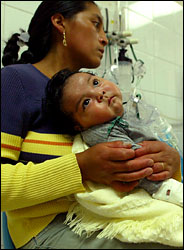
Carlos Villalon for The New York Times
An emergency room at Baca Ortiz hospital in Quito, Ecuador. Patients have to bring their own medicine.
|
|