|
|
Protecting the Elderly from Mother Nature
Reviewed By Evelyn Chow
Haitang, China
July 19, 2005
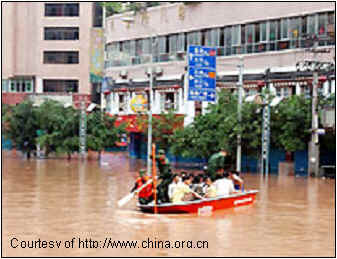
As
people along China's coastline brace themselves for typhoon Haitang, some
are left to wonder how citizens will cope with the devastating effects of
Nature's wrath. Having witnessed several hurricanes myself, I cannot help
but wonder: how will the elderly make it through? As a population, the
aging of the Pacific are little suited to battle the onslaught of rain,
heavy winds, and flooding-problems easily exacerbated in China's rural
areas. Already, one 65-year-old Taiwanese man has been crushed to death by
a rock dislodged by torrential downpours in Hoping, according to Taiwan's
National Fire Agency.
The hurricane has left 1.36 million households without water and
electricity in Taiwan alone, and 850,000 have already been evacuated in
mainland China. Haitang is expected to hit China's coast at 240 kilometers
per hour.
Pilot Areas Receiving Social Support
Reviewed By Evelyn Chow
Yunnan, China
July 19, 2005
Around 49, 700 persons 60 and over in Yunnan province have received funds from the newly-conceived System of Social Support for Some Rural Families Practicing Family Planning. This step marks a profound shift in China's policy towards its rapidly aging population, which is expected to reach 400 million by 2050.1 The program provides 600 RMB yearly per person for parents of one son, 700 RMB for parents of one daughter, and 750 RMB for parents of deceased children who did not give birth to another child.
The Yunnan Population and Family Planning Committee laid the foundation of China's fledgling social support system by separating fund management, fund distribution, identification of eligibility and public supervision into four components to facilitate the rapid expansion of the new social support program from pilot areas to the entire country. At present, almost 70% of China's aging population is concentrated in rural areas2, making the need for a transparent social support system ever more pressing.
China's postal system has been identified as the machinery through which the system's funds will be distributed. China's National Population and Family Planning Committee is looking to establish individual accounts that would allow a provincial financial department to directly transfer funds to a designated social support system account at the provincial postal savings bureau.
So far, a reported 32.814 million RMB has been dispensed to China's rural aging population.
Sources:
1"At present as many as 132 million Chinese are over 60, accounting for more than 10% of China's total population. It is estimated that the figure will surpass 200 million by 2015, which then will take up about 14% of China's total population, and will reach 400 million by the mid-21st century when one out of every four Chinese will be of advanced age."
-- Statement made by the Honorable Ismail Amat, Head of the Chinese Government Delegation, State Councilor and Executive Vice-Chairman of China National Working Commission on Ageing at the Second World Assembly on Ageing.
2 "China's Aging Population is Expanding Fast." Global Action on Aging Newsletter 21 Aug 2002. 18 Jul 2005
<http://www.globalaging.org/elderrights/world/fast.htm>
Liu, Xi. "Almost 50,000 People Received Funds of Social Support System in Yunnan."
Yunnan Daily 21 Jun 2005. 19 Jul 2005 <http://www.npfpc.gov.cn/en/en2005-
06/enews20050621.htm>
Handling Hong Kong's Healthcare System
Reviewed By Evelyn Chow
Hong Kong
July 19, 2005
Secretary for Health, Welfare and Food York Chow has pledged to take decisive measures to improve Hong Kong's public hospital system, according to a press conference statement made yesterday. This move is crucial in addressing the rising population of the elderly in Hong Kong, with over 23% of Hong Kong's population expected to be over 65 by 2023.
Hong Kong's overstrained hospitals will dedicate themselves to caring only for those suffering from pressing medical emergencies, while private practices will take over basic, personal and quality care to patients with chronic problems and non-emergency medical needs. At present, Secretary Chow says that "about 70% of emergency cases in public hospitals do not actually qualify as emergency services.[so] the government will set up 24-hour clinics across the territory to deal with the misuse and to reduce the burden on public hospitals".
Some, however, remain concerned about the lack of qualified private healthcare practitioners in the region and worry that this privatization of Hong Kong's healthcare services will alienate poor and vulnerable groups from specialist outpatient clinics because of higher costs. Chow notes that the government would continue to care for the poor and would maintain the current health services expenditure at around 14%.
Source:
"Gov't Dose for Ailing Healthcare." China Daily Hong Kong Edition 19 Jul 2005.
20 Jul 2005 <http://www.china.org.cn/english/China/135548.htm>
|
|