|
|
Elderly
Savings Slow Economic Recovery
By
Choi Kyong-ae, The Korea Times
South Korea
December
1, 2005
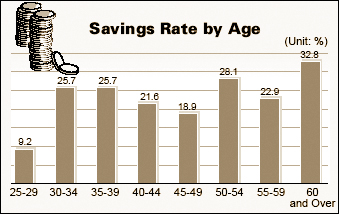
Koreans minimize their spending when they are in their 50s to finance their children's marriages and provide for their retirement, a local economic institute said Thursday.
``Koreans over 50 are eager to save money to help their children marry and to prepare for their own lives after work,'' said Yoon Sang-ha, researcher of the LG Economic Research Institute (LGERI).
The economic institute also pointed out that diminished spending among the Koreans in that age group could slow the economic recovery.
Using data of the National Statistical Office (NSO), the LGERI surveyed households whose bread-winners were aged between 25 and 29 in 1969 to analyze their current savings pattern in their 50s and over.
These households raised their savings rate to 25.7 percent, when the breadwinners reached the age of 39 before the rate fell to 18.9 percent by 49. But the rate rose again to 28.1 percent by age 54 and continued to rise to 32.9 percent by age 60.
``Rising savings rates among senior citizens are not good for the economy as their belt-tightening policy could lead to slumped consumer spending,'' Yoon said.
Moreover, he noted, companies that mainly target the ``silver'' market may have to reorganize their business strategies, if the elderly continue to save than to spend.
LGERI said Korean seniors showed a very different savings pattern from that of other advanced countries. Foreign seniors usually spend their lifetime savings together with pensions in their retirement years.
Yoon said that elderly people in Japan and Taiwan also prepare for their life after work but they do not sharply increase their savings as Koreans do.
NSO data also showed that the savings rates of people in their 50s and 60s were higher than the rates of people in their 20s, 30s and 40s last year.
|
|