|
|
Senior Citizens, Our Responsibility
By Uttam Maharjan, The Rising Nepal
Nepal
October 1, 2005
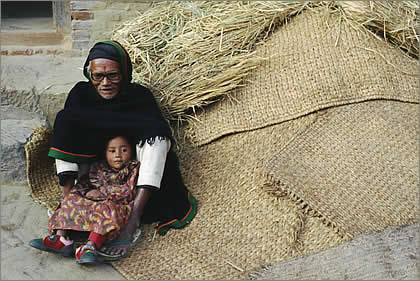
Senior citizens have spent the lion's share of their life in their youth. They have gone through umpteen ups and downs in their life. They are rich in oceans of experience and knowledge. Some are still contributing to the nation in one form or the other, while others are in a state of spiritual respite after devoting their precious lifetime to family, society and the nation.
Fair Treatment
Senior citizens are beset with a number of problems. The most conspicuous problems are those relating to board, lodging, shelter and medical facilities. Senior citizens often complain that they are not getting fair treatment from their family and society.
It may be noted that the government made provision for addressing the woes of senior citizens in the Ninth Plan. Such provision has been enshrined in the current Tenth Plan as well. The Tenth Plan is in its third year, but no significant steps have been taken so far to mitigate their woes. Therefore, it is necessary that top priority be given to addressing the problems of senior citizens so that they can have a comfortable niche in society.
Society should harbour a sense of respect towards its senior citizens and of sympathy and service towards those that are powerless and helpless. Man has the instinct to help those who are in trouble. Such instinct has been implanted in the mind of man since the time of creation.
It is the duty of the state to take special care of the powerless and the helpless in an organized manner. As a matter of fact, it is the social as well as moral responsibility of a state to look after its disadvantaged people. This is because the democratic world has accepted the ground reality that due respect to human rights is the services to the powerless and the helpless. Even at the international level, all kinds of help and assistance are being provided for service-oriented institutions by keeping in mind the importance of such human services.
In Nepal, there is a network of social institutions that are rendering services to the disadvantaged people who are powerless and helpless. It need not be reiterated that senior citizens often fall into such groups.
Social institutions play a very important role in fulfilling national ambitions oriented towards a progressive direction by maintaining the liveliness of democratic society. But it has become very necessary in our society for such institutions to change and reform their practice of focusing merely on limited areas of concern.
Our society has suffered several inconsistencies and perversions as the institutions fail to play a meaningful role in the all-round development of the nation and society. As such, many service-oriented institutions have become sick, a bitter truth that has existed in Nepalese society. Our society greatly needs those that engage themselves in social service altruistically. Just as blood vessels are needed for a living organism, so healthy activities of institutions are needed to keep up the momentum of democratic society.
That various institutions that have been set up in the country to play a supportive role in national development by preserving and safeguarding public welfare are of far-reaching public concern. Such institutions should devote themselves to the welfare of the powerless, the helpless and all other compatriots needing help by joining hands with all to promote national interest.
It may be noted that most of the social organisations are concentrated in the urban areas, where there are plenty of facilities. But it is those who live in the rural areas that need most of the social help. That is why, despite the existence of many institutions in the capital and big cities, their services are by far out of reach of the rural folk. This is a serious concern, which must be addressed by the state on a priority basis.
Social institutions that take care of senior citizens are important in many ways. They make all arrangements for board and lodging for some helpless and powerless old people as a token of respect and esteem to senior citizens. They promote good feelings and morality through religious worship, speeches, interactions and the like designed to develop and expand a healthy, clean and spiritual environment.
They sometimes organize health programmes for the senior citizens. They actively participate in various service-oriented and public awakening programmes. They benefit the nation through the mature experience of old people that contribute to the promotion of the nation, nationality and democracy. They enhance the respect to constitutional monarchy and national personalities from various countries. They are also active in socially beneficial programmes like population control, environment preservation, control of girl trafficking and improper behaviour towards girls, control of drug abuse and women's empowerment.
They organize and participate in various national festivals, ceremonies and social development programmes. Last but not the least, they promote fraternity by exchanging experience, skills and assistance with national and international service-oriented institutions.
Resource Mobilisation
The government, social workers, intellectuals from all walks of life and other members of society must help such social organisations by contributing their mite as per their capacity so that they can mobilise resources for their expansion and stability. As senior citizens are the repositories of knowledge and experience, we must look upon them as our mentors by bestowing proper respect and care on them.
|
|