|
|
Active and
Productive Seniors
Malaysia Star
Malaysia
February
2, 2006
Older persons are often perceived as weak, needy and helpless. However, with an ageing population, promoting an active and productive lifestyle among seniors is a necessity, writes WONG LI ZA.
In the quiet town of Tumpat near Kota Baru, Esah Mat Ali opens her small grocery-cum-sundry shop at Pasar Wakaf Bharu every morning at eight.
Fresh produce like vegetables and fruits are arranged neatly outside her shop while canned food and other items are stacked on shelves inside. A mother of eight, Esah has been running her business for the past 15 years, earning a decent living for her and her family.
Her husband passed away 10 years ago. Many people at Esah's age of 60 would have retired and stopped working, but that was not a choice Esah had. To get capital and maintain cash flow in her business, she took up loans from Amanah Ikhtiar Malaysia, a national micro-credit scheme that gives out interest-free loans to the hardcore poor to undertake incomegenerating projects.
Esah's first loan was a sum of RM2,000 applied five years ago. She repaid the loan a year later. In 2002, she took up another loan of RM4,900, which she paid back in two years. This year, she secured a bigger loan of RM10,000 which she hopes to pay back in a year via a weekly repayment of RM203. The scheme incurs a 10% administration fee on borrowers.
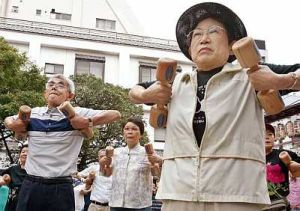
Senior citizens workout with wooden dumb-bells outside a temple in Tokyo to mark Japan's Respect for- the-Aged Day.
"Without the loan, I cannot buy and keep much stock. With it, I have capital to buy stock with cash," said Esah in the local dialect, adding that she hires two workers whom she pays RM10 each a day and her rental is RM5 a day.
Asked how much sales she makes a month, she merely smiled and said, "Enough-lah, to pay my workers, rental and other things." According to Dr Richard Leete, United Nations resident coordinator for Malaysia and United Nations Population Fund (UNFPA) representative for Malaysia, two thirds of older persons (aged 60 and above) live in developing countries.
This involves some 400 million people, with women forming the greater proportion and the disparity increases with advancing age.
Leete gave the keynote address at a Media Seminar on "Active and Productive Ageing" held in Kota Baru in December. The seminar was jointly organised by the Institute of Gerontology and the UNFPA, Malaysia. (On Jan 1, 2005, the Institute was appointed the implementing agency for an UNFPA-assisted project on "Promoting Active and Productive Ageing in Malaysia".)
In Malaysia, there are currently 1.5 million (about 6% of the population) older persons but the number is set to increase to 3.5 million or 11.5% of the total population by 2020. Of the 1.5million older persons, 14% live in poverty, especially women. Leete added that in 2000, 64% of older persons who never attended school were women, compared to only 34% of men.
In Kelantan, the percentage was higher, with 71% of older persons who had never attended school, out of whom 84% were women. "We need to include ageing issues into multi-sectoral development processes with a particular focus on the older poor," he urged.
Assoc. Prof. Tengku Aizan Tengku Abdul Hamid
He said there was a need to ensure appropriate social services and welfare coverage for the poor and disadvantaged older persons, most commonly women. "Micro financing may help but it is not sufficient. We need to promote intergenerational solidarity with the goal of maintaining and increasing social cohesion across generations. "We need to focus on the poor in rural areas, who have to wait for their children to come home to take them to the clinic because there are no buses to take them and they cannot afford public transport," he emphasized.
Aside from meeting the basic needs of older persons, how older persons age is another issue in an ageing population. Institute of Gerontology Director Assoc. Prof. Dr Tengku Aizan Hamid reminded the audience that the basic tenet of the country's National Policy for the Elderly, formulated in 1995, was active and productive ageing.
According to the World Health Organisation, active ageing is the process of optimising opportunities for health, participation and security in order to enhance quality of life as people age. Productive ageing refers to the capacity of an older person to continue working either on a paid or voluntary basis.
It also refers to simply acts or behaviour that give meaning and satisfaction to the older person. "Biologically, we can live up to 120. In Japan, there are over 30,000 100-year-olds," said Tengku Aizan. She added that the ageing issue needed rebranding.
"The approach to it should change from being needs-based, as in the old are helpless and needy, to rights-based, one which recognises the rights of people to equality of opportunity and treatment in all aspects of life," said Tengku Aizan, one of the speakers at the seminar.
"Promoting active and productive ageing requires a change of attitude, legislation and building of partnerships," she added. United Nations International Institute of Ageing's (Malta) deputy director Prof Joseph Troisi said many Governments and voluntary agencies, including Malaysia, have been more occupied with protecting and caring for older persons.
"Very little emphasis has been put on the participation and contribution of older persons themselves in the developmental process of their countries," said Troisi, another speaker at the seminar.
He highlighted that Malaysia was one of the signatories of the Madrid International Plan of Action on Ageing 2002, which emphasized that while every society has the duty to assist those older persons in need of support, it should equally explore possibilities of benefits from varied resources of older persons to the fullest extent possible.
Another point Troisi brought up was that adult and late-life education should be treated as an investment. "This education and training should not be restricted to high levels of specialisation such as geriatrics and gerontology," he said.
Young and old enjoying themselves at a dinner and dance organised by the Society of Active Generation of Elders in
Penang.
United Nations Economic and Social Commission for Asia and the Pacific's (UNESCAP) social affairs officer Osama Rajkhan said one of the main issues faced in Malaysia was the negative image of older persons.
"The culture and society expects older persons to just stay home, but that should change," said Rajkhan, who is attached to the Human Rights Focal Point section. He said for the poor, the situation was worse. "They have no social protection scheme. The country has economic growth but the rural poor are left out and their situation uncertain.
"That's why we must give them cash allowance for their old age. At least that lets them buy basic things and there's some form of certainty, thereby less stress and also increase their status in society," he said. He further urged that the younger generation start being concerned about ageing issues and prepare for their old age.
"Our health starts deteriorating from the age of 25. We need to think now about financial and caregiver support in the future," he emphasized.
|
|