|
|
Aged Are Hidden Suicide Victims in Japan
The Yomiuri Shimbun
Japan
April
4, 2006
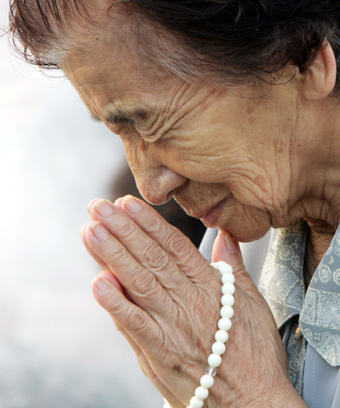
On the surface, Fujisatomachi looks like any other peaceful rural Japanese town. Looming up above the rooftops is the snow-capped Shirakami-sanchi mountain range, a World Natural Heritage Site, casting a benign spell over the picturesque scene.
But beneath the peaceful veneer lies a grisly secret: The town once had one of the highest suicide rates in the prefecture that has the country's highest suicide rate.
On a sunny Tuesday in late February, dozens of elderly people gathered at the "Coffee Salon" near the Fujisatomachi municipal office, sipping cups of coffee and munching on obanyaki bean paste-stuffed cakes. The salon was set up in 2003 as a meeting place for local people to gather by a Fujisatomachi suicide study group, and it meets every Tuesday with the aim of preventing attendees from becoming lonely and depressed.
"It's important for people to have someone to talk to, and the first step in suicide prevention is to provide people with a place where they can chat," said Shunei Hakamada, a Buddhist monk who leads the study group that set up the salon. "It's especially helpful for elderly people, who're not used to seeking personal advice over their problems."
In 2001, Fujisatomachi recorded a suicide rate of 107.6 _ meaning 107.6 people out of 100,000 killed themselves _ the second highest in the Akita prefecture, whose suicide rate, 37.1, was the highest in the country that year. Nine out of 19 Fujisatomachi residents identified by the local government as having committed suicide since 1998 were older than 60.
The nation's suicide rate suddenly jumped from 19.3 in 1997 to 26 in 1998 when the number of suicides in the nation exceeded 30,000 for the first time. The reasons were variously attributed by researchers to turmoil in the financial industry and the associated increase in the number of middle-aged corporate warriors taking their own lives. The public was shocked to find the working population, the backbone of the nation's economy, in such serious trouble. The number of suicides remained greater than 30,000 until 2004, the most recent year for which official figures are available.
However, it seems that few were aware which segment of society had been most seriously affected for years prior to the economic-related suicide spike _ the elderly.
In the year when the public was worried about the predicament of the middle-aged, about 11,500 people aged 60 and older killed themselves, compared with about 7,900 in their 50s and about 5,400 in their 40s. Suicide among the elderly accounted for about 34 percent of the total in 2004, the highest among all age brackets.
(EDITORS: BEGIN OPTIONAL TRIM)
Sitting apart from groups of women who were cheerfully talking to one another at the salon, 60-year-old Kazuko Ito (not her real name) was sipping coffee alone, bathed in bright sunlight that was streaming in through the large windows.
"I've wanted to visit this place for a long time because from the outside I always saw people who I know," Ito said. "I usually don't have much time to talk with people."
Ito, who was sitting alone nonetheless, said she had little time to go out because she had to look after her husband's elderly parents, who lived with her.
"My friends are in a similar situation _ they have old parents or have to tend their land _ so now I don't have anybody who visits me or who I can visit to talk to," Ito said. "I do the same old things day in, day out: watching television, looking at my husband's face, and wondering why I have to take care of his parents."
Ito was not there to seek advice from anybody about her problems, and many of the people who visit the salon, most of them elderly, do so just hoping to have some company, Hakamada said.
(END OPTIONAL TRIM)
As Japan's population is rapidly aging, the increase in elderly suicides could be devastating to society and the nation's future, specialists warned.
"Aged people, who have gone through such various hardships as sickness and the loss of spouses, friends and social roles are more likely to be depressed than those of younger generations due to the experience of losing things that they once treasured," said National Defense Medical College professor Yoshitomo Takahashi, a psychiatrist.
(EDITORS: BEGIN OPTIONAL TRIM)
The Fujisatomachi government was one of the first to introduce suicide prevention measures. Starting with lecture classes and symposiums in 1996, the local government has helped residents learn about the serious suicide situation, conducted screening tests to find those in need of attention and provided medical treatment. The Akita prefectural government followed suit in 2000.
(END OPTIONAL TRIM)
According to specialists, suicide rates are higher in rural areas, which are mainly inhabited by elderly people and where the unemployment rate is relatively high.
(EDITORS: BEGIN OPTIONAL TRIM)
People aged 65 and older in Fujisatomachi accounted for 35.4 percent of the town's population as of 2005. The comparable figure for Akita, a prefecture with one of the highest proportion of elderly residents in the country, was 26.7 percent, against a national average of 20 percent. The unemployment rate for the prefecture was 5.3 percent in 2005, one of the nation's highest.
However, these factors do not fully explain the reason why elderly suicide rates are high in rural areas, said Yutaka Motohashi, professor of Akita University School of Medicine's Public Health Department.
According to Motohashi, the suicide rate was higher in large cities up to the 1960s, and it was not until the 1970s that the rural suicide rate exceeded that of urban areas.
"After the nation's high-growth period, when many people in rural areas headed to big cities in search of work, rural communities collapsed as the economic gap between urban and rural areas increased," Motohashi said. "Young people who went to cities didn't return to their hometowns, and mechanization deprived old people of their role in farming."
(END OPTIONAL TRIM)
However, many local governments have not addressed the issue sufficiently, let alone taken measures specifically targeting the elderly.
Sixteen of the country's 47 prefectural governments had no suicide prevention measures in place as of fiscal 2005, and 19 of those that did said theirs were only temporary, according to the Internal Affairs and Communications Ministry.
The central government has moved even more slowly, despite the fact that the nation's suicide rate is the highest among the Group of Seven industrialized nations and the 10th highest in the world as of 2000.
It was only in 2001, three years after the drastic increase, that the Health, Labor and Welfare Ministry set aside funds for suicide prevention for the first time, following the groundbreaking efforts by the Akita and _ other prefectural governments.
Fujisatomachi's suicide rate fell to zero in 2004, eight years after the local government officially started to address the issue. However, Sachi Natsui, a Fujisatomachi public health nurse in charge of residents' mental welfare, warned that it would take longer to determine whether this was purely due to the authorities' efforts.
"Elderly people are unwilling to see psychiatrists, and avoid talking about suicide as if it were a taboo," Natsui said. "In light of this, we need to take a long-term approach."
Keio University professor Yutaka Ono, a psychiatrist and suicide-prevention specialist, said local communities should be reconstructed to prevent suicides among elderly residents.
"There are certain beliefs in society that elderly people who can't work and earn a living shouldn't exist," Ono said. "If we fail to reconstruct local communities so that the young and old help each other, the problem will reach horrendous proportions as society ages rapidly."
|
|