|
Kenya's Prisons Not Designed For the Aged
By Peter Ngare, NationMedia
Kenya
May 4, 2006
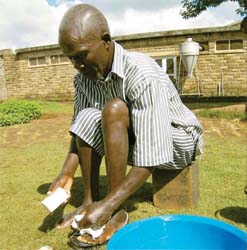
Like the general public is ageing so are prisoners, but our prisons are not geared towards their needs. They are having a difficult time coping with the demands of daily living and disease.
For 28 years, Robert Masaba has not known freedom. He was sentenced to death in 1978 for robbery with violence and has been waiting for the hangman ever since.
When he went to Kamiti Maximum Prison, he was a young, robust 34-year-old. Today, he is battling diabetes and peptic ulcers and has to make do with an erratic supply of drugs.
Life has become an endless circle of prison routine, guilt, regret and hopelessness. With these have come stress and depression. Masaba and many of his fellow prisoners serving long sentences have now developed hypertension, diabetes, ulcers, stroke and paralysis.
“Apart from wine, getting old can be a stressful experience and more so when you are inside a prison,” says Dr Stephen Nyakeri, the medical officer of health in charge of prison services in the country.
Whereas in the free world the elderly are accorded special treatment, “inside here they eat what others are eating, use the same facilities and follow the same rules. In prison, all inmates are equal their age notwithstanding,” says Duncan Ogore, the outgoing officer in charge of Kamiti.
The causes of diabetes in prison are not well understood but some contributory factors are thought to be ageing, obesity and physical inactivity, factors that can also lead to high blood pressure.
Peptic ulcers, vitamin deficiency, heart ailments and skin disease are increasingly common among the old inmates. Dr Nyakeri attributes most of these diseases to high stress levels suffered by the prisoners, aggravated by the harsh living conditions in prison.
“Most of these old men are full of stress arising from a sense guilt, regret and the psychological effects of confinement and loss of freedom. They sink deeper into sickness due to poor diet,” he told Horizons.
In a new study published in the April issue of the Journal of the American Geriatrics Society, jail is not a safe place for older people.
According to the study, while many aging prisoners share the same challenges faced by their counterparts in the community – such as bathing, dressing, and using the bathroom – they also must perform activities of daily living that are specific to prison.
These include dropping to the floor rapidly when an alarm goes off, climbing onto a top bunk, hearing orders from correctional officers, standing in line to be counted, and walking to the dining hall, which may be a considerable distance from a prisoner’s cell.
“When an alarm goes off, every inmate has to get down on the floor immediately, for the staff to maintain control of the inmates. Even some people in wheelchairs are expected to get out of their chairs and onto the floor,” explains Williams, also a fellow in aging research at the University of California, San Francisco.
“You can imagine that for someone who has trouble walking, or with brittle bones, a very quick drop to the floor can be quite hazardous. And alarms may sometimes go off several times a day.”
And brittle bones are exactly what are disturbing 76 year-old Ikwabe Lagero Waitara at Kamiti. He was sentenced to death in 2000 for murder.
A conversation with him is not easy. He has hearing problems and you have to shout. He also has poor vision and walking around prison corridors is not easy either.
The old man from Kuria is so eaten up with guilt that he would not like to meet his family. When I ask whether he would like a visit by them he exclaims, “No! They should not come. I would not like to face them.”
He also suffers insomnia due to disturbing thoughts, he says.
“Most of these old men are stressed due to a strong sense of guilt, regret and the psychological effects of confinement and loss of freedom,” say Dr Nyakeri. The stress combined with poor diet and health facilities aggravate their problems.
Peter Mwaura Ng’ang’a, 70, is battling skin cancer, which has turned his hands and face white. He is serving a life sentence for defiling a seven-year-old girl.
“This disease struck after I was convicted in 2003. I am going to die soon and have placed my life in God’s hands since I’m told medicines for my condition are expensive,” he says.
Dr Nyakeri says prison diet is not favourable to the old people. “The diet in prisons lack vital nutrients especially vitamins. This is why many elderly inmates have low immunity, making them more vulnerable to infections.”
Managing conditions such as diabetes, hypertension and peptic ulcers is a complicated affair in the prisons. For diabetics, he says, a stringent diet discipline is required to manage the disease. “But this can’t be done in prisons and we only recommend that they avoid taking sugar and instead of taking ugali prepared from maize flour take that made from millet flour,” he adds.
“As a diabetic and with ulcers, I have gone through hell. Drugs are not readily available and the diet is not as special as it is supposed to be,” says Masaba.
But also stressing Masaba is the knowledge that though he was sentenced to death, he will most likely not be hanged.
“These people are no longer hanging us and I wish they hanged me long time ago instead of subjecting me to a slow and painful death.”
Ngure Mugaki, 81, is the oldest prisoner in Kamiti and is serving a life sentence for robbery with violence. He was locked up in 1986.
He has had stroke, is paralysed on one side, suffers insomnia and speaks of chest pains and migraine.
Mugaki is not comfortable with being housed with younger convicts. “It is very embarrassing to bathe in front of someone your grandson’s age. Some of the younger prisoners harass us by taking our food,” he says. Other elderly prisoners complain about noise, cold water, the food and just being behind bars itself.
But Dr Nyakeri says special treatment such as hot water can only be extended to a prisoner on purely medical recommendation by our doctors.
Those suffering from chronic illnesses are booked for clinics at Kenyatta National Hospital while drugs are obtained at a dispensary in the prison, he says.
On the possibility of separating the elderly from younger convicts, Ogore says there is no such provision.
Most of the elderly inmates are the moderators and peacemakers in the prison: “Each block has a council of elders who intervene whenever differences especially between the younger inmates, arise.”
Specific studies dealing with the health of older inmates are few and far between making the University of California research particularly useful.
The study found that 69 per cent of women reported that at least one prison activity of daily living was very difficult to perform. Sixteen per cent reported needing help with one or more daily activity – twice the rate of the general population aged 65 and older – and 51 per cent reported falling in the previous year.
The women were also less healthy than the general population, reporting significantly higher rates of hypertension, asthma or other lung disease and arthritis.
Williams says that since the study was conducted, she has visited a number of men’s prisons throughout California, spoken with correctional officers and prisoners, and concluded that many of the same issues of aging and safety apply to male prisoners as well.
Williams makes several recommendations that she says would help make prisons safer for older inmates:
“Every prisoner 55 and over should be assigned to a bottom bunk unless the person specifically requests otherwise, and should be in a cell with grab bars near the toilets.
They should be housed closer to the dining hall.”
She points out that these modifications would make prison safer for younger inmates with physical impairments as well.
Copyright © Global Action on Aging
Terms of Use |
Privacy Policy | Contact
Us
|