|
Lost Generation
The Price of Blood in China: HIV/AIDS
Reuters
China
November 27, 2006
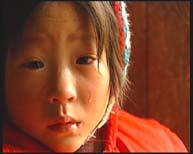
One
of Ma Shenyi's daughters
In the early 1990s, many poor farmers in China sold their blood for cash. Without knowing it, they were exposing themselves to a terrible risk - HIV/AIDS. Henan Province in Central China was hit hardest, reports Henry H.
Xiong Linye is just 8 years old. She used to live in Donghu village, the home of her parents before they died of AIDS. Now she lives with her grandfather Xiong Baoming and aunt Wang Xuezhi. Both of them are HIV-positive. "It's hard bringing up Linye, as I'm seriously ill," says Wang Xuezhi.
Linye is already playing an adult role. She helps out in every way she can. Aunt Wang loves her, and says she will never give her up. But she is growing weaker day by day. Her biggest worry is who will take care of Linye when she passes away.
There are hundreds of children like Linye in Henan Province - all of them orphaned by AIDS. Their parents did not get HIV from drugs and dirty needles, or unsafe sex. All of them were infected by contaminated blood.
"In Henan, HIV spread through unsanitary blood-selling," said Chinese AIDS specialist Wan Yanhai. "Farmers contracted AIDS from contaminated blood. The situation in Henan was made worse because the government condoned the blood-selling business."
Almost 100 million people live in Henan. And it's here, in the remote villages of the province, that this tragedy is still unfolding.
Ma Shenyi, 37, is a farmer in Wenlou. He has full-blown AIDS. His wife died of AIDS five years ago. Now, two of his children are HIV-positive. They are receiving treatment. Ruru is eight, and Chaochao is five. Only the elder daughter Ningning is free of the disease.
Today, Ma is too weak to work in the field. But he has to take care of three children. "I don't know what their future will be when I die," he said. "My parents are also sick. I only hope the government will find a way to help."
In the mid-1980s, the central government said "to get rich is glorious." Around the country, money-making schemes sprang up overnight. Selling blood was only one of them.
In the early 1990s, the Henan Government endorsed "blood farming" to help the poorest people of the province out of their misery. Ma and his wife earned about $5 for each litre of blood they sold. Sometimes they sold more than once a day.
Almost all the other villagers did the same. The plasma was extracted for selling. After that the blood was pumped back into their bodies, often from the same bucket. This is how HIV spread.
The number of officially registered cases of HIV/AIDS in Henan is only 30,000. The official number nationwide is just under 1 million. But experts believe the real number is much higher.
It's a familiar story in Henan. Farmer Chen Defu sold blood to finance his family. Now he's HIV-positive, and likely to die. He regrets the price he and his wife paid to make a living. He says his wife only sold blood three times, much less often than he did, but AIDS killed her.
Chen is not looking for compensation from the government. He says nothing can cover the loss of his wife. Today, almost every family in many villages has lost somebody to AIDS. Often, every member of a family is HIV-positive.
Wei Jianjun began selling blood when he was 15. All seven members of his family are HIV-positive. He is extremely ill. His wife Wang Guozhen died of AIDS seven years ago.
"I was so depressed, and always crying. How could I live without her, and look after our child? " As he spoke, tears came into his eyes. Wang Guozhen's only dream had been to build a bigger house for the family. But any money she earned was spent on medicine. It made no difference.
The central and provincial governments may have cracked down on the illegal blood trade. But for a whole generation, the damage is done.
Experts agree the blood is much safer today than it was a decade ago, yet nothing can bring back Henan's lost generation. The exact death toll will probably never be known. But those graves in the village are silent witness to the scale of the tragedy.
Ma Shenyi doesn't know what his future holds. Meanwhile, he holds on to all he's got. "As long as I'm alive, at least I'll have my children."
Copyright © Global Action on Aging
Terms of Use |
Privacy Policy | Contact
Us
|