|
|
Stressed Out After Retiring
Star.com
Malaysia
January
9, 2006
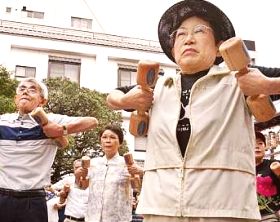
Husbands who have retired should remain as active as their wives. An expert on the Retired Husband Syndrome estimated as many as 60% of wives of retired men may be suffering from different degrees of RHS, whereby retired husbands lead sedentary lives and become
demanding
Post-retirement is meant to be a relaxing period of life but it can also cause stress for both husband and wife. In Japan, wives actually suffer from something called the Retired Husband Syndrome. WONG LI ZA takes a look at how our senior citizens are handling life after retirement.
Housewife Doris Cheong (not her real name) felt lonely when her youngest child finally left home to live on his own a few years ago.
Although it was rather quiet in her double-storey link house in Petaling Jaya at first, she got used to it, and filled up her time with many activities.
Cheong, 58, gets up at 6am and walks to a playground near her house to exercise. By 7am, she's back to do some household chores after which she's off to the market.
Cheong is also a member of a senior citizen club that organises karaoke sessions. A few days a week, she and her friends will be at the club letting their hair down and belting out oldies the whole afternoon for a mere RM5 (per afternoon).
"I go there to pass time and meet up with friends. Sometimes, a day before, we will take turns to bake cakes or other desserts to bring there," said Cheong.
The affable lady also takes voice lessons and some of her afternoons are spent practising Chinese songs mainly from the 1960s at home.
Cheong's husband, on the other hand, retired two years ago after spending more than 30 years running his own business dealing with heavy machinery parts.
His time now, however, is filled mainly by one activity - watching Chinese drama series either on television or by watching rented VCDs from the neighbourhood video store.
The 62-year-old hardly goes out with friends, preferring to stay home most of the time.
Husbands who have retired should remain as active as their wives. An expert on the Retired Husband Syndrome estimated as many as 60% of wives of retired men may be suffering from different degrees of RHS, whereby retired husbands lead sedentary lives and become demanding.
With his wife out most parts of the day, he is left alone in the house. It is something that he grumbles about a lot.
"He's always complaining about me going out. It's not that I don't do my chores or prepare his meals. I've always been doing things this way before his retirement. He cannot expect to change just like that just because he's retired," complained Cheong.
Cheong has tried asking him to tag along to her social activities but he refuses or would go for a short while before insisting he wants to go home, which frustrates Cheong extremely.
"But what can I do? He is still the man of the house. He's so stubborn and bad tempered; I usually just keep quiet to avoid quarrelling with him," she added.
Cheong is one of many wives of retired husbands who find it stressful to adjust to their husband's drastically increased presence and dominance at home post retirement.
In Japan, the situation is more acute and the problem is widely known as the Retired Husband Syndrome (RHS). In 2004, the number of people aged 65 and above was 19.5% of the total population or close to 25 million.
The Washington Post reported last October that a top Japanese RHS expert estimated that as many as 60% of wives of retired men may be suffering from different degrees of RHS.
Some Japanese women refer to such husbands as Sodaigomi or "oversized garbage" and nureochiba or "wet fallen leave" which refers to being difficult to sweep away.
Symptoms of RHS include stomach ulcers, slurring of speech, rashes around the eyes, growths in the throat, palpitations, tension headaches and depression.
Even though there are no statistics on RHS in Malaysia, post-retirement adjustment issues are still a major concern, according to the Gerontology Institute based in
University Putra Malaysia.
Malaysia has 1.6 million senior citizens aged 60 and above and the figure is expected to double by 2020.
"The number of problems related to this is believed to be increasing because women's orientation towards life has changed. For a woman who was not working, her life revolved around family and friends and she had her own routine.
"With more exposure in life, they are open to a lot more alternatives rather than just serving their husbands. And when this clashes with the husband's expectations, they don't get along," said institute director Associate Professor Dr Tengku Aizan Hamid.
Compared to Japan, she said, the RHS problem is not as serious here because Japanese men are more or less expected to be out of the house very early and back only late at night. Therefore, the home is almost completely taken care of by the wife.
"Here, the men are expected to be more involved in the family," said Tengku Aizan.
However, in our society, she said men are still largely considered the provider in the family, especially those from the older generation, and a lot of their image and self-esteem comes from the job position that they hold.
"For most men, the work role is their ultimate definition of identity. When they retire, they lose that sense of respect and recognition.
"But for women, even though we work, our identity lies with the family," she said.
Tengku Aizan added that for many husbands, their confidantes are their wives but for the wives, it's their friends or children.
She advised that a person approaching retirement should make adjustments from being an employee to a retiree and see to what extent he is prepared to change his role.
"If there's too much time on their hands, it will lead to depression," she said.
In her experience, she said many retirees who are active in voluntary activities were already involved when they were working, which makes it easier for them to move straight into those activities post retirement.
"We cannot suddenly expect the men to find a hobby or become a volunteer when they retire if they only concentrated on working before."
One of the things that the Institute advocates is productive ageing.
In sociological terms, this means the involvement of older persons in meaningful activities either individually or in a community.
"They are a priceless human resource which needs to be integrated into society.
We don't have a comprehensive system to do that," emphasised Tengku Aizan.
"Productive activity will give the retired a sense of self worth."
What can be done
The National Council of Senior Citizens Organisations Malaysia (NACSCOM) said that elderly couples in the lower income group face huge financial worries, leading to differences between husband and wife.
"This group of people has little savings for their old age and after they retire, it's a matter of how to survive day-to-day. This leads to stress and mental problems and causes a lot of friction at home," said president Lum Kin Tuck.
To help address this issue, NACSCOM has proposed that a social pension scheme, allocating RM240 a month to those aged 60 and above in the hardcore poor category or with no financial security, be implemented.
"Older people also fall sick easily and many cannot afford to pay their medical bills. The poorest are usually the women because they are widows with no sources of income," said Lum, 88.
He also urged the Government to provide daycare centres for senior citizens in every district in the country.
"Senior citizens can meet there for discussions and companionship," he said, adding that Japan has more than 10,000 such centres for the elderly.
He said activities held at the centres will keep the senior citizens busy.
"Then they will have less time to quarrel but have more things to talk about to their spouses," he said.
Tengku Aizan believes there is a biological explanation why some elderly couples do not get along. Due to hormonal changes, men are more mellow when they grow old while women are more aggressive and dominant," she explained.
She added that another reason is a lack of intimacy due to differing expectations on this between the couple. She advised couples to understand their psychological and biological selves and to have open discussions about them or seek counselling.
"In our society, it is also always the women who give in, which is not right.
Couples should overcome their problems together and not take them as just part of life," she urged.
About RHS
The phrase "retired husband syndrome" was believed to have been coined circa 1980s when the baby boomers' generation began turning 50.
In a commentary on RHS that Dr Charles Clifford Johnson wrote in an October 1984 issue of The Western Journal of Medicine, he said that his patients complained of dependency, constant demand for attention and the need by husbands to control household matters previously handled by the wives.
Dr Clifford had advised that "retirement should be a planned programme for both spouses with mutual acceptance of both spouses' desires; and a productive hobby must usurp a large part of one's day rather than recreation being the major factor in retirement."
Tips for retired husbands and their wives
. Understand the adjustments that both of you go through post retirement.
. Be open-minded to new things and learn to adjust.
. Maintain your health to lead happier lives.
. Overlook the little things in life.
. Forgive and forget.
. Learn to be humble.
. Husbands, leave the household affairs to your wife.
. Wives, steer your husbands toward meaningful activities or encourage them to join yours.
|
|