|
UNGASS Review Highlights Role of Older Carers
HelpAge International
May
31, 2006
Download Using data to inform policies: Reducing Poverty by Supporting Caregivers, People Living With HIV/AIDS and Orphans and Vulnerable Children (131.33 Kb)
As international government leaders meet in New York this week to review progress against the targets set out in the 2001 Declaration of Commitment on HIV/AIDS, HelpAge International is urging them to continue to recognise and support the role of older carers in tackling the AIDS epidemic.
UN Secretary General Kofi Anan, will present the 2006 Report on the global AIDS epidemic at the high level meeting – also open to civil society organisations – which will take place from 31 May to 2 June.
Older carers are the backbone of AIDS care
The UNAIDS report highlights the role of older carers and the need for social protection approaches, such as non-contributory pensions, to help the poorest and most vulnerable households.
According to the report, the number of people affected by HIV has finally stabilised, but there is still a need to sustain a full-scale response to the AIDS epidemic for the next decade.
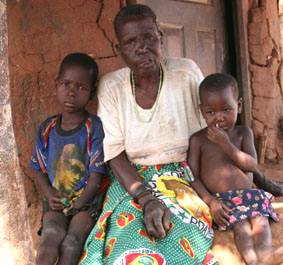
Research by HelpAge International shows that older carers are the backbone of AIDS care, as carers of people living with HIV and AIDS (PLWHA), and of orphaned and vulnerable children. Therefore it is vital that they are targeted in response
programmes.
The cost of care
Nguinia is a 58-year-old widow from Tete in Mozambique. Two years ago her 44-year-old son, Fungai, became very ill and could no longer work so he and his family came to live with his mother.
“His wife couldn’t do much as she was also sick. I had to find food and cook for all six of us. Fungai needed a lot of help. He had continual diarrhoea and developed pains in his back and legs,” explains
Nguinia.
“We tried everything to make Fungai better. We consulted traditional healers, but there was no improvement. The transport and treatment costs were expensive, so we sold many of our belongings.”
Nguinia was helped by a community activist from HelpAge International’s Living Together programme in Tete. Members of support groups are trained as community monitors and activists. They identify vulnerable older people and help them to access hospital care and free medical services. They also give them food, clothes and fuel.
HelpAge International provided financial help and transport to the health centre, so both Fungai and his wife could go for an HIV test. They were both found to be HIV positive and are now receiving treatment. Since starting the treatment their health has improved and Fungai has returned to work.
Call for action
Nguinia’s story demonstrates the important role many older people play in providing care and helping to pay for treatment such as antiretroviral therapy. HelpAge International is calling for national governments and the international community to support older carers like Nguinia by:
• Addressing the economic and emotional needs of older carers so that they are better able to care.
• Providing social security measures such as cash transfers. Universal social pensions can provide the financial support needed by older women carers to enable them to carry out their caregiving roles effectively.
• Improving access to testing and treatment for PLWHA. This can provide substantial benefits for older carers by reducing the burden of physical care and emotional stress, and improving their financial situation.
• Ensure better data collection, disaggregated by age and sex, in order to design appropriate policy and programme responses. Existing surveys do not provide an insight into the role of older people within households.
“In 2001, 189 UN member states signed up to the Declaration of Commitment on HIV/AIDS, committing themselves to develop and make significant progress in implementing comprehensive care strategies by 2005,” says Mark Gorman, HelpAge International’s Director of Policy and Development.
“Paragraph 56 of the Declaration included a specific commitment to strengthen family and community-based care, including that provided by the informal sector. HelpAge International is urging governments to keep their promises by addressing the special needs of older caregivers and their families affected by HIV/AIDS.”
Copyright © Global Action on Aging
Terms of Use |
Privacy Policy | Contact
Us
|