|
Thailand's Aging Population
By Siriporn Sachamuneewongse,
Bangkok
Post
Thailand
August 19, 2007
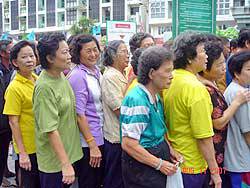
Older ladies in an exercise group line up at a local park for free sportswear. Social participation is an important requirement for active aging.
About the best thing that can be said about growing old is that it beats the alternative, but as SIRIPORN SACHAMUNEEWONGSE reports, there are a number of positive steps that can be taken to add value to the twilight years
When we are born, we're surrounded in the caring arms of our parents, who from then onwards watch out for us in whatever we do. They understand our cries, admire our laughter, find happiness in our smiles and are excited upon hearing our first words and seeing our first footsteps.
But as the years go by and we go off to school and then get caught up in our work and in our own lives and families, the older generations often fade into the background. These days, particularly with the influence of western values, it is not uncommon in Thailand, or other eastern countries for that matter, for the younger generations to strike out on their own, and after a time some may begin to ignore or even abandon their parents and grandparents. The question then follows as to how the seniors left at home are able to cope with a reality that would have been unthinkable in the not-too-distant past.
For example, I have a neighbour, an old woman, who lives alone in a classic Thai-styled wooden house. With regret, I must say that I doubt she goes anywhere, or has any visitors at all. I have spotted her only once in the past 7 years.
According to my own parents, in this neighbour's house once lived a happy family of five. She has lived through the death of her partner and now survives in solitaire, without the company of her children or grand-children, a gloomy fate for an Asian matriarch.
Generally speaking, old age has little fascination for either the young or old, certainly as far as the physical aspects go. The wrinkles, the lost muscle tone, the thinning and graying hair, in addition to lower immunity levels, frailty and loss of vigour, all define the final stages of life.
Yet, for better or worse, the statistics point to an aging population throughout most parts of the world, and this includes Thailand. There are around 7 million people aged 60 or above in this country at present, which amounts to 11% of the national population. It is projected that by 2020 this figure will rise to 10.8 million, at that time around 17% of the population.
In addition, there are also a number of indicators that point to significant changes in the traditional Thai family structure, which in the old days effortlessly and naturally accommodated older family members.
Considering the new trend of greater independence for the young, which tends to weaken the safety nets for the old, and the rising proportion of older people, it becomes critical for the government to take appropriate actions and implement policies to address the health and socio-economic needs of the elderly.
At the recent Seminar on the Social, Health and Economic Consequences of Population Aging in the Context of Changing Families, co-organised by the UN Economic and Social Commission for Asia and the Pacific (Unescap), the UN Population Fund and the UN Department of Economic and Social Affairs, it was noted in the Thai delegation's statement that as a result of changing social values and economic conditions, the elderly are more likely to live alone at home, especially in rural areas where the younger generations frequently migrate to urban and industrial zones for the purpose of education and employment. It was also noted that Thai families are becoming smaller, which leaves less potential care givers for the elderly.
In such changing times, it may, therefore, be beneficial to gain more understanding of how to deal with the process of aging, and just as important, to recognise the concept of "active aging".
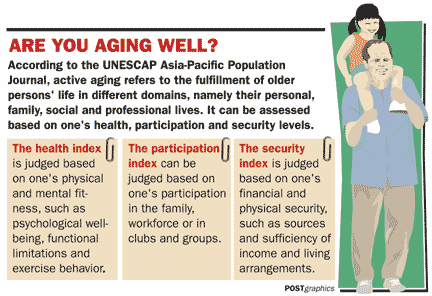
There is a difference between aging, and aging well, or active aging. Active aging, according to the Asia-Pacific Population Journal put out by Unescap, refers to the fulfillment of older persons in different domains, namely personal, family, social and professional.
The World Health Organisation defines active aging as the process of optimising opportunities for health, social participation and security in order to enhance the quality of life.
AGING WELL
An example of someone who is aging well is Supot Dantrakul. Born in Nakhon Si Thammarat province in 1923, the 84-year-old writer is recognised for his works on Thai politics, history and Buddhism. He now lives in Nonthaburi with one of his 6 children. He reflected that aging is a part of the natural process, and as such it is not something that should be feared or loathed, but accepted.
"Everything happening around us is correct within the laws of nature...One will be able to realise this only if they try to understand nature.
"Whatever has to happen will happen. Change is inevitable. Even illness and disease, it is all destined," he continued. "Some older persons fail to understand this law and therefore live through old age in distress."
Although he acknowledged that financial security is particularly important for the elderly, he suggested that if one understands the law of nature and accepts change willingly, there should be no problems at any age.
However, he noted, many older people become the victim of negative thinking, which is why so many are prone to psychological illnesses.
As for himself, he says that he just tries to be the best human being that he can. He is absolutely content with his achievements and contributions to society and continues to write even today.
He recognises that as people age the roles and duties as a child, husband/wife, parent and as a contributor to society by way of occupation are gradually fulfilled, but it is essential to consider that even in old age one can contribute to society. "If one is alive, there should be some purpose to it," he thought.
Another actively aging senior is Dr Phichai Tovivich - 69 and the president of the Centurion Club of Thailand. He is always involved in some sort of meaningful social activity, whether organising spiritual discourses under the Samnak Poo Sawan's Fellows Society or representing the World Citizen Association (Thailand). He is president of both organisations. He remarked that the age of 60, the present measure for retirement in Thailand, was not ideal. For many careers, for example that of a university professor, functionality and even excellence can persist for many years past the mandatory retirement age.
"One's retirement should be assessed based on the requirements of the profession as well as the health of the individual. It should not only be subject to one's age as there are many other aspects to be considered," said Dr Phichai, who at 69 remains perfectly fit, cheerful and active, ready to take up his various roles in society.
Like Supot, Dr Phichai is totally content with his life too. He did confess to one regret - that as a chemistry professor at Chulalongkorn for over 2 decades he may have given his students only superficial knowledge.
"Such knowledge is everywhere; it is accessible by 2 fingers via the Internet nowadays. It is wisdom that is more important - the key to help solve life's problems."
His practical and positive message for the elderly is that they should try to shift their focus to keeping the mind relaxed. Remarking that this is sometimes easier said than done, he suggested prayer, meditation and religious involvement as being very helpful.
Dr Phichai went on to say that if one can control their mind, it will give them a lot of happiness: "Worldly happiness is temporary; sometimes when it is over and done with, it leaves much sorrow. Peace and meditation is therefore better if one wants real lasting happiness, which is what makes life easier."
"People often overlook such matters ....but only by developing mindfulness and peace can one really be happy."
He also commented on the changing family structure. "In earlier times, children in Thai society lived closer to their parents, but with the lifestyle changes today, due to societal or business reasons, children nowadays live further away from their parents, and sometimes may not even visit them."
Noting that most older people really make few demands on their children, he said: "If one cannot visit one's parents, they should at least call them regularly."
Dr Phichai gave this final pearl of advice: "A parent's blessings for their children are very sacred, beyond price, and may be life transforming for the children. Many people overlook this."
IS THAILAND UNPREPARED?
In a study by Kattika Thanakwong and Kusol Soonthorndhada from the Institute for Population and Social Research, Mahidol University, published in the Asia-Pacific Population Journal in Dec 2006, it is noted that since 1964 the average life expectancy in Thailand has risen from 59 years to 72 years. Kattika, a PhD candidate at the institute and Kusol, an associate professor, comment in the study that the preparation for an aging society in Thailand is absent among the priorities of the national agenda, although certain associated laws may have been designed and implemented, such as the Act on Older Persons (2003), which guarantees older persons' rights to receive social welfare services, as well as tax privileges for citizens who take care of their elderly parents.
In their study, Kattika and Kusol looked at the second National Plan for Older Persons, covering 2002-2021, which aims at promoting well-being and social security for older persons and national preparation for quality aging. In this context, it was put forth that it is important to promote the concept of active aging in Thailand.
According to the researchers, active aging enables people to realise their potential for physical, social and mental well-being throughout their life course, and to participate in society according to their needs, desires and capacities. They stress that 'active' in this case refers not only to old persons participating in the workforce, or those physically active, but also those who are continuously interacting with others, in the family or others in the larger society.
Based on interviews of 43,447 older persons across Thailand conducted in their research, they found that the concept of active aging is still not widely accepted.
In assessing the health of the older Thais they interviewed, they noted that Thai seniors generally enjoy moderate health, with older men faring better than older women. The married elderly were generally more robust than single, widowed or separated seniors. Older persons living in Bangkok and those who had higher education levels were also found to have better health conditions than their rural and uneducated counterparts.
In terms of community participation, the study suggested that elderly persons in the Northeast and other rural areas in Thailand were more involved with the family and society in general than elderly persons in Bangkok. At the country-wide level, community participation by the Thai elderly was ranked remarkably low. Again, marital status and education level figured prominently in this domain.
On a more positive note, the study found that in terms of security, a high percentage of Thai elderly had secure living arrangements, although financial security was still poor in rural communities.
More
Information on World Elder Rights Issues
Copyright © Global Action on Aging
Terms of Use |
Privacy Policy | Contact
Us
|