Fidel Castro, 81, is not the only
Cuban who is aging.
Thanks to the socialist island's free
health care system — which emphasizes preventive medicine — Cubans
enjoy a very high life expectancy. The average life span in Cuba is 77.08
years. As a result, the island's population is one of the oldest in the
Americas, surpassed only by Uruguay.
Just who will shoulder the burden of
caring for this burgeoning group is one of the questions being probed by
sociologist Marlen Diaz Tenorio.
Cuba's economic woes, housing
shortage and a lack of institutional facilities for the elderly mean that
most of those over 60 either live with relatives or alone, says Diaz
Tenorio.
"Less than one percent of those
in the Third Age live in old age or assisted-living facilities," she
says — meaning that either family or neighbors have to step in.
In 2005, 15.8% of Cuba's population
was 60 or over. Specialists say that by 2025, that group will include one
out of every four Cubans.
The latest statistics show that 28.4%
of Cuban families have at least one elderly relative, usually a parent,
living with them.
"We've had to turn our lives
inside out because my father-in-law, Victor, who lives with us, suffers
from advanced Alzheimer's," Matilde Velazquez, 54, told CBS News.
Velazquez and her husband both work,
as do their two grown sons and one daughter-in-law, all of whom live in
the house with them — along with a grade school-age grandson. Because
there are no fancy gadgets, no electronic monitoring systems to be had on
this island, the family had to come up with a "Cuban solution"
five years ago when Victor first began to show signs of memory loss.
"We hung a handmade sign around
his neck with his name, address and phone number on it. Strangers and
neighbors were always bringing him home," she explains. "People
who lived in the neighborhood began to recognize him and would invite him
into their homes, then call us."
But as her father-in-law's condition
worsened, her husband retired and then took a job as an airport security
guard working the night shift. Velazquez got a job as a secretary in a
night school. They use their meager savings to pay a neighbor to watch
Victor when everyone has to be out of the house. The emotional strain on
the family is great.
Fortunately, Cuba's universal, free
cradle-to-grave health care system means Alzheimer's patients do not add
an additional financial burden to the family. But the shortage of
state-and church-run facilities for the elderly mean there is no relief
for most families confronting this situation.
Diaz Tenorio speaks about the plight
of the elderly not just as a sociologist, but as a daughter. Her
83-year-old mother is blind, a consequence of her diabetes. The bulk of
responsibility for her mother falls on Diaz Tenorio’s sister, who sought
a job that allows her to work at home.
"Before her eyesight went, we
used to lock the gate from our garden to the street because my Mom loved
to escape and buy ice cream — deadly with her diabetes. Now she sits on
the porch and listens to boleros (a romantic genre of Cuban music) and
neighbors stop to talk to her when they walk by," Diaz Tenorio says.
She notes that Cubans have a highly developed sense of community and
voluntarily pitch in to help each other.
As for what she can do, "I try
to find a way to go there once a week so that my sister can get some rest,
sleep or get away to the Malecon [Havana's seafront drive] where she can
sit and relax," says Diaz Tenorio.
"We look for alternatives, a
neighbor who helps out in the morning. My Dad's 80, but he helps out in
the afternoons. My uncle who lives there also; we take turns,” she
concludes.
According to Diaz Tenorio, there is
no such thing as a typical Cuban family. But she admits that Cuba's
difficult socio-economic conditions tend to run counter to what is known
as the "empty nest syndrome," where children grow up and leave
home. "We have what we call the 'full nest,' and not an empty one,
because children get married and continue to live at home," she says.
This, she says, can be a positive —
with older parents and grandparents playing an important role in holding
the family together and transmitting values.
"Those who are 60 or older do
not play a passive role in the family, nor are they marginalized from
family activities," points out Diaz Tenorio. "Older persons in
Cuba fulfill multiple tasks that help the family function — taking care
of household tasks, providing childcare for grandchildren.”
The sociologist, who heads a family
study group at the Psychological and Sociological Research Center in
Havana, says that while they have found isolated cases of persons who have
been sidelined or excluded from family life, the predominant trend is for
even those at very advanced ages to be integral and useful, productive
members of the family.
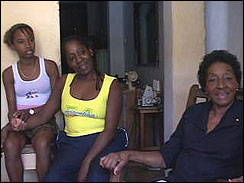
A case in point is Laura Clark, a
very healthy 73, who was born in Banes, the same town as Fidel Castro. She
lives with two daughters, a son-in-law and four grandchildren in the
working-class Havana neighborhood known as Pogolotti. It’s the kind of
neighborhood where family life spills out into the streets, music blares
and conga lines form at the slightest excuse. But inside their modest
crowded apartment, Laura runs a tight ship.
"I can't imagine living without
her, not for anything. It's impossible," says her daughter Marisol,
42, an X-ray technician. "I don’t have to worry about anything. I
can go to work knowing when my girls come home from school, Mom will be
here."
Her 12-year-old daughter Rachel
depends on her grandmother for meals, for help with her schoolwork, for
ironing her school uniform. Asked who does more for her, her mother or her
grandmother, Rachel doesn't hesitate: "In reality, my grandmother.
She has more time to pay attention to me. My mother's work doesn't leave
her with practically any time for me.
Another granddaughter, Leidy Laura, a
21-year-old, fourth-year medical student, said her mother Ileana is always
so busy with work that only her grandmother has time for her.
"She's there when I get up in
the morning, when I come home from school. She wants to know how my day
went. She makes sure my uniform is washed and ironed."
Free education and free universal
health care take the financial burden off the family. The biggest problem
when Laura needs to go to the doctor is transportation. The family has no
car, and Havana's public bus system is sorely taxed. But that's where
Leidy Laura steps in.
"I'm always on top of her. I
make sure she takes her pills on time, I take her blood pressure every day
and if she has a problem I take her to see one of my professors at the
hospital where I have classes.”
Laura beams as her granddaughter
Dionne, a last-year music student, picks up a guitar and begins to sing.
"I'm not old, No, no. The word 'old' describes a person who can't
stand alone. I walk, I move, I dance. I’m not decrepit yet, so I like to
say I belong to the Third Age or even better, Accumulated Experience, that
the prettiest thing to call me.
Laura is active in her local Baptist
Church and occasionally cooks dishes brought to Cuba by her Jamaican
parents: dumplings and rice and beans with fish in coconut cream. She
herself retired after 24 years as a sewing teacher when her brother, who
was "everything" to her, fell ill.
"My two daughters and my son
were studying and I say no, the one who has to stay home, I have to stay
home because they are coming up and I am going down," she said in
English with a slight Jamaican accent. Her brother died 10 years ago.
Now with her daughters and their
husbands working, the grandchildren clean the house, she says. "My
daughter says my work is done already,' so she doesn't let me do a lot. I
have my own room with a television set in it and whenever I want to rest I
go in there and watch my favorite programs and do my sewing.”
There are others like Laura.
My 88-year-old neighbor Ana, who
rules over a household filled with a divorced daughter, married
granddaughters and great grandchildren. She's an amazing woman who hands
out advice, watches that the right seasoning is added to the black beans
and supervises the great grandchildren.
Or, take the case of Olivia, a
retired nurse in her 80s who lives with her now 60-plus daughter Eunice,
also retired, and a retarded grandson. Money is always short in their
house and Olivia's cataracts make doing household chores difficult. But
she still cooks and even prepares desserts like bread pudding as gifts for
her neighbors.
Others are not so fortunate. A local
church in the Marianao section of Havana runs a once-a-week informal group
therapy and dance class for those 60 and over. It gives those who attend
an opportunity to discuss their problems and socialize. I watched as the
group leader asked participants to describe what a family is. One woman in
her late 60s bitterly described what it was not. She lives with her
daughter in a small, one-bedroom apartment; because of
Cuba
’s critical housing shortage they have no way of expanding. That has
provoked a bitter conflict: The daughter wants her mother to give up her
bedroom and sleep in the living room so she can move her boyfriend in.
Despite problems such as this one,
Diaz Tenorio believes that economic shortcomings and a traditionally
strong Cuban family can and do merge in a constructive way.
"The elderly prefer to live with
their family; they don't like to live in institutions or asylums.
Remaining in the family gives them a link to social life, to family life,
they can feel useful by providing support to their family in such a way
that despite the shortages their human condition is recognized and they
are the object of affection," she concludes.
Objective reality may change this
picture in the future. The island’s low birth rate — 11.89 per 1,000
inhabitants in 2006 — can be linked to the economic crisis that began in
the 90s. At the same time, its already-high life expectancy continues to
grow, with Fidel Castro's personal physician Dr. Eugenio Selman heading
the "120 Years Club" designed to promote longevity among the
population.
This combination of factors has
already resulted in shifting statistics.
In 1981, 40% of all Cuban families
had at least one elderly person living with them. In 2007, as a result of
Cuba
's shrinking families and low birth rate, only 28.4% had a senior citizen
at home. This means there will be fewer families to care for the elderly.
In the future, more and more elderly
will have to fend for themselves or depend on strained state resources to
provide for them as their faculties decrease.
Copyright © Global Action on Aging
Terms of Use |
Privacy Policy | Contact
Us