Impoverished Refugees Flood Japanese Cities
CNET Asia
Japan
April 30, 2007
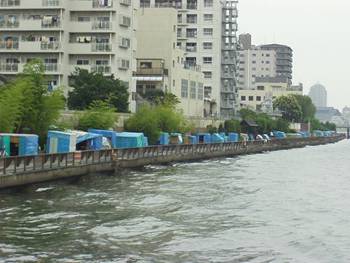
This is not Mumbai, nor Manilla.
In the heart of Tokyo, on the bank of Sumida-gawa, homeless street grew
ever longer.
You think poverty does not fit to Japan? Wrong. Poverty in Japan can't
be swept under the carpet any more. It's getting more visible everyday.
Of course, Japanese poverty is not that absolute one like you find in
South Asia or backwater rural China. Even in the most hopeless
situation, no Japanese poors lack of some grains of rice in the rice
cooker. Nevertheless, poverty is poverty. You can't deny it.
Even out favourite Akihabara streets hide quite a few numbers of urban
poverty cases, homeless people. Probably you'd seen some of them last
time when you visited this fairly land of this world. A scruffy guy or
two who were pulling a hand cart laden to the brim with empty carton
boxes collected from Akiba shops. These elderly people earn a small
money by recycling them, and live rough in the park or under the bridge.
Japanese homeless people are, mostly, middle aged and elder. The cruel
economy is especially harsh to these senior people. Their lifeline,
unskilled construction job category, dwindled out. When they were "restructured",
it would be almost impossible to reverse the downward drift.
But how about young and poor? There is a huge layer of extremely poor
young people in urban enrinonment. Called "Freeter" (coined from 'free'
and 'Arbeiter'), they move from one temp job to another that pays a near
starvation wage and ample supply of instability and uncertainity. Unlike
their elderly counterparts, they never lack of the chance of finding
job, if they don't complain too much.
But you rarely see those young poors sleeping rough in the open air.
They have special habitat for this purpose. Internet Cafe.
Japanese Net Cafes are usually accompanied by a Manga tearoom ('Manga
kissa') where young customers can peruse thousands of Manga paperbacks
at will. This NetCafe-cum-Manga Kissa has a peculiar fare construction
called "Night Pack". A customer can spend 6 to 9 hours with a bargain
charge of 1,000 to 2,000 yen (US$ 8.5 - 17). Shower room with extra fee.
Some even keep the arriving mails and bills for the customers.
This is not a satisfying bedroom at all, though. Young people have to
wriggle and turn constantly on a thin-cushioned chair whole night, not
unlike the sleep on a red-eye trans-pacific flight. Park bench would be
thousand times more comfortable ....well, if the weather allowed.
Boat people had come and gone. Dar Four refugees haven't reached East
Asia yet. But NetCafe Nanmin ('NetCafe refugees') are invading into
urban enclaves with a vengeance. All of them, young or youngish or just
pre-middle aged. Hard core temp workers. Working poors with extremely
low starvation wage, who can't afford to rent even a cell-like cubicle.
Also, who has to work very long time everyday, and can't commute back to
faraway rabbit hatch, too. NetCafe Nanmin is the frightening example of
ever increasing poverty in Japan.
NetCafe Nanmin can't survive without NetCafe and, guess what, K-tai
terminal. They are registered to one or another of on-line slave driver
joint, called Hiyatoi Haken ('day-work dispatch'). They have to inquire
frequently about tomorrow's job availability. Day job with sub-starvation
hourly rate. The slave and its driver are in contact only with K-tai
e-mail. You can lose your soul in an emergency, but not your K-tai,
never!
Elderly homeless can completely drop out from the system and live the
life of a hermit. But, these NetCafe Nanmin have been totally caught in
the cruel jungle system, and been functioning as its essential cog.
Without any hope and future, of course. Internet is their yoke, and
K-tai their shackles. This is the darkest part of Japan you rarely see.
Copyright © Global Action on Aging
Terms of Use |
Privacy Policy | Contact
Us