March
20, 2007
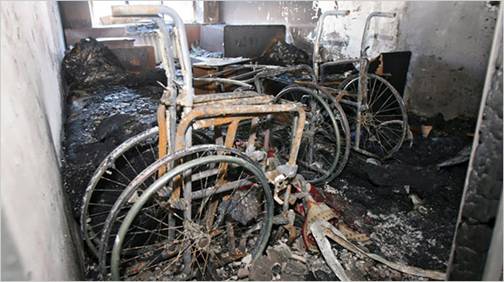
The fire erupted in a government nursing home in Kamyshevatskaya, a small village on the Azov Sea.
A fire that swept through a home for the elderly and disabled in southern Russia killed at least 62 people early today, a toll that officials attributed to safety violations and a night watchman’s negligence. Many of the dead were confined to their beds and unable to flee the smoke and flames, the officials said.
In a country seemingly inured to unnatural deaths in accidents and attacks, the scale of the fire — the deadliest in Russia since the collapse of the Soviet Union more than 15 years ago — was jarring.
The fire erupted in a government nursing home in Kamyshevatskaya, a small village on the Azov Sea, and it came as rescuers continued to search for survivors of an explosion in a coal mine in Siberia. The death toll in the mining accident rose to at least 106 today and included 20 members of the mine’s management, officials said. At least four other miners remain missing, though one emerged alive today, the emergencies minister announced.
President Vladimir V. Putin of Russia took the unusual step of addressing the disasters publicly, appearing in televised remarks only hours afterwards to observe a moment of silence and then to demand thorough investigations. He later declared Wednesday a national day of mourning, calling for the cancellation of entertainment events and programs.
The disasters — coming on the heels of an airplane crash that killed seven and injured more than 20 of 57 people aboard on Saturday in Samara, on the Volga River — highlighted concerns about the state of Russia’s buildings and industries, the laxity of safety standards and enforcement, and the strains on emergency rescue services, despite an economic boom spurred by rising oil and gas production.
Fires, in particular, kill with alarming frequency in Russia, a phenomenon that officials blame on substandard buildings, minimal fire-safety measures and training and social factors like smoking and drinking. In 2006, 17,065 people died in fires, an average of nearly 47 a day. In 2005, the last year comparative figures were available, nearly five times as many Russians died in fires than Americans, even though Russia’s population is less than half as large as that of the United States.
Russia’s deputy emergencies minister, Lt. Gen. Aleksandr P. Chupriyan, said in a recent interview that the country’s fire services had begun to reduce the frequency and fatality of fires in recent years by acquiring modern equipment and improving training. Still, he said, the country had yet to adopt a culture of fire safety and responsibility.
“We have become Russia,” he said in the interview, conducted before the latest fire, “but we have carried with us the baggage from the Soviet Union.”
The toll in Kamyshevatskaya appeared to have been worsened by a series of violations, including insufficient fire-fighting equipment in the two-story building, home for more than 90 patients, both the elderly and the disabled.
Two inspections last year turned up 36 fire safety violations, a senior emergency official, Sergei S. Salov, said in televised remarks. He acknowledged that not all the violations had been resolved and the owners — the regional social welfare department — had been fined 20,000 rubles, or about $770.
“The alarm system was incomplete,” Mr. Salov said. “The personnel did not have equipment to protect against smoke. The bedrooms’ wooden panels were not made flame resistant.”
Marina A. Loskutova, an official in Yeisk, the largest town nearby, said in a telephone interview that she was unaware of any fine.
The cause of the fire was not immediately announced. Of 35 people who escaped, at least 30 were hospitalized, some with serious injuries. The dead ranged in ages from 46 to 86, Ms. Loskutova said.
Among them was a 58-year-old nurse, identified as Lidiya Pechentseva, whom officials praised for helping some patients escape before succumbing herself.
The toll exceeded that of a fire in a police headquarters in Samara in February 1999 that killed 57 people, according to the Russian newspaper Kommersant, which recently listed it as the worst in Russia’s history.
In December, a fire in a drug rehabilitation hospital in Moscow killed 46, mostly patients. Many of the victims were trapped behind locked doors and windows, meant to keep them from fleeing treatment.
In the latest deadly fire, officials also criticized a guard on duty overnight, saying he ignored two initial fire alarms, apparently because he was outside the building, and then delayed calling the authorities for 21 minutes.
“Instead of informing the fire department about the tragedy and emergency, he shut off the gas, began calling his bosses and informed the nurses and medical personnel,” Yuri R. Nenashev, the head of the country’s fire inspection department, said in a televised remarks. “Only after this,” he added, did the guard call the authorities to report the fire.
A volunteer fire department at a local collective farm was closed last year. The closest fire station was in Yeisk, more than 30 miles away. It took nearly an hour for firefighters to arrive. A resident, identified as Pavel Babenko, complained about the closure. He said people had plundered the old station and stripped the fire engine of anything valuable.
“No one cares about anything,” he said on Rossiya, a state television channel.