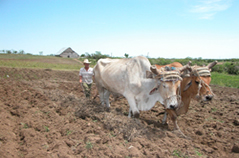
The definitive solution to the high prices at Cuba’s markets and the improvement of the domestic economy depends, among other factors, on the production of sufficient food and of the quality required. When achieved, an ordinary citizen won’t have to spend a good part of his or her salary to purchase foodstuffs. However, for this to occur, an answer to the problem of the labor deficit in the countryside must be found.
FARM WORK IS HARD AND NOT EVERYBODY IS WILLING TO DO IT.
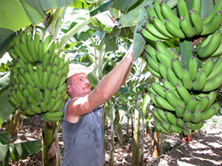
Today, most of Cuba’s arable land is in the hands of the ministries of Sugar and Agriculture, and, to a lesser extent, to cooperatives, which make the most significant contribution to meeting the population’s food needs.
In the central province of Villa Clara, for example, farmers with 35 percent of the land in the territory contribute 68 percent of the total production, which includes 52 percent of the milk, 98 percent of the tobacco, and 54 percent of the coffee, besides being the owners of 54 percent of the cattle. Similar figures exist for other provinces.
However, officials from ANAP (the National Association of Small Farmers), which represents individual and cooperative farmers, are concerned about the future of a labor force capable of cultivating the food the nation needs.
THE AVERAGE AGE OF FARMERS IN VILLA CLARA IS OVER 50 YEARS.

Today, the average age of the 31,920 farmers in Villa Clara is over fifty, and there’s a trend towards further aging, said Carlos Gonzalez, an ANAP board member responsible for the food and agriculture sector.
Only 1,689 of the farmers are young (under 30), which represents, in the case of the collectively owned cooperatives of agricultural and livestock (CPA), 5.2 percent, and there’s a marked tendency in the new generation not to return to the countryside after concluding their studies. Very few students who graduate in agronomy at technical colleges go to work on cooperatives.
The decline in the number of members of the CPAs by over 2,000 members in recent years is troubling. In 2007, 700 members left their CPA’s, motivated by the poor treatment received from state entities (involved in purchasing and distribution), the deterioration of machinery, the halting of the home building program and the lack of profitability of many of them. The lack of an adequate labor force led to the contracting of more than 3,000 retirees to work the land.
THE EFFORT OF WORKERS IN THE COUNTRYSIDE SHOULD BECOME SATISFACTION FOR CUBAN FAMILIES.
For those reasons, since 2000 it has been necessary to break up seven CPA’s in the province, says Neysi Santos, head of ANAP’s Organization Department in the province.
The situation of the CCS (Cooperatives of Credit and Services) —that group family farmers for some joint activities that may include the purchase and use of machinery, technical assistance, other purchases and the marketing of harvests—, differs from the unstable situation of CPA’s. Many CCS coops show improving living and working conditions of their members.
FIGURES DON’T LIE
Data provided by Hector Machado, representative of the territorial office of statistics in Villa Clara, show a tendency towards the decrease of rural population.
According to the 1981 Population and Housing Census there were 239,807 people living in the countryside in the province of Villa Clara. Today, the figure has dropped to 195,845, which represents only 24.2% of the province’s current population (809,231 inhabitants).
Other figures show a reduction in economically active people in the countryside; that is, people between 18 and 60 years of age. A total of 67,062 are men, on the shoulders of who rest, to a large extent, the production of food for more than 700,000 people —those who live in the cities—, as well as the elderly and children in rural areas.
Another element to bear in mind is the age of people in the countryside. According to the latest Population and Housing Census, there were more than 24,578 people ranging from 60 to more than 85 years of age, a clear example of the marked tendency towards aging.
WHO’S GOING TO TAKE OVER?
The training of a labor force that can continue the work of parents and grandparents in the countryside is not in the best of times, points out Jose Alberto Garcia, deputy director for Technical and Professional Training in Villa Clara.
“The situation of schools is very complex in terms of their accumulated deterioration motivated by the harsh years of the special economic period after the collapse of the Soviet Union. This led to fluctuations in their staff and a loss of interest on the part of students for agriculture and livestock degree courses,” notes the official.
In 1992, the province had 15 centers to train students who would go on to work in agriculture. Today, there are only six left, and next year there will be five, due to the noticeable reduction in enrollment, said Garcia.
He notes that the tendency of recent years has been a failure to meet the expected enrollment. Only 1,233 students are currently studying a mid-level technician career in agronomy, a figure that is insufficient to cover the demands of a qualified labor force in this sector.
Among the main reasons for this situation are the neglect of work places in recruitment and vocational orientation and training, and the fact that they are boarding schools rejected by most families.
The farm cooperatives are the ones who are aware of the needs of their municipalities and entities, and responsibility rests on them to guarantee the future of their labor force. However, there aren’t many coops that bother to visit primary schools to create vocational clubs, or high schools with the purpose of recruiting students for these careers, stressed Garcia, a methodology specialist.
In fact, most of them distance themselves from students once they are at technical colleges. This shows the lack of integration that exists between work centers, the farm organizations and centers for technical and professional Education. Student internships at workplaces are deficient, which makes them become demotivated and apathetic.
Data provided by the education officials in the territory show that only 40 of every 100 students entering these technical colleges actually graduate, and in the end, not all of those go to work in their field.
Therefore, the solution to the problem of a labor force capable of boosting Cuban agriculture and producing more milk, grains, vegetables, meat, and other vital products is complex, and requires integral measures that the country’s leadership is trying to come up with.
More
Information on World Elder Rights Issues
Copyright © Global Action on Aging
Terms of Use |
Privacy Policy | Contact
Us