|
Facing the Food Crisis
Help Age International
August
7, 2008
World
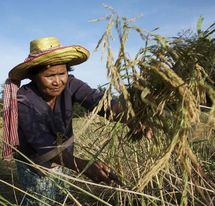
Investing in income security helps subsistence farmers become more productive.
Anna Pearson looks at how the global food crisis affects older people in developing countries, and explains how social protection schemes can cushion its effects.
Continuing inflation of international food and oil prices is causing an escalating food crisis in the developing world.
Even before these rises, 854 million people lived in chronic hunger. This is more than the combined populations of the European Union, Canada and the USA.(1)
Estimates now suggest a further 290 million people are facing an immediate threat of hunger.(2)
As many older people lack any basic income, and access to decent work, they are one of the groups most vulnerable to the food crisis. And as small-scale producers of food, carers of children and respected members of communities, they are also key to a successful response.
High levels of underlying poverty in the developing world that have particularly exacerbated the current food crisis. The link between hunger and poverty is clear, with 90% of those experiencing hunger also living in poverty.(3)
Older-headed households are particularly vulnerable. In Malawi, poverty rates among older-headed households are 5% higher than average.(4)
Income security
World leaders meeting at the World Food Summit in Rome in June 2008 recognised that increasing food production was essential to finding a solution to the crisis. However, consideration of tackling poverty came second to technical discussions about agricultural methods.
Participants failed to recognise that investing in people’s income security can itself help improve production. This in turn would enable small-scale farmers to move away from lower-risk subsistence farming towards investing in higher-yielding seeds, fertilisers or other inputs that may lead to surplus production.
The role of social security in reducing poverty and contributing to economic stability is widely recognised in the developed world. However, 80% of the world’s people still lack any access to basic social security, leaving them deeply vulnerable to shocks such as the current food crisis.
It is often suggested that poor countries cannot afford to invest in social protection systems. But the question is: can they afford not to?
In developing countries that have invested in universal systems of cash grants, or even in small cash transfer pilots, the benefits have been impressive. Poverty and hunger are reduced, and the injection of cash into communities increases local economic productivity.
• In South Africa, the overall poverty gap has dropped by 20% purely as a result of the non-contributory (social) pension.
• In Namibia, a social pension has increased local spending. It has been commented that half the shops would close if it weren’t for pension day.
• In Malawi, for every US$1 that was transferred to people in an emergency cash transfer pilot, an extra US$2.1 of additional local economic activity was created.(5)
• In Zambia, 30% of money transferred in the Kalomo cash transfer pilot was invested, for example, in goats, oxen or seeds. Other households have paid neighbours to plough their gardens.(6)
Include older people
In many countries, the impact of food price rises has become so severe that it requires either an emergency response or a scaling-up of existing programmes. Too often, however, older people are neglected in such responses.
Neglecting older people’s needs not only hurts them, but also hurts communities as a whole. Older people often have a vital role to play in caring for others.
They can also play an important part in emergency responses because of their experience and respect in the community. Governments and international agencies that are making urgent responses to the food crisis should include older people in their efforts.
Increase social protection
HelpAge International believes that governments and the international community must seek to ensure that comprehensive systems of social protection are established in the developing world.
At least a portion of the increased aid that the World Food Summit called for should be allocated to this purpose.
Where the price, rather than the supply, of food is the major issue, governments and international agencies that are looking to spend aid should consider increasing social protection payments to prevent a long-term crisis. This can be a rapid, efficient and cost-effective way to inject extra cash into communities at times of crisis.
How social protection helps
There is now a body of evidence to suggest that social security systems, including social pensions, are affordable in the developing world. Such systems can help to protect populations from the worst effects of shocks such as rapidly rising food prices or disasters caused by climate change.
Social pensions provide older people with a predictable and reliable income. This enables older people and their families, including children, to improve their diet. It also helps to boost the local economy, supporting local food production and helping to offset the effect of high food prices.
In addition, social protection is not only a vital response to the food crisis, but an essential means for governments to achieve the Millennium Development Goals and the commitments made in the Madrid International Plan of Action on Ageing.
More
Information on World Elder Rights Issues
Copyright © Global Action on Aging
Terms of Use |
Privacy Policy | Contact
Us
|