|
December 7 Images: One Story, Different Tellers
By Anahit Hayrapetyan, Armenianow.com
December 5, 2008
Armenia
The yard of the Yot Verq Church in Gyumri is unusually crowded as the incumbent and former presidents of Armenia are inside the church attending a Catholicos-administered divine liturgy for the innocent dead of the tragedy of 20 years ago. Much in the earthquake-hit northern provinces of Armenia has changed during these two decades, but people who lived through the horrors of the day continue to live with their bitter memories.
Sargis Petrosyan, 57, says 70-80 percent of the tremendous damage has been restored, new buildings have been constructed, people have been returning as jobs are being created.
The 1988 quake killed more than 25,000, crippled hundreds of thousands physically and psychologically.
On December 7, in Gyumri, Armenia’s second largest city that was one of the most affected by the earthquake, almost all carried white flowers and all had reasons to visit the cemetery.
One elderly man was making his way to the cemetery.
“My disabled leg is not moving,” he mumbles.
He finds the gravesite of his loved ones and spreads the flowers on several of its tombstones. Kim Harutyunyan, now 74, lost his 54-year-old wife in the 1988 earthquake, as well as his 22-year-old son, his son-in-law, his grandson…
“And my daughter lost her leg, she was found and brought up from under the ruins but without a leg,” he says.
Harutyunyan was one of those who received a new apartment from the state to compensate for his lost property. But he says he left it and now lives in a makeshift shelter after his son divorced from his wife and left for Russia.
Sashik, 71, tells of his son and daughter who lost their lives in the quake as they were out at school and at work. He says their house remained intact but his wife died only two years after the tragedy.
The stories are many, all in fact tell the same story only personalizing it.
Edik Arakelyan says his 20-year-old daughter was to get married on December 16 but was killed by the calamity nine days ahead of her big day.
While Gyumri has seen large construction, many makeshift houses still remain.
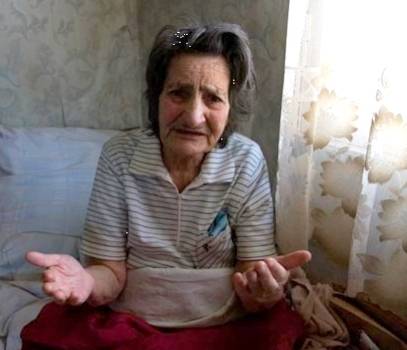
Varsenik Mkhitaryan, 76, says on the day of the quake she survived only because she had gone to the shop to buy some bread.
Now a resident in a Gyumri “temporary” quarter, she complains of her living conditions. “Is it possible for six persons to live in a small hut?” she queries rhetorically.
Varsenik suffers from a malignant tumor, he relatives say. And now she has to share the small room with a whole family of her son, who has a three-month old infant.
“Water penetrates from above when it rains, we have to then place an umbrella to protect the little one from the rain,” she says.
It is a good day for selling carnations in Gyumri; a bad day for the reasons they represent.
More
Information on World Elder Rights Issues
Copyright © Global Action on Aging
Terms of Use |
Privacy Policy | Contact
Us
|