|
Korean Women Want a “Nest” to Live out Days
By Kathy L. Gilbert, United
Methodist News Service
January 2, 2009
Korea
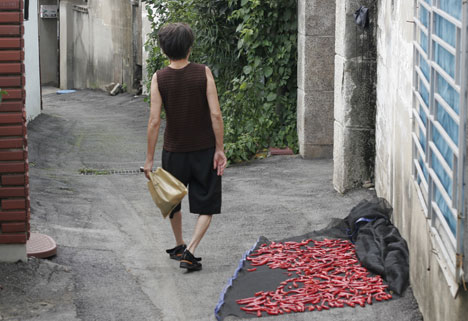
An
elderly Korean woman makes her way down a winding street in the military
town of Anjung-Ri
This article was excerpted from a report written by Kathy L. Gilbert for the United Methodist News Service. It deals with the Sunlit Sisters’ Center, an organization that assists the women of Anjung-Ri who entered into prostitution as a result of the Korean War. Gilbert also examines a major threat to the women: the loss of their homes.
ANJUNG-RI, Korea – Over 300,000 Korean women aged 50 to 70 years old, survivors of the Korean War (1950-1953), are today plagued by their past which has left them without a future. Once sex workers as a result of the War, these women find themselves shunned and openly chastised for their actions in the past by their community.
In the time of war, these women, abandoned due to the conflict, were drawn to Anjung-Ri, one of the largest military bases in Korea, searching for hope and a means of survival. Instead, they were faced with few choices and thus resorted to prostitution, an industry that was supported by both the Korean and the US governments. The two governments reportedly saw the sex industry as a means of increasing a “friendly relationship” between the two warring nations and of pleasing the US soldiers. Now, 50 years later, the women still suffer from the same poor health, financial distress, and perhaps most affecting, persisting social alienation and personal anguish for their actions as they did in the past, according to Soon Duk Woo.
Soon Duk Woo, a graduate of the Ewah Graduate School of Social Welfare, took it upon herself to offer support for these women. In doing so, she initiated the Sunlit Sisters’ Center in 2002 to provide refuge, assistance and ultimately acceptance for the Asian women and the children they conceived with US soldiers during the war. Like their mothers, the illegitimate children, named “Amerasians”, face ostracism from Korean society. Ms. Woo also stated that the Korean government provides no official support for the impoverished women.
Ms. Woo’s Center does, however, receive financial support from alumni of her past institutions. The center also received a $30,000 local grant in 2004 from the United Methodist General Board of Church and Society (GBCS). Reverend Neal Christie, a GBCS director, explains his reason for the support of the center: “These are women stripped of property, dignity, family. They live with diminished physical and mental capacity, physical scars from abuse, but they have a vibrant, trusting faith. They do art therapy, physical therapy, literacy training, legal advocacy for them and I have tried to hold the military accountable.” Christie sees the center as a testament to the perseverance of the women as a whole.
Ms. Woo organizes weekly gatherings, where the women congregate and enjoy a meal together. Ms. Woo also makes an effort to organize numerous outings, picnics, and various types of therapy as often as possible, so as to reintroduce the women into society and to make themselves more comfortable with their pasts. In addition, “the center throws special rice cake parties on festive days” says Ms. Woo, in order to combat the women’s loneliness and estrangement from one another, and to foster a sense of solidarity within the group. Ms. Woo receives many donations from local organizations which make it possible for the women to enjoy these simple pleasures. In short, the Center tries to become a safe classroom and playground for the women and their children.
Despite the progress which has already been made, a larger problem looms. As more US Army soldiers move from Seoul to nearby Camp Humphreys, the surrounding area is expected to grow and change to meet the demands of the soldiers. Ms. Woo fears that the women will be evicted from their homes because of these imminent changes. It is expected that by 2012, the US Korean headquarters move will swell the population from about 10,000 to 45,000. The drastic change represents yet another threat to the women’s fragile existence. Most of the women live in apartments for $100 a month, but it is likely that the landlords sell these properties to build new, bigger houses that will cost from $1,500 to $2000 a month. With the influx of people, the women will not be able to afford the rent on their one-room apartments, which is already difficult enough to pay, and will have no place to turn to for residence.
“Our sisters are about to be expelled into the streets,” Ms. Woo said. “The Sunlit Sisters’ Center is praying hard for a nest for our sisters to spend the rest of their lives.”
“Life is very hard”
On a recent Saturday afternoon, the women gathered at the center to cook, to share a meal and to talk about their needs and worries. One of the attendees, Esther Cho, 21, an Amerasian educated in American schools in Korea, helped Ms. Woo and the women to communicate with their US visitor. Ms. Cho is an example of one of the Amerasian women that Ms. Woo is trying to help. She wants to go to college, but without the available funds, it is not likely that she will be able to attend a school in Korea. In addition, she is not able to attend an American university as she would need help from her estranged father. Ms. Cho’s father is a US soldier who left her mother while she was pregnant.
“I tried to communicate with my father, but he doesn’t want to have anything to do with us,” Ms. Cho said, wiping away tears.
Many of the women explained that they did not wish to be identified or photographed, out of respect and shame for their children who are adopted and living in the United States.
“We don’t want to embarrass them,” one woman explains.
Among other things the women discuss their plight concerning the rise of the rent for their apartments.
“My health is bad and they are taking all the old buildings,” said one of the women. “It is a big problem especially, when the government only gives you $200 and your rent it $100.”
“My ceiling has been leaking and I have asked the landlord to fix the roof for the past five years,” said another. “It costs too much to move. What can I do?”
The women are very grateful therefore for Ms. Woo’s help and kindness, despite the problems, but recognize the need for further assistance. “Ms. Woo tries to help as much as she can. She gives us comfort but it is not enough. Life is very hard,” said one woman.
Ms. Woo is trying to raise funds to build a new multipurpose building to house the ladies. It is her dream to be able to provide the women with permanent residence as well as a place for recreation and rehabilitation.
The women want to spend the rest of their lives in a permanent residence. It is imperative that this be done before the land prices rise too high. Ms. Woo hopes that “the sisters do not have to finish their lives at a corner of a strange street.”
More
Information on World Elder Rights Issues
Copyright © Global Action on Aging
Terms of Use |
Privacy Policy | Contact
Us
|