|
With Help, Conductor and Wife Ended Lives
By John F. Burns, The New York Times
July 14, 2009
United Kingdom
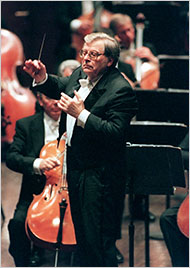
Sir Edward
Downes conducting the Orchestra of the Royal Opera House in 1999.
LONDON — The
controversy over the ethical and legal issues surrounding assisted suicide
for the terminally ill was thrown into stark relief on Tuesday with the
announcement that one of Britain’s most
distinguished orchestra conductors, Sir Edward Downes, had
flown to Switzerland last week with his wife and joined her in drinking a
lethal cocktail of barbiturates provided by an assisted-suicide clinic.Skip
to next paragraph
Although friends
who spoke to the British news media said Sir Edward was not known to have
been terminally ill, they said he wanted to die with his ailing wife, who
had been his partner for more than half a century.
The couple’s
children said in an interview with The London Evening Standard that on
Tuesday of last week they accompanied their father, 85, and their mother,
Joan, 74, on the flight to
Zurich
, where the Swiss group Dignitas helped arrange the suicides. On Friday,
the children said, they watched, weeping, as their parents drank “a
small quantity of clear liquid” before lying down on adjacent beds,
holding hands.
“Within a
couple of minutes they were asleep, and died within 10 minutes,”
Caractacus Downes, the couple’s 41-year-old son, said in the interview
after his return to
Britain
. “They wanted to be next to each other when they died.” He added,
“It is a very civilized way to end your life, and I don’t understand
why the legal position in this country doesn’t allow it.”
Sir Edward, who
was described in a statement issued earlier on Tuesday by Mr. Downes and
his sister, Boudicca, 39, as “almost blind and increasingly deaf,” was
principal conductor of the BBC Philharmonic Orchestra from 1980 to
1991. He was also a conductor of the Royal Opera House at Covent
Garden in
London
, where he led 950 performances over more than 50 years.
Lady Downes, who
British newspapers said was in the final stages of terminal cancer, was a
former ballet dancer, choreographer and television producer who devoted
her later years to working as her husband’s assistant.
“After 54 happy
years together, they decided to end their own lives rather than continue
to struggle with serious health problems,” the Downes children said in
their statement.
British families
who have used the
Zurich
clinic in the past have said that Dignitas charges about $6,570 for each
assisted suicide.
Scotland Yard
said in a statement on Tuesday that it had been informed on Monday “that
a man and a woman” from
London
had died in
Switzerland
, and that it was “looking into the circumstances.” The information
that prompted the police inquiry appeared to have been given voluntarily
by the Downes family, which, Caractacus Downes said, “didn’t want to
be untruthful about what had happened.”
“Even if they
arrest us and send us to prison, it would have made no difference because
it is what our parents wanted,” he said.
Attempting
suicide has not been a criminal offense in
Britain
since 1961, but assisting others to kill themselves is. But since the
Zurich
clinic run by Dignitas was established in 1998 under Swiss laws that allow
clinics to provide lethal drugs, British authorities have effectively
turned a blind eye to Britons who go there to die.
None of the
family members and friends who have accompanied the 117 people living in
Britain
who have traveled to the
Zurich
clinic for help in ending their lives have been charged with an offense.
Legal experts said it was unlikely that that would change in the Downes
case.
But British news
reports about the Downeses’ suicides noted one factor that appeared to
set the case apart from others involving the Dignitas clinic: Sir Edward
appeared not to have been terminally ill. There have been at least three
other cases similar to the Downeses’, in which a spouse who was not
terminally ill chose to die with the other.
Sir Edward was
known for his support for British composers and his passion for Prokofiev and Verdi. After studying at
the Royal College of Music in
London
, he joined the Royal Opera House in 1952. His first assignment was
prompting the soprano Maria Callas. He traveled
widely as a conductor and became music director of the Australian Opera in
the 1970s.
Friends of Sir
Edward said that his decision to die with his wife did not surprise them.
“Ted was completely rational,” said Richard Wigley, the general
manager of the BBC Philharmonic. “So I can well imagine him, being so
rational, saying, ‘It’s been great, so let’s end our lives
together.’ ”
Jonathan Groves,
Sir Edward’s manager, called their decision “typically brave and
courageous.”
But even among
those who support decriminalizing assisted suicide, Sir Edward’s death
raised troubling questions. Sarah Wootton, chief executive of Dignity in
Dying, said in a BBC interview that the growing numbers of Britons going
abroad to die, and the manner of their deaths, made it more urgent to
amend
Britain
’s laws. There are “no safeguards, no brakes on the process at all,”
she said.
The British Medical Association voted this month against legalizing
assisted suicide, or lifting the threat of prosecution from “friends and
relatives who accompany loved ones to die abroad.” Last week, the House
of Lords defeated a bill that would have allowed people, subject to
safeguards, to travel abroad to help people choosing to die.
More
Information on World Elder Rights Issues
Copyright © Global Action on Aging
Terms of Use |
Privacy Policy | Contact
Us
|