|
Designing Planes with the Aging Population in Mind
By Francois Shalom, The Montreal Gazette
November 27, 2009
Canada
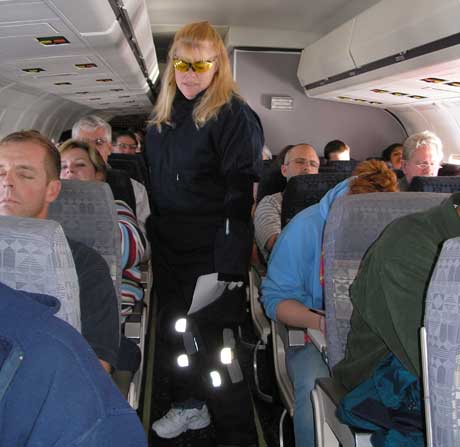
Dolores Lystad, a functional test engineer in Everett, Wash., walks slowly down an airplane aisle wearing a "Third Age Suit" that allows users to experience the limitations felt by many older individuals.
Photograph by: Handout, Courtesy of Boeing Frontiers magazine
It may be because many engineers, planners and designers are themselves reaching middle age that suddenly, a lot more thought and money seems to be poured into designs specifically meant for older people and those with reduced mobility. And it doesn’t stop at wheelchair access ramps.
Consider the coming airliner from Bombardier Inc., the CSeries.
Robert Dewar, vice-president, integrated product development team for the CSeries, said it was designed largely with aging people in mind.
“We’re working with a number of societies (that study the) aging population, but that doesn’t mean it’s all about people with handicaps,” said Dewar. “It’s as much a question of ergonomics and of ease of use.”
The result of all the consultations? Larger seats (“we learned that people on average put on (one kilogram) a year after a certain age,” said Dewar); full-size stand-up lavatories that can accommodate wheelchairs; 20-inch aisles rather than the 17-inch norm; overhead bins that drop down automatically about a foot when opened, making them easier to load; pans that move forward at the bottom of seats, enabling passengers to find their comfort zones; pressure and crumple points seats that do likewise; height-adjustable seats (“if the seat is high, someone with shorter legs can start feeling numb after a while”).
Blake Emery said Boeing Co. went a step further. The director of differentiation strategy for Boeing commercial airplanes said that “one of the most innovative things we did (for Boeing’s soon-to-fly 787 Dreamliner) was a project in which a number of our engineers and designers wore suits.”
Not a three-piece or double-breasted, Emery explained, but a 60-pound bulk suit including finger-constricting gloves that forced the wearer to experience actual flights as many older passengers would.
“The gloves simulated arthritis and loss of dexterity in the hands, special goggles simulated cataracts or diminished vision and the suits did not enable the wearer to stand fully erect,” recalled Emery.
“Let me tell you. Everyone who did the test found it to be quite a revelation, quite the experience.”
Boeing also focused on the overhead-bin latches, replacing the single release mechanism, which can be confusing and hard to manipulate, said Emery.
“We came up with a beautiful latch that can open in multiple ways. You can push on the top of the latch or at the bottom – or pull on top or the bottom. Even if you have difficulty, it will open.”
Those pesky bi-fold toilet doors are also toast. Boeing designed a single-panel door for the 787 that starts to open out, but since opening out completely would block the aisle, after a couple of inches, it actually slides sideways into a wall opening.
Richard Bartrem, of WestJet Airlines got a plug in for his airline’s policy of never overbooking a flight, “which can be disorienting and unnerving for older
travellers.”
Trains and cruise ships have long been adapted to older people, who have formed the better part of their business for decades. VIA Rail spokesperson Catherine Kaloutsky said, for instance, that the railroad has long provided porters to help wheelchair-bound and frailer trekkers pre-board, and allows someone accompanying a passenger with an illness to travel for free (on validation by a doctor).
Staterooms on cruise ships have long had amenities like wheelchair ramps and sedentary activities geared to the less physically active, and you’ll still see the occasional passenger engaging in the traditional passive
deckchair-beneath-the-life-rafts-on-the-promenade-deck pastime. But that’s the exception. On today’s mega-ships, aging boomers are more likely to be the main clientèle of the wrap-around running track, inline-skating course, rock-climbing wall, putting greens, large banks of cardio machines, fully equipped weight rooms, aerobics studios, yoga classes and spas – even the occasional ice rink.
Meanhile, Emery places a caveat on all the blue-sky talk about the stellar ergonomic improvements and advances.
“(Aircraft makers) can spin all the stories they want about bigger seats and lavatories,” he said. “But in the end, it will be the airlines that decide how big the seat is and how much room there is ... Anyone can make bigger seats, but you can’t do that without taking away some seating space. And airlines have to make money with those seats.”
So will the real world defeat the improvements made on behalf of seniors? We’ll find out when the CSeries and 787 Dreamliner planes are outfitted by an actual airline.
More
Information on World Elder Rights Issues
Copyright © Global Action on Aging
Terms of Use |
Privacy Policy | Contact
Us
|