
back
Some
related articles :
|
 |
Grief must lead to change
By: Unknown Author
Amnesty International-The Wire, June, 2002
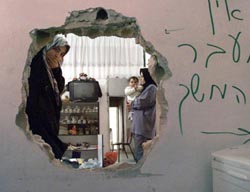
A Palestinian family looks through the hole made by Israeli soldiers in
their house, Balata refugee camp
AI
Secretary General Irene Khan's eye-witness account after a visit to Israel
and the Occupied Territories stresses need for impartiality
In Jenin refugee camp, an old woman sits besides a pile of stones that was
her house before the Israeli incursion. She shows me the identity card of
her disabled son, Jamal, who was wheelchair-bound. She tells me that when
the Israeli Defence Forces started to demolish her house, the women tried
to carry Jamal out, but the walls crumbled and they ran out. Jamal was
buried alive under the rubble.
Nearby an elderly man describes how Israeli soldiers asked his son to hand
over to his wife the four-month old baby in his arms. He tells me that
then they took his son, his neighbour's son and himself to a narrow
passage behind the house. They asked them to raise their shirts and then
sprayed them with bullets. The old man survived, saved by the body of his
son falling on him. He pretended to be dead, until the soldiers moved away
and he could crawl to safety.
In the courtyard of Jenin hospital, two ambulances lie, mangled by army
tanks. The Medical Director tells me that for 10 days Israeli tanks and
snipers blocked the entrance to the hospital. For days he was not allowed
to retrieve the dead or wounded. On 10 April, when the army finally
allowed him to take his ambulance to the refugee camp, it took 11 hours of
negotiations to evacuate one seriously wounded person.
Later I pick up the newspaper Ha'aretz. On the front page is the
picture of a blood-covered teddy bear. It belonged to a five-year-old
Israeli girl who was killed the night before in an attack by Palestinian
armed men on an Israeli settlement near Hebron.
The next day I meet an Israeli who speaks proudly of his father who had
devoted his life to the cause of Israeli-Palestinian friendship, but was
killed in a suicide bombing in a café in Haifa on 31 March 2002. A
25-year old woman at the Sheba Tel Hashomer Rehabilitation Centre tells
how, on her first day at work at the Park Hotel on 27 March 2002, a bomb
carried by a Palestinian suicide bomber exploded a few yards away from
her. She is now paralysed from the waist down.
The experiences of these people I met during my visit to Israel and the
Occupied Territories in mid-May show that nothing justifies the targeting
of civilians, the destruction of lives and livelihoods, the gross abuses
of human rights and humanitarian law, whether in Haifa or Hebron, Jenin or
Jerusalem. While the political debate rages about the security of Israel
and the liberation of Palestine, the reality is that on both sides
ordinary people are paying a heavy price for the escalating violence.
Every day children are being maimed, lives are being destroyed with
impunity.
Only an impartial approach, based on objective standards of international
human rights and humanitarian law will break the cycle of violence in the
Middle East. Establishing the facts is the first step towards justice for
all victims. This is why I am deeply disappointed that UN initiatives,
including establishing what happened in Jenin, appear to have been traded
away in the interests of politics.
AI has called for a comprehensive, independent, international
investigation of all abuses of human rights and humanitarian law.
There is credible evidence of serious violations of international
humanitarian law and human rights by Israeli forces in Jenin. To allow
that to pass uninvestigated is an insult to the victims who deserve
justice. There must be an inquiry not only in Jenin, but also in Nablus
and Hebron.
By the same token the responsibility of the Palestinian Authority and
Palestinian armed groups must be determined. Deliberately targeting
Israeli civilians violates the fundamental right to life. Those
responsible for the suicide bombings, including those who assisted these
heinous acts must be held to account and brought to justice.
There are many Palestinians who are angry and want revenge. But there are
also Palestinians, including people I met in Jerusalem and Gaza, who
condemn the killing of Israeli civilians. There are many Israelis who are
afraid for their lives and see a military response as the only solution,
but there are also those who think differently. One man, whose teenage
daughter, Smadar, had been killed in a suicide bombing in September 1997,
said to me: " I could have made my grief a tool for hatred, but I
decided to make it a platform for change." Ariel Sharon, Yasser
Arafat and George Bush must listen to the calls of the victims, and put
respect for human rights and humanitarian law at the centre of political
negotiations.
Copyright
© 2002 Global Action on Aging
Terms of Use | Privacy
Policy | Contact Us
|




