|
|
|
|
||
|
||
|
|
||
| SEARCH | SUBSCRIBE | ||
|
 |
New
challenges for China's elderly
By
Francis Markus
BBC News, October 1, 2002
The
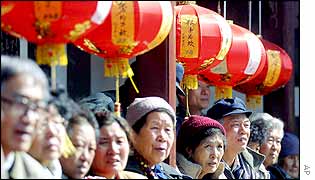
elderly traditionally commanded great respect It
is Saturday morning at an internet and English learning club for senior
citizens in Shanghai. As
they sit at their computer screens, Mr Zhang, a fit and energetic retired
professor, takes his class of elderly students through their repertoire of
English songs. The
pupils seem to be enjoying themselves. One woman says learning and singing
is the greatest pleasure for her. "Sickness
is the biggest problem," she says. "I have so many
diseases."
But
overall, rising living standards coupled with the one-child policy have
created a rapidly ageing population in Shanghai. The elderly now account
for nearly a fifth of the city's inhabitants. It
all adds up to make Shanghai an appropriate venue for a recent United
Nations-organised conference on the elderly, at which Xiao Caiwei was one
of the officials representing China. "In
the past we used to say it was the responsibility only of the family, then
with social development, people say ageing is the responsibility of
society," he says. "Now
we say it should be a combination - the responsibility of government, the
community, the family and society." 'Marginal'
role
But
to put that into practice in China, with its vast scale and economic
disparities, is a daunting task. "We
have a very special situation in China, with a very wide range of disease
patterns and ageing patterns," says Dr Henk Bekedam, the World Health
Organisation's representative in China. "I
believe personally it's very important to come up with tools and
instruments to get a much clearer idea of what's happening in all the
provinces in China."
The
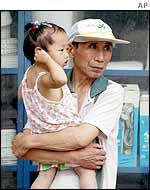
one-child policy has slowed China's growth One
thing that is definitely happening is a change in society's attitudes
towards the elderly, says Mu Guanzong, a researcher from the Centre for
Ageing Research at Beijing's People's University. "In
the past, in the Chinese family, people obeyed their parents, but now the
relationship is one of greater equality because the economic power has
moved towards the younger generation," he says. "The
elderly no longer control so many resources and their position has become
more marginal, especially in rural areas. "Many
of them can't get proper support from their families." Back
at the senior citizens' club, Professor Zhang digresses from song to
rhetoric, quoting Abraham Lincoln's Gettysburg Address - which happens to
be a party piece of President Jiang Zemin as well. After
the class is finished I ask him to reflect on how this society has changed
since the era of Mao Zedong and what that has meant for the elderly. "After
the reform of society everything is different," he says. "In
Mao's time everything focused on class struggle but now that the emphasis
is on money and old people still follow the instruction of Mao which was
'never do business', all the business is controlled by the Communist
leaders." Around
us, the class of senior citizens is packing up and getting up from their
sleek flat-screen computer terminals. They may be among the privileged
few, having such technology at their fingertips, but is it difficult to
try to absorb new things? I
ask one woman in her late 70s and get a poetic answer.
Copyright
© 2002 Global Action on Aging
|