|
|
|
|
||
|
||
|
|
||
| SEARCH | SUBSCRIBE | ||
Some related articles :
|
 |
Mavis goes to East Timor
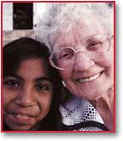
Two years ago, Mavis Taylor, 86, was at the point in her life when many her age have long since retired. She had raised a family of nine children and spent years running her own textile business in the small town of Yarrawonga,Australia. It was time, Mavis decided, to close shop. So Mavis, who had never been overseas, closed her shop and took it - piece by piece - to East Timor. Mavis' interest in East Timor, a territory less than 200 miles off the northwest coast of Australia, dates to 1974, when five Australian journalists were murdered while covering the political unrest there. A former Portuguese colony, East Timor was under Indonesian occupation at the time. "I was terribly upset that Australia wasn't doing a good job. I thought why aren't we doing more? But at the time there was nothing I could do," says Mavis. When the East Timorese voted for independence in August 1999, militias and some elements of the Indonesian security forces launched a campaign of violence, looting and arson. By the time a multinational peacekeeping force (UNTAET) arrived in September, the capital Dili was a ghost town: no vehicles, no electricity, no water and 70 to 80 per cent of all the homes had been burned to the ground. "When the devastation occurred I felt I was in a position to do something. I had brought up nine children and they were all looking after themselves," says Mavis. "I thought, 'I'll just shut the shop and take it over there.'" She started with two container loads of equipment and supplies, financed with more than $100,000 (Australian) of her own money, and headed to East Timor to set up a women's sewing cooperative. Her daughter Elwyn, inspired by her mother's sheer determination, joined her. Setting up shop in East Timor proved more difficult than Mavis could have ever imagined. Even prepared for the worst, Mavis was still astonished by the level of devastation. "I knew that it would look pretty battered but it was really depressing to see so much destruction," she sighs. "What a terrible waste." It was a long road to get the sewing cooperative off the ground. The United Nations donated an abandoned military hospital in the hills above Dili to house the factory. But the building had no doors or windows and Mavis couldn't move the supplies in because of security concerns. The containers of supplies languished in the Dili harbor for weeks tied up in paperwork. Though frustrated, Mavis never gave up. "I knew I'd do something good. And I hoped to stay long enough to achieve it," she said. And she did. An experienced businesswoman, Mavis focused on practical needs. The women began by sewing mattress covers and pillows in a city short on bedding. "Some had never seen a sewing machine and in about a half an hour, they were sewing straight lines," marvels Mavis. In the two years since she started the sewing co-operative Mavis has achieved a great deal. She has traveled back to East Timor twice and a third trip is in the works. Twelve more container loads of supplies and materials have been shipped over. Twenty-three more sewing centers have opened up and hundreds have been gainfully employed and countless others trained in sewing skills. Back in Australia, Mavis was featured in a film series produced by December Films called Grey Voyagers which won the United Nations Association of Australia Media Peace Award. A play has been made depicting her life and she was named older person of the year in 2001. She now has 28 grandchildren and 27 great-grandchildren. No matter how small, it's the effort of the individual that makes a difference, says Mavis. "I feel that I've done a little bit to give the people in East Timor a lift." Today at 88, Mavis is an example of the extraordinary contributions people can make late in their lives. She plans to travel back soon where she has some heavy lifting ahead of her. "I'm going to move heaven and earth to start a credit union," she says, with determination. And it's impossible not to believe her. People are living longer and the percentage of older persons, particularly in developing countries, is expanding rapidly. The phenomenon of ageing populations has profound social and economic implications. The United Nations is holding the Second World Assembly on Ageing in Madrid, Spain, from 8 to 12 April 2002, to address these concerns. Thousands of delegates from governments and grass roots organizations will hammer out strategies to deal with issues such as living standards, access to health care and community involvement for older people. Copyright
© 2002 Global Action on Aging
|