|
|
|
|
||
|
||
|
|
||
| SEARCH | SUBSCRIBE | ||
Some related articles :
|
 |
Elderly 'Witches' Persecuted in Mozambique
Elderly
'witches' persecuted in Mozambique
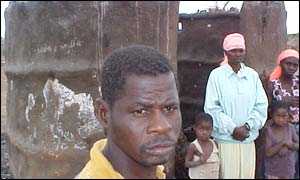
A victim of witchcraft accusations at his burnt home There has
been an alarming increase in accusations of witchcraft in Mozambique. These
frequently lead to elderly women being kicked out of their families. There have
also been reports of murders and violent attacks linked to witchcraft
accusations. The increase
in accusations is believed to be linked to soaring rates of illness and
death associated with HIV and Aids. While there
are no statistics to support the claims, academics and field workers from
aid agencies report the increased influence of traditional healers or
curandeiros. They frequently make accusations of witchcraft in such cases.
Abandoned
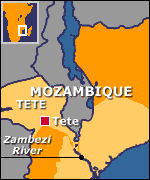
In Tete
province, in central Mozambique, an area with a high rate of HIV and Aids
- 21.2% - it is frighteningly easy to find people accused of witchcraft. When two of
Daina Pedro's grandchildren died, a traditional healer told her son that
she had bewitched them.
"The
healer lied," Mrs Pedro said. "He lied
a lot and used to call up the spirits to earn money. My son told his
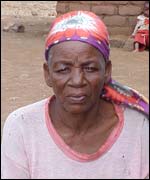
brothers. They all left and went far away." Mrs Pedro now
lives alone in an area hit by famine. She believes
in the existence of witchcraft, which is part and parcel of local
tradition and belief, but says she has been accused falsely. Unscrupulous
Zeca Chicusse,
programme officer in Tete for HelpAge International, has been trying to
help elderly people accused of witchcraft. His aid
agency, funded by Britain's Help the Aged charity, is trying to teach
people not to believe these accusations. "Here we
have a belief that if your child falls sick the first thing you do is go
to the traditional healer. "The
answer is always to accuse someone in your family. To say it is your
mother, your father or grandfather. "They
never say it is malaria or tuberculosis. They always accuse an
elder," he said
Traditional
healers in Mozambique are supposed to be registered with an official
organisation. But this is
not believed to be enough to stop unscrupulous curandeiros taking
advantage of people's traditional beliefs or colluding with them where the
motive of an accusation may be to take someone's land or cattle. 'Liars'
In June,
Simon Manuel Gomes's hut was burned down by his son, who was drunk. All of
Mr Gomes's possessions and food were destroyed. This happened
after his son had visited a curandeiro. The healer had told him that his
impotence was a result of him having been bewitched by his own father. "All I
know is that most healers are liars," Mr Gomes said as he looked
despondently at the charred remains of his hut. Necodemus
Chipfupa, head of HelpAge International in Mozambique, says that the
accusations of witchcraft are increasing because of Aids. He says it is
happening in his native Zimbabwe and across the rest of southern Africa. Mr Chipfupa
says Aids means big money for the curandeiros because people are sick for
longer. "The
healers charge for a consultation. They charge for medicine and also to
'cleanse' the compound." "When
they do that they get paid in animals or big sums of money," he says.
Healers
can help Not all
Mozambicans believe that the influence of traditional healers is entirely
malign.
Professor
Ricardo Duarte believes there are victims but, in general, the traditional
healers "do more good than harm". When it comes
to fighting disease, Professor Duarte, who teaches ethnography at Maputo
University, believes that curandeiros help people. This is
particularly the case in areas where there are few, if any, formal medical
services. "They
act on the psychological side," he explains, "giving the person
the impression of fighting the disease." "People
are convinced that they are 'armed' so the body gets more strength. It is
a benefit. Some don't use the right techniques but it is not all
bad." Copyright
© 2002 Global Action on Aging
|