|
Older
refugees face hurdles
Citizenship eludes Valley seniors who
lack transportation
By Diana Balazs
The Arizona Republic, December
11, 2002
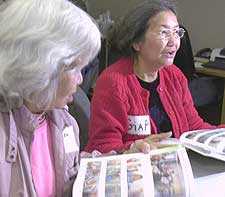
Sherrie
Buzby/The Arizona Republic
Vietnamese
refugees Nghien Kieu (left) and Giap Le learn English at the Area
Agency on Aging so they can apply for citizenship
Lejla
Bogdanovic recalls a recent visit to the home of a Bosnian refugee
in north Phoenix.
The elderly woman's younger relatives worked several jobs to support the
family, leaving her home alone much of the time.
Bogdanovic, coordinator of the Maricopa County Elder Refugee Program for
the region's Area Agency on Aging, complimented the woman on her
nice home.
"I don't care," the woman said. "This is a prison for
me."
For many elderly refugees, getting out to run errands, go to medical
appointments, attend classes or simply meet people is difficult.
They typically don't have a car, and if there is one, it is used by
family members to get to work. Many seniors also aren't familiar
with the Valley's bus system.
"Ninety-five percent I would say of them don't have transportation
at all because they never learned to drive," said Bogdanovic,
52, of Phoenix.
That lack of transportation is a barrier to seniors who want to attend
classes to learn basic English and become U.S. citizens, two
requirements for keeping their government benefits.
The 1996 Welfare Reform Act states that refugees who arrived after Aug.
22, 1996, can receive Supplemental Security Income, or SSI, for only
seven years. The only way they can keep the benefits is to become
U.S. citizens. Locally, more than 350 seniors will need to obtain
citizenship to keep their benefits.
The Maricopa County Elder Refugee Program was established in 1997 to help
refugees age 60 and older become citizens. It works with several
agencies including the Lutheran Social Ministry of the Southwest and
refugee groups to organize classes in English as a second language.
It is a program likely to be funded by this year's Season for
Sharing campaign.
The program is struggling this year because it lacks funds to purchase
vans to transport refugees to classes and add more English as a
second language teachers.
"Transportation has always been our biggest concern," said
Phoenix resident Camelia Assem, former women's education director
with the Arizona Refugee Community Center in Phoenix.
"To bring them to the centers or to get them either to ESL, computer
classes, citizenship classes, is our biggest problem," she
said.
Darla Sebenik, 57, of Phoenix, knows the problem firsthand. She teaches
refugees at Mountain View Elementary School in north Phoenix and
says she often takes students home or picks them up.
While the school is in a residential neighborhood within walking distance
of the homes of many who take the class, walking home at night or in
the cold can be difficult for seniors, Sebenik said.
"We all have to help each other," Assem said. "I feel like
if they don't get help they are going to be a burden on the
society."
Assem, who came to the United States from Egypt, said the reward is in
teaching people how to pay their bills, fill out a form and other
things that will make their new lives here a little easier.
"I wipe a lot of their tears. And then I go home and I wipe my own
tears because I feel so blessed that God has brought me to this
country," she said.
|