|
|
|
|
||
|
||
|
|
||
| SEARCH | SUBSCRIBE | ||
Some related articles :
|
 |
Hiroshima Mayor Calls on the U.S. to 'Sever the Chain of Hatred'
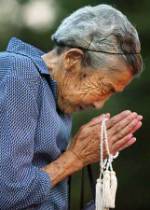
HIROSHIMA -- On the 57th anniversary of the first atomic bombing, the view from this reborn city was of a world that since Sept. 11 has turned its back on the message of the bomb's survivors. During the anniversary ceremony on Tuesday, Mayor Tadatoshi Akiba strongly criticized what he described as the unilateral approach of the United States administration of George W. Bush in dealing with global problems. "The United States government has no right to force Pax Americana on the rest of us, or unilaterally determine the fate of the world," Akiba said in the city's annual peace declaration at Peace Memorial Park in Naka Ward. "The probability that nuclear weapons will be used and the danger of nuclear war are increasing," especially in the wake of the Sept. 11 terrorist attacks on the U.S., to which the Bush administration responded with its war on terrorism. "The path of reconciliation, severing the chain of hatred, violence and retaliation, so long advocated by the survivors (of the 1945 atomic bombing) has been abandoned," Akiba said. The annual memorial was the first for atomic-bomb victims since the Sept. 11 attacks on Washington and New York and the start of the U.S.-led military campaign in Afghanistan. Delivering the declaration, Akiba urged Bush to visit Hiroshima and Nagasaki to "confirm with his own eyes what nuclear weapons hold in store for us all." Akiba also demanded that the Japanese government preserve its war-renouncing Constitution and not make Japan "a 'normal country' capable of making war like all other nations." Prime Minister Junichiro Koizumi, who also attended the ceremony, said in his speech that there will be no change in Japan's three avowed principles of not producing, not possessing and not allowing nuclear arms on its soil. Koizumi also said that Tokyo will continue its efforts to call on other countries to join the Comprehensive Nuclear Test Ban Treaty and have the pact enforced in the near future. Other participants included Health, Labor and Welfare Minister Chikara Sakaguchi, whose ministry deals with assistance for atomic-bomb survivors, House of Councilors President Hiroyuki Kurata, Hiroshima Gov. Yuzan Fujita, Nagasaki Mayor Itcho Ito and Ramesh Thakur, vice rector of the United Nations University. Among the estimated 45,000 other people present was Rita Lasar, a retired businesswoman from New York who lost her brother in the terrorist attack on New York's World Trade Center. She has criticized the Bush administration for justifying U.S. bombing in Afghanistan in the names of the victims of the terrorist attacks, including her brother. The Hiroshima Municipal Government has invited ambassadors of seven countries that possess nuclear arms to attend the ceremony since 1998, but only representatives from the Russian and Indian embassies attended. No U.S. government representatives were present. The 50-minute ceremony started at 8 a.m. with citizens presenting offerings of pure water taken from springs around the city to the arch-shaped cenotaph, in memory of the victims who died in desperate need of water. The mayor and two citizens then placed two books listing 4,977 people whom the city recognized as victims of the attack over the past year in the cenotaph. Koizumi, Akiba, other guests and representatives of survivors and local residents then placed flowers in front of the cenotaph. As the peace bell resounded through the park, the participants at 8:15 observed a minute of silence in memory of the victims. It was at that time 57 years ago that the U.S. B-29 bomber Enola Gay dropped the first atomic bomb. As of Monday, the number of victims of the blast confirmed by the city totaled 226,870, including an estimated 140,000 who had died by the end of 1945. An 80-year-old Hiroshima woman attending the service said she can still recall the mushroom cloud she saw from the suburbs of the city. "I feel pain to see people keep fighting in Palestine or children in Africa suffering in poverty," she said. While memories of the tragedy seem to have faded gradually as survivors have grown older, hibakusha still have problems that are yet to be resolved by the government. Last month, 76 hibakusha nationwide filed applications with prefectural governments across the country demanding official recognition as sufferers of radiation sickness. Although the government provides officially recognized patients of radiation-caused illnesses with 140,000 yen in medical benefits each month, it has so far granted official status to only about 0.7 percent of the estimated 285,000 people who were recognized as having been exposed to atomic bomb radiation. Groups of hibakusha have criticized the government, saying the system to recognize illnesses caused by radiation is too rigid. Hibakusha living outside Japan are also demanding that the government provide them with the same level of assistance granted to those who reside in Japan. Koizumi nuclear pledge
HIROSHIMA (Kyodo) Prime Minister Junichiro Koizumi pledged on Tuesday, the 57th anniversary of the atomic bombing of Hiroshima, to pursue a world free of nuclear weapons and to maintain Japan's no-nuclear-arms principles. "Now that the danger of terrorism is real, we (Japanese) need to make efforts to abolish nuclear arsenals, as the only nation in the world to have been attacked with the weapon," Koizumi told reporters at Peace Memorial Park in Hiroshima. Japan must tell the world how terrible an atomic bomb attack can be, he said. The prime minister also said his Cabinet will adhere to Japan's three principles of not producing, possessing or allowing the entry of nuclear weapons into the country. Concern has arisen, particularly in neighboring parts of Asia, that Japan may revise its no-nuclear-weapons policy, following remarks earlier this year by key members of the Cabinet. Chief Cabinet Secretary Yasuo Fukuda told reporters in late May, asking them not to name him, that Japan could possibly revise its no-nuclear policy in the future, depending on the global security situation. Fukuda told reporters Tuesday in Tokyo that Japan will strive to create an international environment in which no nuclear weapons would be used. He said he believes the world has come to share the view that such arms must be abolished. Koizumi, commenting on his absence from a Hiroshima meeting with atomic bomb survivors Tuesday, said he is always trying to understand the reality of the bomb survivors' plight, even though he did not meet them in Hiroshima this year. "I listened to them last year," Koizumi said. Koizumi skipped the annual meeting, in which the survivors usually tell prime ministers what they expect in the way of governmental measures to help them. The meetings began in 1976. Koizumi is the first prime minister to attend the Hiroshima peace ceremony without attending the survivors' gathering. Health, Labor and Welfare Minister Chikara Sakaguchi attended that meeting. Later on Tuesday, Koizumi visited Hiroshima National Peace Memorial Hall for the Atomic Bomb Victims to attend its inauguration ceremony. He offered flowers and a golden paper crane he folded in memory of the victims.Copyright
© 2002 Global Action on Aging
|