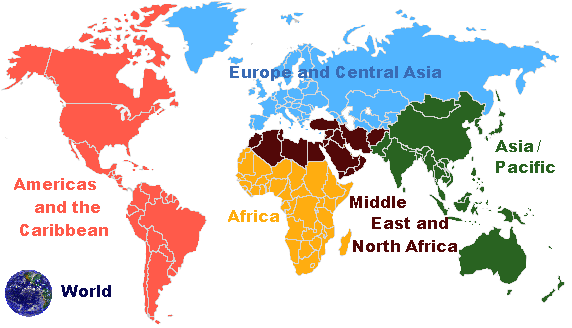
|
|
Elder Rights: World
- Archives 2006 -
Africa
Reports
Who
are the Vulnerable Children? Exploring the
Implications of Different Criteria for Determining
Eligibility for Program Assistance (2006)
In this study, the implications for social
protection programs and policies that support children
affected by HIV discussed.
Multiple individual and household circumstances
expose children to economic, social, and health risks.
This paper explores community perceptions about
vulnerability and how estimates of need vary using
different definitions. Participants responded by
identifying as vulnerable those households that are headed
by someone who is female, elderly, widowed, or
disabled. This paper was recently
presented at an International Conference, jointly hosted
by UNICEF and The Graduate Program in International
Affairs at the New School
Social Protection Schemes in West and Central Africa : A Proposal for
Renewal (2006)
Social transfers refer to direct cash or in-kind transfers
to the poor and groups in need of special care and
protection. Beneficiaries include the elderly, persons
with disabilities, orphans and other vulnerable children,
and individuals/groups affected by HIV/AIDS. Recently, the
issue of social protection has gained greater importance
due to its capacity to reduce poverty. This paper reviews
the vulnerabilities and risks faced by the people of West
and Central Africa,
particularly focusing on children. These vulnerable
children are often cared for by elderly family members. This paper
was recently presented at an International Conference,
jointly hosted by UNICEF and The Graduate Program in
International Affairs at the New School .
The Malawi Social Cash Transfer Pilot
Scheme/Preliminary Lessons Learned (2006)
Over the last ten years, poverty levels have remained
stagnant with 52% of the 12,608,000 people of Malawi
living under one dollar per day. Of the 52%, some 22%
are ultra-poor, living under USD 0.20 per day. This
group lives under severe conditions of chronic poverty
and is unable to meet daily needs. The pilot targets
households which are ultra poor and whose household
members are unable to work . Results indicate that these
mainly happen to be household headed by the elderly that
care for orphans and other vulnerable children since the
breadwinners are chronically sick or have died due to
HIV/AIDS or other reasons. This paper was recently
presented at an International Conference, jointly hosted
by UNICEF and The Graduate Program in International
Affairs at the New School .
Understanding and Responding to Ageing, Health,
Poverty and Social Change in Sub-Saharan Africa : A
Strategic Framework and Plan for Research
According to the Madrid Plan Action on Ageing and the
WHO framework, crucial research is needed toward
developing a broad research agenda on ageing for the
Africa region. In sub-Saharan Africa, older people’s
lives are characterized by growing inadequacies in
customary family support systems, vulnerabilities to
poverty and exclusion from health services. Yet, due to
the AIDS epidemic, older persons have taken on the role
of carers to diseased and orphaned children and
grandchildren. This report presents a strategic
framework for producing high-quality policy and
scientifically relevant research.
Tanzania: Widows Face Eviction (January 19, 2006)
A recent Help Age International study shows that despite
the 1999 legistation on land and property that entitled
women to the right of inhertance, most widows do not
have access to land and face eviction from their own
homes. Customary law prohibits women from owning land
and a house; male relatives often retain all property
rights, despite women's wishes and legal rights. Elder
women are particularly vulnerable in such situations.
Help Age International is training local people in a
community-based paralegal program, to inform women about
widow's rights.
Articles
Zambia: Older
Years Not Proving Golden Years (December 13, 2006)
Zambians often seek government employment to obtain
financial security, but now the National Planning
Minister has told them not to rely on the government’s
Public Service Pensions Fund Board, (PSPF), to finance
them during retirement. Government officials now advance
the idea of personal responsibility when they talk about
retirement. They advocate educational programs for civil
workers to teach them business skills so that they can
plan economically safe retirements. But is this the
optimal solution? What happens to the current pensioners
who worked arduously for decades and now wait for a
pension that never comes?
Namibia:
Elderly Face Changing Times (November 29, 2006)
On the occasion of the annual Christmas Lunch for Elderly
People, the Minister of Labor and Social Welfare of
Namibia, Alpheus Narusebo, noted the absence of older
people’s participation in community development, as well
as in political or economic activities. He said that their
exclusion from the community impoverishes the society and
denies everyone access to their role as models for aging.
Ethiopia:
Mission Feeds Overlooked Seniors in Africa (November
1, 2006)
In Addis Ababa, the capital of Ethiopia,
Rev. Michael Craig created a day care center to
provide help for the homeless senior population.
After initially caring for 15 people, the day care
center is now able to feed 125 older persons 5 days
a week. This year the organization launched a
pension fund plan that will provide small payments
for participants to live on. The organization is the
result of a few persons committed to tackling the
forgotten and calamitous situation of the destitute
elderly in Africa
.
Swaziland: Government
Stops Grants for the Elderly (October 31, 2006)
Because of technical problems, the Swaziland
government has suspended its grants for the elderly.
The situation is very grave, as government grants
for many older people were their only cash income as
well as used to care for their grandchildren
orphaned because of the HIV/AIDS disaster.
South
Africa: North West Government to Root Out Those who Prey
on the Elderly (October 11, 2006)
The North West Government of South Africa is tackling
financial elder abuse in response to the Parliament of
older persons where the issues were raised. It is an
example of how older persons can play a key role in the
development and transformation of their country.
Namibia:
Elderly Go Hungry (October 5, 2006)
In Namibia, a recent survey revealed how issues such as
alcohol consumption, eyesight or hunger affect elderly
persons. According to this survey, many elderly people are
subsisting on a single meal a day. Ten years ago at the
World Food Summit, world leaders of many countries pledged
to halve the number of undernourished people by 2015.
Today, more than 850 million are still hungry, 18 million
more than 1996. When will the hungry be fed?
South
Africa: Elderly Cautioned Against Exploitation
(October 4, 2006)
In South Africa, the Government is
tackling financial abuse against elderly people. Indeed,
some trading stores are charging elderly people very high
prices. This shameful behavior seems to contradict
traditional African values that normally accord respect to
elderly peopl
Democratic Republic of Congo:
Obsession of Youth: the Difficulty of Being Old in
Kinshasa (October 3, 2006)
(Article in French)
In the Democratic Republic of the Congo, it was customary
to call the elderly “Daddy” or “Mummy.” Today this
appellation is seen as offensive; older people accept only
the new nomenclature: “Uncle” and “Aunty.” The reason is
simple. The elderly don’t want to be considered old in
this country where growing old is often accompanied by
poverty and marginalization. Yet when life expectancy
hardly exceeds 40 years, growing old should be considered
an honor and not a shame.
Zimbabwe: Proposed Older Persons Bill Discussed (October
3, 2006)
In Zimbabwe, the Parliament is discussing legislation that
aims at improving older persons’ situation. The Bill
focuses on several elderly issues, such as assistance for
old people who look after their grandchildren whose
parents have died of AIDS. Also, the proposed Bill
advocates for specific treatment of old prisoners who
until now have been not treated distinctly, despite their
particular needs.
International Day for Older Persons
Celebrated in African Countries (October 1, 2006)
(Articles in English and French)
On October 1, 2006, many countries celebrated the
International Day for Older Persons. The UN created this
day to focus worldwide attention on the aging population.
It’s good to know that the elderly celebration day is
taking place throughout the world, including developing
countries, such as Cameroon, Tunisia, Gabon and Namibia.
Cameroon: Discussing Old People's
Problems (September 12, 2006)
Participants from 13 African countries and the United
Kingdom, including Help Age International, came to
Yaoundé, Cameroon, to take part in a seminar on
older people’s issues. Participants want to set up a
partnership for the government, civil society and
international organizations to address problems facing
older persons in Cameroon and to identify strategies to
review the 2002 Madrid International Plan of Action on
Aging.
South Africa:
Heartbreak for Old Folk Dumped by their Families (July
27, 2006)
In Port Elisabeth, many older people suffer abuse by
family members. As a result, some elderly leave their
homes, getting lost in the city’s streets. Upon finding
such people, hospital staff members bring them to the
hospital, the only shelter available in this situation.
Though these older people should reside in old-age homes
or care facilities, they often fall through the cracks
of the care system when they cannot identify themselves
and their relatives do not look for them
Namibia: AIDS
Impacts on Elderly (July 19, 2006)
A survey funded by the US President's Emergency Plan for
AIDS Relief shows that more than 56% of caregivers for
orphans and vulnerable children in north central Namibia
are between 60 and 99 years of age. Moreover, 19% of
caregivers are in the age bracket of 80 to 89 years.
This survey is part of a larger program of the US
assistance to the Namibian Government and NGOs to render
support services to 59,000 orphans and other vulnerable
children.
South Africa:
Emotional Stress of HIV/AIDS Hits Elderly (July 12,
2006)
Despite the common fears and challenges that older
people face throughout the world, South African elderly
have an additional health risk factor: Death due to AIDS
among the younger generation. Recognizing this problem,
the government introduced the Older Person's Bill that
purposes to promote rights of older people as well as
encourage elder oriented community services.
South Africa: Abuse
of Our Aged on the Rise, Say Experts (June 18, 2006)
“Beth,” a frail 67 years old person, used to live
with her grandson. They separated when she entered an
old age home for her safety. Her grandson used to steal
her pension leaving her in poverty and hunger. According
to a gerontological social worker, sometimes older
people’s children refuse to place their parents in an
old age home because they do not want to lose access to
their parents’ pension. Older persons are often
reluctant to talk about the issue because they are
afraid of the consequences. For social workers, it is
important to build a relationship with abused older
adults so that they can feel secure enough to describe
their situation truthfully.
South Africa: Elderly Belong at Home (June 7,
2006)
The Department of Health and Social Service is at
work on a large- scale renovation of the health care
system. One of their pilot plans is to remove
institutions that isolate older people from the rest of
society, and to relocate them in their own communities.
To make the readjustment easier for older adults, the
Department will find caregivers within the communities.
By preventing neglect and abuse, the Department strives
to reduce the number of older adults who move to old age
homes.
Namibia: Namibian Widows
Suffer More Than the Loss of Their Spouses (June 1,
2006)
Younger and older women suffer tremendous emotional and
financial loss upon the death of their husbands. During
the mourning period, a widow remains very isolated, and
her dead husband’s family often takes away most of her
belongings. Many women and their children end up in
dismal poverty. While women’s rights activists groups
try to fight this problem, conservative chiefs in rural
Namibian society have absolute power, and refuse to
discuss the issue.
Kenya: Kenya's Prisons Not Designed For the Aged (May
4, 2006)
According to a study, elderly prisoners suffer negative
physical and psychological symptoms as an effect of the
harsh living conditions in Kenya’s prisons. Many
complain about inadequate food and medical care, as well
as the detention administration’s strict rules and
practices. “These people are no longer hanging us and I
wish they hanged me long time ago instead of subjecting
me to a slow and painful death,” says Masaba, a
62-year-old prisoner sentenced to death in 1978 for
robbery with violence.
Namibia: Namibian
Government Turns Down Poverty Reduction Grant (May 17,
2006)
The Namibian government turned down a request by civil
society to grant all Namibian citizens a monthly cash
allowance to help them cope with poverty. The coalition,
consisting of Churches and NGOs in Namibia suggested to
the government to pay a basic income grant (BIG) to
every Namibian citizen until the age of 60, after which
the national pension scheme would take over. Prime
Minister Nahas Angula rejected the idea, saying that it
is not affordable for the government to introduce a BIG,
given the country’s meager resources. Namibia has one of
the most unequal societies in the world: the gap between
rich and poor is unacceptably high. According to the
preliminary results of a Survey conducted by the
government's National Planning Commission, about 30
percent of Namibian households live in poverty.
South Africa: Elderly
Suffer Harm, Abuse at Hands of Family, Neighbors (May
18, 2006)
Older people in South Africa are rushing into old
age homes to escape abuse and neglect. Cases of elder
abuse have increased, among them sexual abuse of older
women by both family members and outsiders. It is based
on the belief that sexual intercourse with a sexually
inactive person is an effective way to cure HIV/AIDS.
Persons concerned about these abuses are urging passage
of an Older Persons’ Bill to provide protection for
vulnerable older persons in communities and in
residential care facilities.
Sudan: Grannies Step in to
Care for Children Orphaned By HIV/AIDS (April 17,
2006)
In Juba, the capital of South Sudan, 250 children are
known to be orphaned from HIV/AIDS. The real number of
orphans might be higher since HIV/AIDS is still taboo
and stigmatized. Sudanese society also ostracizes the
orphans, fearful to admit the epidemic is spreading.
Helped by NGOs, grandparents often become the caregivers
of those children. Grandparents try to prevent their
grandchildren from becoming outcasts and they work hard
to keep them in school, away from drugs and
prostitution. Yet "the economic burden for grandparents
of AIDS orphans is so great it can't be described,"
stated Marcellina Denya, formerly a social worker. That
is why without NGOs’ support, grandparents are left in a
precarious position.
Kenya: UNIFEM Calls for Zero Tolerance for Sexual
Violence Against Women (April 17, 2006)
“Its time for government, community and religious
organizations to take concrete action to end violence
against women,” said Nyaradzai Gumbonzvanda, regional
program director for the United Nations Fund for Women
(UNIFEM). The recent increase in rapes in Kenya provoked
UNIFEM to sound the alarm. Every 30 minutes, a Kenyan
woman is raped. Men assault young girls to elderly women
in a long tradition of silence and impunity. But Kenya
has signed the Convention on the Elimination all Form of
Discrimination Against Women. That is why UNIFEM calls
for an urgent action from the Kenyan government.
Uganda: Women Condemn Female Circumcision (April 11,
2006)
Tensions remain high over the debate about female
circumcision in Uganda. Critics raise health and human
rights concerns, while supporters argue for culture
preservation. Older women condemned female circumcision
in a resolution at a recent advocacy training for
Karimojong elders. While these elders condemn the
practice, older women continue to be the primary
circumcisers. Older persons are central to the outcome
of this debate.
South Africa: Boon for Our Elderly (March 27, 2006)
In South Africa, new legislation will soon be adopted to
strengthen the rights of older persons, fight elder
abuse, address the isolation of older persons, and
protect against age discrimination. The bill emphasizes
full inclusion of older persons in society and condemns
the misperception of seniors as mere “objects for
welfare.” Supporters of the bill say they will monitor
implementation closely.
Kenya: Addressing the Plight of the
Older People (March 27, 2006)
In Misyani, Kenya, doctors and medical staff now turn
away older persons, telling them they are not sick but
old! To overcome such age discrimination, the Kenyan
government is making an effort to implement the UN 2002
Madrid International Plan of Action on Ageing. In
collaboration with the Older Citizens Monitoring
program, which encourages older persons to supervise
governmental services, Kenya wants to include older
people fully in the decision-making processes and
eliminate such discrimination.
South Africa: New
Bill in Parliament Seeks to Enshrine Rights of Elderly
in Law (March 21, 2006)
The South African Parliament is about to adopt new
legislation that will define the rights of older
persons, including protection against domestic abuse.
The author calls this legislation an historic event
because until now legislators have never directly
addressed the rights of older persons or tried to
implement laws that insure respect for the elderly.
Pakistan: Focus
On ‘Vani’: The Practice of Giving Away Young Women to
Settle Feuds (March 16, 2006)
Fareedullah Khan, nearly 70, and his wife are fighting
against the tradition of “Vani.” Vani, a traditional
Pakistani practice allows families to trade a young
female family member as compensation for a misdemeanor
between two clans. Khan’s family gave away his grand
daughter as “compensation” and she is virtually used as
a slave in the family she was offered to. The old
couple’s fight against the Vani tradition is very
unusual and courageous.
South Africa: Granny
Feels Sense of Fulfillment after Casting Her Vote
(March 1, 2006)
After seeing visible changes in their lives since
independence, large numbers of older persons turned out
to vote in South Africa’s most recent elections. Some
elders relied on family members to drive them to the
polling stations. Many stations had special
accommodations for older persons to avoid long queues.
At 81 years old, Dorah Matiwane “knows how difficult it
is to wait almost a lifetime before being given a chance
to exercise her right.”
Mauritius: Older Person's Integration to Be Reviewed
(February 27, 2006)
(Article in French)
A recent roundtable organized by the Mauritius
Ministry for Social Security has emphasized the need
for better integration of older citizens in Mauritius
society. A ministry study says that integration does
not necessarily mean that the elderly should live with
their relatives. The roundtable prepared some
recommendations to develop initiatives like
neighborhood watch or senior's employment. Some 120, 000
older persons currently live in Mauritius.
South Africa:
Elderly Hit Hard as Cash-Strapped Social Organization
Forced to Cut Back Services (February 12, 2006)
Because the welfare department reduced its subsidy, the
Johannesburg Institute of Social Services (JISS) has
been forced to cut back on its aid, especially to senior
citizens. The cuts hit the service centre for the aged
hardest. This centre provides subsidized meals and gives
social services to older persons.
South Africa: Youngsters Invade Pensioners' Turf
(February 5, 2006)
The Eldorado Park retirement village is meant to provide
housing for married and single pensioners, not their
dependents. Residents have been complaining of verbal
abuse, noise, litter, theft, lack of security, and no
staff at the clinic in the complex. Ghadiha Landis, 87,
thought that moving to Eldorado Park was going to bring
some peace to her life. Instead, she finds herself
locked in her flat during the day and sleeping in the
lounge at night after her relatives kicked her out of
her room. Johannesburg's Region 10 Department of Housing
is investigating these abuse allegations.
Ghana: National Policy on the
Aged Will Help Older Women (January 30, 2006)
A National Ageing Policy was submitted to the cabinet of
Ghana in 2003. Ebenezer Adjertey-Sorsey, the Executive
Director of Help Age Ghana (HAG), explains that this
policy is necessary because it "aims at promoting the
social, economic and cultural reintegration of older
persons into the mainstream society." Not only is this
policy helpful in providing a definition of "elderly,"
but it is also a step towards guaranteeing the rights of
older women who are not fully compensated for the work
they do. Adjertey-Sorsey also calls on Ghana to evaluate
its pension plans because the plans currently do not
cover informal sector positions despite the fact that
many people work in this sector.
South Africa: A Man Who Has Passed Many Tests Vies
With One More (January 7, 2006)
This heartwarming story chronicles a 84 year old man who
went back to school to learn how to read. Mr. Chauke, a
father of five children, and an anti-apartheid activist,
was an African National Congress delegate at the
approval of the nation's historic Freedom Charter in
1960. But for almost all his life, he was also
functionally illiterate, his education halted at the
sixth grade, in 1953, with the assistance of South
Africa's apartheid police. He's pursuing an education so
that he can write and dignify his history.
Return to Top of Page
Americas
& Caribbean
Reports
Canada: Labour
Supply Effects of Informal Caregiving in Canada
(December 2006)
This report examines the impacts of care giving to elderly
persons on the caregiver’s labor market behavior, based
upon data from the General Social Survey. In contrast to
institution-based care given by paid health care workers,
a vital component of elderly care in Canada is
significantly performed by unpaid caregivers, such as
friends or family, and constitutes as much as 80 percent
of care given to elderly Canadians.
PAHO Annual Report Focuses On Closing Health Gaps in
Least Protected Populations (September 2006)
The PAHO report examines the
continuing inequities in resource allocation and unequal
access to services due to present health policies. In
addition, the report explores the disparities between
rural and urban areas as well as places where poverty is
highly concentrated. The study incorporates the
situations of disadvantaged groups such as women,
children, indigenous populations, young people, and the
elderly.
Canada: Debate Over Mandatory Road Test for Elderly
Drivers (March 14, 2006)
In Canada, older persons are the fastest growing group
of the driving population. Often senior drivers are
involved in traffic accidents and even major collisions.
Recent traffic incidents and new studies showing the
possibility of older drivers suffering with dementia
have prompted the Parliament to revise current driving
tests. Soon seniors might be required to take a road
test, along with their written and eyesight examination. Will the Canadians also require
tests for the younger generation (teens and
twenty-somethings) who, if they resemble their US
neighbors, have high accident rates?
Mexico: Building Human
Capital in an Aging Mexico (July 2005)
While the number of young children (under age 20)
exceeds that of older adults (65+) in Mexico today,
according to UN projections the country will go through
a huge demographic change in the foreseeable future. By
2050, the number of older adults will represent the same
proportion with children, which means 1 out of 5 people
in the country will be over 65years old. This report
analyzes how Mexico’s expanding aging population will
affect its future labor market and human capital
formation. It also emphasizes the importance of
socioeconomic development in the next 25 years while the
population is still young and growing, so that the
government will be able to support the coming large
generation of older adults.
Articles
Chile: The Market Does Not
Understand Elderly Persons (December 25, 2006)
(Article in Spanish)
Seventy-three percent of Chilean elderly consumers
think that merchandise companies do not take them into
consideration when making products for sale. Elderly
consumers are most frustrated with the clothing section.
They also feel dissatisfied with the food and medical
sections of the market. Unfortunately, 55% of the
merchandisers do not consider elderly persons to be
relevant consumers. The result is that almost 4 out of 5
elderly consumers do not go to big shopping centers but
rather do their shopping in the supermarket.
Mexico: There’s no Culture of Respect Towards Old Age
(December 14, 2006)
(Article in Spanish)
“Society has a negative image of [old women] and it
perceives them as unproductive persons that are, more than
anything, a burden. This attitude feeds discriminatory
attitudes. There is no culture of respect towards old
age!” The Xovhimilco Azcapotzalco y Gustavo A. Madero
delegations estimate that in Mexico’s Federal District, at
least 36.2% of older women 60years and older are abused
economically, emotionally and physically. As a response, a
November 2006 education project on “Intergral Promotion of
Elder Rights, Prevention of Violence and Abuse, and
Promotion Values of Coexistence with Older Adults in the
Federal District” was launched.
Mexico: The Elderly First
(December 7, 2006)
(Article in Spanish)
Mexico’s large youth population competes fiercely for
jobs. However, elderly people also need jobs. Most
pensions are inadequate. Transfers from children or
grandchildren barely cover their very basic needs,
excluding medical expenses. The majority of them are
living in poverty and with hunger. Many young people, on
the other hand get financial support from their
parents--they live with them, eat their food and receive
education at their expense. Elderly persons have no
such luxury. Therefore, their need for employment must be
considered.
Canada: LGBT Seniors Face Healthcare Abuse (November
2006)
The McGill School of Social Work conducted a study on
how health care providers treated gay and lesbian
seniors in Montreal, Vancouver, and Halifax. Their
research resulted in some disturbing findings. Many of
the LGBT seniors told researchers that they never told
their doctors about their sexuality because they grew up
in a less-open society. Additionally, there are other
seniors who have suffered mistreatment and neglect from
their doctors and nurses who suspected or discovered
their sexual orientation. Some LGBT seniors even go into
the closet (disguise their sexuality) when they need to
go to a hospital or enter nursing homes.
Dominican Republic: Increase in Housing Tax Will Cause
Many Homeless (November 27, 2005)
(Article in Spanish)
“Not everyone who has a house is rich and the rich
are not the only ones who have a house” is what
José Rodríguez Cáceres, President
of the Dominican Association of Housing Constructors and
Promoters, says.
The Dominican government wishes to increase the property
value by 1% and increase the housing tax. This will
affect mostly poor people and most of them are retirees
relying on an already low pension. The retired poor
would not be able to afford the tax and would then be
forced to give up their homes to the Dominican IRS.
Rodríguez Cáceres states that houses
cannot be treated like rum or tobacco. The government
should find other ways to increase revenue. He also says
this tax proposal is unconstitutional.
Argentina: Each Week an Elderly Person Is Killed
(November 27, 2006)
(Article in Spanish)
From January 1 to October 31, 43 elderly people over
the age of 65 were killed in Argentina; all of the
killings involve robbery. Even though the statistic is
appalling, it is an improvement over the year 2004, when
an elderly person between the ages of 65 and 85 was
killed every 36 hours. Elderly people are an easy target
for several reasons: they are frail, often alone, and
save their pension in cash at home. In some cases,
robbers have the assistance of the police who have
access to blueprints of the houses where elderly people
live alone.
Panama: A Study Reveals That There Are 370,000
Disabled People in the Country (November 27, 2006)
(Article in Spanish)
One out of ten Panamanians has some kind of
disability, both physical and mental. The study finds that
people are likely to develop some kind of disability after
the age of 40. The National Secretary for the Disabled
conducted the study and concluded that Panama needs to
focus on the rights of people with disabilities, more than
a tenth of the national population, including many elderly
people.
Honduras: Bringing Happiness to the Retirees (November
24, 2006)
(Article in Spanish)
At the fourth fair for retired people, more than 500
members of the Honduran Institute for the Retired and
Pension for Public Employees will receive medical
attention throughout the day. The event promotes better
medical care for the elderly and integration into
society. Retired people feel valued when the government
demonstrates its concern about their physical and social
health.
Argentina: Old,
Me? The Elder Boom (November 19, 2006)
(Article in Spanish)
It seems that people are both getting older and having
a better lifestyle. Today’s older persons do not conform
to the stereotype of staying home for the winter, wearing
slippers all the time, and living a grandfatherly
lifestyle. Thanks to scientific and technological
advancements, they are more independent and interested in
doing things they have always done – from continuing
education to traveling to shopping. These unprecedented
demands have resulted in the inclusion of older persons in
different markets- tourism, academia, and business, to
name a few. This article explores the striking change in
the role of the elderly people in society and how they
contribute in unimaginable ways.
Argentina:
Benefits for those over 65 (November 14, 2006)
(Article in Spanish)
It’s no longer, “about finding scientific advances that
will increase life expectancy, rather we should concern
ourselves with improving the well-being and quality of
life in old age.” It is imperative that Argentina put
preventive measures in place to avoid dependency and
disability among older persons. With this in mind, the new
Law of Adults will try to keep older persons independent
by guaranteeing access to health services, supplying
medications and home aid services to those most in need,
and by offering subsidies to poor families caring for
chronically ill elders.
.
Honduras: Older Persons Required to Work for Survival
(November 14, 2006)
(Article in Spanish)
More than half of the Honduran elderly population does
not have any formal education. Only five out of a hundred
older persons are retired and have pensions. This means
that almost 12,500 elderly above the age of 80 are forced
to work in order to survive. Despite the fact that there
are laws that protect the rights of elderly people 60
years old and older, the government does not enforce these
laws. Most observers blame a weak judicial system and
government neglect. This unfortunately directly affects
the living conditions of older persons.
Chile: Older Persons Becoming Their Own Bosses Gives
Them New Energy (November 13, 2006)
(Article in Spanish)
Psychologists showed that older persons who are
entrepreneurs lead a healthier and better lifestyle than
their unemployed counterparts. Most of them are
entrepreneurs because their income is insufficient to
support themselves. But there are others who have
personal business goals into which they want to invest
their time and energy. Writer Carolina Disegni Gili
included a mini-biography of several successful
post-retirement entrepreneurs who lead a very active and
happy lifestyle. Rosita Kornfeld, the director of the
Program for Elder Adults, accurately stated, “Having an
independent work allows older persons to be more
resourceful, less dependent of their family, and have a
better self-esteem.” But poverty often prevents
entrepreneurial activity.
Argentina. Launch of
Campaign that Promotes Healthy Images of Old Age
(November 8, 2006)
(Article in Spanish)
What’s the most effective way to communicate healthy
images of old age to younger adults? The Israeli
Philanthropic Association, along with the Vicente
López Parliament on Old Age and other agencies,
launched the “Old Age, First to Grow” campaign that
targets the young. They expect that circulating free
postcards of older persons’ health life at locations
where young people gather will help dispel prejudices
against the old. With a picture of a healthy old age,
everyone can expect to enjoy it!
Chile: Project Prevents Embargo of Goods to Greater
Adults
(November 7, 2006)
(Article in Spanish)
In
Chile, if elderly people are not able to pay their
debts, the government confiscates their personal
property and/or houses. This practice leaves them
completely abandoned and ruined. Senator Juan Pablo
Letelier proposed a law that prevents confiscation of
certain personal properties that belongs to men over the
age of 65 and women over the age 60. Senator Letelier
argues on the ground that at that age, it is very
difficult, if impossible, for elderly people to recover
property vital for their needs. This article discusses
the proposal in more detail.
Chile: Tourism for Older Adults Event Will Be in
Cartagena (November 6, 2006)
(Article in Spanish)
The eleventh National Tourism for Older Adults will
take place November 14 – 16 in Cartagena, which is the
capital of tourism for older adults. Organizers have
planned lots of activities with themes ranging from
health to psychology. The event ends with a 1920s
costume carnival and more!
Argentina: Against Exclusion- An Active Elderly Life
(November 5, 2006)
(Article in Spanish)
Writer Jorge Strada aptly states the human
contradiction: “We all want to live longer, but we don’t
want to become old.” Many people have a negative view on
elderly life – one of declining health, the need to have
care, and so forth. He states that we must fight to give
elderly life a new concept.
Cuba: Oldest Cuban Dies,
Said to Have Been 126 (October 11, 2006)
On Wednesday, Benito Martinez Abrogan, the oldest
citizen in Cuba died at the reported age of 126 years.
It is interesting to note that some 2,500 centenarians
can be found among the 11.2 million inhabitants of Cuba.
One question comes up: What is the longevity secret in
Cuba? Good public health care throughout life?
Honduras: Construction of
Geriatric Hospital Halted (September 6, 2006)
(Article in Spanish)
Construction workers have abandoned building the
first Geriatric Hospital in San Pedro Sula City,
Honduras. This project, begun on January 5th, 2002,
encompassed the dreams of many older persons living on
the north coast of Honduras. COPASA, the construction
company, began the project; but unfortunately, it halted
work in March 2005. At the outset, planners intended the
geriatric hospital to serve impoverished older adults.
This article tells the story and the struggle of the
Senior Home former director, Oneyda Rodas. Also, it lays
out how older adults will benefit if the project reaches
completion.
Mexico: The Mexican Federal District Government
Admits: A Long Way in Order to Avoid Physical Abuse
for Elders (August 28, 2006)
(Article in Spanish)
In order to celebrate the Day of Older Persons in
Mexico city, the Federal District Government (GDF)
declared that a lot of work needs to be done to change
social norms because of society stills stigmatizes and
discriminates against older adults from the Third Age.
Pablo Yanes Rizo, director of GDF, also declared that
most 60 year older adults have experienced some type of
violence; consequently, the GDF has decided to carry out
a survey to determine the extent of the elder abuse.
Furthermore, Yanes Rizo added that older adults know
what they want. They demand better Medicare, public
transportation and above all legal support in cases of
physical abuse.
Bolivia: Bolivian Vice President
Promises to Pressure the Congress to Pass the Older
Adult Law (August 26, 2006)
(Article in Spanish)
Due to the Bolivian National Day for Older Persons,
the Bolivian Vice-President promised the Bolivian people
that he would pressure Congress to approve the 264 Law,
which would protect older adults in Bolivia. Alvaro
Garcia Linera, Bolivian vice president, said that “the
Evo Morales government unconditionally supports the
elderly because they are the ones who have taught us
all; therefore, they [elderly] deserve to be respected.”
This article reports on the vice-president’s speech on
the Murillo Plaza and emphasizes the importance of
respecting and caring for older persons.
Bolivia: Governmental Authorities
Forgot to Celebrate Older Citizens Day (August 27,
2006)
(Article in Spanish)
The Bolivian governmental authorities totally
forgot to celebrate Older Citizens Day yesterday, August
26th, 2006. The Bolivian government established August
26th as the official day for Older Citizens in 1948.
Unfortunately, the authorities did not visit one of the
biggest senior homes in La Paz. This senior home, “La
Sagrada Familia,” gets its main support from church
donations and nuns carry out most of the administration.
Actually, “La Sagrada Familia” organizes a cooperative
campaign to motivate people to donate food, clothes, and
cleaning supplies that are used at the senior home.
Although the governmental authorities totally forgot
about the gramps and grannies, this did not stop older
persons from enjoying and celebrating their day.
México: Social Security
Mexican Institute (IMSS) Pays $65 Billion to Retired
Citizens (August 22, 2006)
(Article in Spanish)
Each year the Mexican Government pays out $65
billion pesos for the social security of retired
citizens. The Mexican Social Security Institute has
accomplished many achievements such as the construction
of hospitals; unfortunately, much more needs to be done.
For instance, free medical coverage for older adults is
a subject that the Institute has not yet addressed.
Mexico: Older Mexican Citizens on Hold
(August 19, 2006)
(Article in Spanish)
More than three hundred older Mexican citizens
waited outside of the avenue La Reforma to support the
only candidate and former major of the Federal District
l Manuel Lopez Obrador, who has supported older citizens
since the beginnings of his political career. Lopez
Obrador has been their loyal ally because he was the
first one to build hospitals and create a solid pensions
program. The older citizens wait for a fair recount of
the ballots and continue to supporting him. Lopez
Obrador has never forgotten older persons since he’s the
only politician who has supported them. This article
narrates the story of several Third Age members who are
waiting with hope and faith that their fight for a
recount will not be in vain.
Colombia: The Grandfather
(July 12, 2006)
(Article in
Spanish)
In today’s society,
there is a high tendency for mothers to become single
parents, which in the structure of today’s society
often means that grandparents have a greater role in
raising the children. The article shows how the
grandparent role evolved, its causes and effects, and
changing relationships between grandparents and these
children as they grow older.
Canada: Seniors Get Elder-Law
Lesson at Griffith McConnell Home (June 27, 2006)
Gradually, society recognizes the importance of the
rights and interests of elder people, qualifying older
persons as distinct group with its own challenges and
opportunities. In Canada, Ann Soden, an elder-care law
specialist, advocates “the ins and outs of wills, power
of attorneys elder abuse and elder law.” She gives a
series of presentations for older people explaining the
ways they can protect themselves against discrimination,
exploitation and abuse.
Jamaica: Elderly Abuse
Alert (June 18, 2006)
Human rights activists raise concerns about abuse of the
elderly population in families and nursing homes. They
urge the Government to provide stricter measures to
inspect complaints of such abuse. Although police
statistics indicate that reports of rape and other
violent acts against seniors are declining, other
authorities point out that abuses often go unreported,
as the perpetrators come from family circles. Therefore,
a main concern for activists remains whether or not the
abused under-report such crimes.
Canada: Immigrant Seniors
Face 'Rampant' Abuse by Families, B.C. Advocate Says
(June 15, 2006)
This article explores the problem of elderly immigrant
parents who end up in a country whose language they
can't speak. Unfortunately, some members of ethnic
communities do not take good care of their elderly
parents. Seniors, who are often financially dependent on
their children, become isolated in their kids' homes and
many times work in exploitative environments in
households, farms and factories. These situations often
lead to loneliness and depression among elderly
immigrants.
Canada: The 'New' Faces of Beauty Are in Their Sixties
(June 6, 2006)
Older Hollywood stars such as 60-year-old actress
Diane Keaton or 62-year-old Catherine Deneuve appear on
cosmetic ads. Because large numbers of their consumers
are aging, more cosmetic companies are interested in
using older models to market their products. In the
future, we may see fewer teenage faces on cosmetic
products as older women are targeted.
Puerto Rico: Study on Older
Persons and Gambling Generates Concern (May 29, 2006)
(Article in Spanish)
A group of researchers from the University Carlos
Albizú in Puerto Rico has published a study
showing that a great number of older persons on the
island spend their time in casinos playing slot machines
and gambling. What concerns local authorities the most
is that 64% of the older persons interviewed for the
study admitted having problems with addiction, and 36%
said this is a serious problem. The situation is
complex, as there are few places to go to fight boredom
and loneliness other than to a casino. The report led
authorities to implement programs to prevent gambling
addiction among older persons.
Venezuela: Older Persons as Wisdom Givers (May 29,
2006)
(Article in Spanish)
To acknowledge the valuable role that older persons
play in society, Venezuela has launched a National Day
for Older Adults. Local authorities and community-based
organizations planned various activities and events,
such as public multi-generational dances, to celebrate
and honor the senior population. In this article, the
author presents short interviews with older persons,
illustrating the knowledge and wisdom they have to
offer.
Cuba: Oldest Cubans Share
Secrets for Longevity (May 19, 2006)
(Article in Spanish)
A group of very old persons from Cuba and elsewhere
gathered in an international conference in Havana to
discuss aging issues in advanced aged populations. The
100-year-olds shared their secrets for longevity: a
healthy diet, regular exercise, an active mind and a
positive attitude towards aging. “The Club of the 120
years”—the name of the group that organized the
meeting—was created in Cuba in 2003 and has members from
around the world.
Chile: The Dream of
Owning a Home (May 17, 2006)
(Article in Spanish)
This article gives a clear overview of the
different options available for acquiring a home through
the Chilean Ministry of Housing and Urbanism. The
government offers a number of subsidies for home
ownership, as well as loans and mortgages. Older adults
can apply without making a down payment or other
extraordinary contribution. This program is only open
for older persons who can prove that they do not own
property and live under the poverty line. Older people
residing in rural areas have the opportunity to enroll
in a similar subsidy program.
Belize: Senior Citizens
Organize to Protect Their Rights (May 16, 2006)
To be eligible for the National Health Insurance
in Belize
, a person has to have an identity card. In order to
obtain an ID, a person needs documents showing proof
of age. Yet, not all older persons have this kind of
documentation, so the government asks them to have
someone 10 years their senior to guarantee their age
and identity. As a consequence, many older persons in
Belize are not
covered by the insurance. The National Council on
Ageing advocates for the elderly and is working to
make ID cards available for all older persons so they
can have equal access to crucial services like medical
attention. Understandably, as the population ages,
these issues are becoming a vital topic of
conversation in Belize
.
Cuba: In 20 Years
the Island Will Have the Oldest Population on the
Continent (May 5, 2006)
(Article in Spanish)
According to data from the Center of Population
Studies in Cuba and from the United Nations Population
Fund, by 2025 Cuba will have the oldest population on
the continent. About a quarter of the population will be
60 years and older. High life expectancy and low birth
rates--along with an excellent care health system--
explain why Cubans will live longer.
Ecuador: Government to Create Integral Care Centers
for Older Persons (May 4, 2006)
(Article in Spanish)
Ecuador’s government recently started building
integral or comprehensive care centers for older
persons. The new centers will offer medical and social
services, as well as serve as a gathering place for
recreation and cultural activities. The government aims
to provide a better standard of living for older persons
through these care centers.
Mexico: More Older Persons in Jail (May 3, 2006)
(Article in Spanish)
In Mexico City, the number of older persons
committing both petty and serious crimes is rising.
Jails are now filled with a small yet significant
percentage of inmates who are 60 years old and over.
Authorities are concerned for the wellbeing of older
persons, especially since it is increasingly common to
see older adults involved in risky crimes such as
kidnapping and drug trafficking. Specialists blame
poverty and harsh social conditions as the main factors
pushing older persons into delinquency.
Argentina: Film Festival Targets Older Adult Audience
(April 28, 2006)
(Article in Spanish)
In Rosario, Argentina, the local cultural affairs
office opened a film festival for older persons this
weekend. With the slogan “An Older Perspective,” the
festival’s aim is to explore the issues older persons
face with aging. The films shown will portray different
stories that mirror the reality in which an increasing
number of Argentineans live. The gerontology institute
and the audio-visual center will present a panel of
experts on aging.
Mexico: Shelter for Older Sex
Workers Opens in Mexico’s City Historic District
(April 27, 2006)
(Article in Spanish)
The government of Mexico City opened a shelter for
older female sex workers with the support of various
organizations, including the UN. Elena Poniatiowska,
Marta Lamas and Jesusa Rodriguez, well-known writers and
women’s activists, celebrated the inauguration of this
shelter as an achievement for a group long marginalized
because of age, gender and occupation. Casa Xochiquetzal
(Home of the Joyful Women) will not only be a home and
safe haven for these older women, but also a community
that provides free medical, social, legal and
psychological services.
Chile: Older
Adults and the New Government (April 27, 2006)
(Article in Spanish)
Dr. Marcelo Arnold-Cathalifaud, expert on aging
from the University of Chile, writes an editorial on how
the new government’s policies are impacting older
adults. In a rapidly aging society, social programs in
favor of older persons are essential, states
Arnold-Cathalifaud. He stresses the importance of
recognizing older adult issues as a top priority of
public policy.
Mexico: Older Adults’
Internal Migration Grows (April 10, 2006)
(Article in Spanish)
Population researchers at the UNAM’s Institute of
Geography stated that the number of older adults who are
internally migrating is rapidly increasing. Compared to
the percentage of young Mexicans who leave their
hometowns, the number of migrant older adults is small.
Yet the social and economic impact of their migration
could create great challenges for the government, warned
experts. Older persons have a harder time finding a
formal job and are more likely to be socially
marginalized.
Chile: Towards Dignity
in Aging (April 3, 2006)
(Article in Spanish)
In this editorial, Benito Baranda evaluates the
social reforms that President Michelle Bachelet recently
initiated and examines their impact on the elderly.
Baranda states that all older adults should have enough
resources to cover their basic needs, plus have access
to health care and recreation. Chile’s plan to install a
universal social security system by 2010 aims at
ensuring dignity for all older persons.
Canada: Ageism and the Invisible
Minority (March 15, 2006)
The Ontario Human Rights Commission (OHRC) has issued
a new report entitled "Time for Action: Advancing
Human Rights for Older Ontarians" focusing on
discrimination against older persons. The report
criticizes common perceptions that impact policy
making, such as the notion that depression comes
naturally with old age and does not require any
specific treatment. On a more practical side, the
report raises the issue of the standard time for
crossing traffic lights, which is calculated on the
basis of an average young walker. To overcome old age
discrimination, the report suggests changing popular
views that often portray older persons as senile and
child-like.
Argentina:
Older Adults Have a Space at La Plata University
(March 9, 2006)
(Article in Spanish)
In 1994, the national university in La Plata
created a program called “Permanent Education for Older
Adults.” Each year a number of senior citizens enroll in
over 53 courses and workshops. Recently, seminars on
aging and health issues have become very popular. Yet
dance lessons remain among the favorite of students.
Participants range in ages from 55 to 96, and are mostly
women.
Bolivia: More Women
Will Have Access to Education (March 8, 2006)
(Article in Spanish)
Paulina Mamani is a 71 year-old woman who is
learning to read and write. She grew up in the rural
areas, herding sheep and working in the fields. Lack of
means and opportunities prevented her to go to school.
Mamami's story recalls that of many older poor women in
Bolivia who are illiterate. This March 8, Bolivian women
celebrated the newly launched literacy program. With the
financial support of Venezuela and the technical
guidance of Cuba, Bolivia aims to eradicate illiteracy.
Older women in the rural regions are those most in need
of education.
Bolivia: Older Persons Ask
Media Support for Elder Rights (February 23, 2006)
(Article in Spanish)
A local elderly organization (Association of Older
Persons) and HelpAge organized a workshop to coach older
persons on how best to approach the media. The
Association of Older Persons is promoting campaign that
encourages older people's participation in the media.
They are asking for greater support from the press,
radio and television. This group of older persons wants
to use the media to express their needs, to claim their
rights and inform the public about their
activities.
Chile: How to Face the Process
of Retirement? (February 20, 2006)
(Article in Spanish)
Different people retire for different reasons. Some
retire by force (workforce accidents, layoffs, or simply
because they reached the retirement age) and some retire
voluntarily (wanting to spend more time with family, to
realize long-term dreams/goals, to relax and spend time
with family and friends, etc.). Regardless of the reason
for retiring, it is a big – and sometimes traumatizing –
step in life. Experts emphasize the need to show that
while retirement is the end of labor, it does not mean
it is the end of life. Rather, it is the beginning of a
new chapter in life that can be better. This article
also explains the five different phases of the
retirement process. Read this interesting and inspiring
article to find out more!
Canada: The Old: Myth and
Realities (February 19, 2006)
(Article in French)
If you think that all older
persons looked like cookie baking Grannies, this
article may surprise you. Very different characters
and moods live together in retirement homes. These
portraits show that there is not one way to age and
testify to the need to provide homes and residents
with high-quality service and care. Professionals are
required to make these homes friendly places to live.
Bolivian Woman Presents Older Person's Views at the
44th annual session of the UN's Commission for Social
Development (February 14, 2006)
(Article in Spanish)
Mery Lozano de Aranibar (63 years old) came to New
York from La Paz, Bolivia, to participate in the events
of the 44th meeting of the Commission for Social
Development at the UN. Lozano delivered a key statement
on the situation of older Bolivians' and informed
government delegates about her work with grassroot
organizations and HelpAge's project Older Citizens
Monitoring. Run by a group of older persons who overlook
and monitor the elders' free health care system, they
make recommendations to the authorities. Although
Bolivia has stepped forward in aging issues, the free
care system for older persons still needs improvements.
Doña Mery Lozano and her group believe that older
people's imput helps the system work better. "Society
and families see older people as useless, as if we were
part of the furniture. But we have a social value and a
life of our own" stated Lozano. Indeed, Doña Mery
Lozano demonstrated by her personal example that older
persons are productive and active contributors.
Mexico: Social
Development Agency Focusing in Helping Elderly in
Need (February 4, 2006)
(Article
in Spanish)
In Zacatecas, the National Agency for the
Development of Families started a campaigned called
"With Love for the Old Ones" to support elderly people
facing extreme poverty. The authorities gave away
hundreds of blankets and food baskets to a large crowd
this past weekend. A select group of old adults
received an equivalent of 90 dollars; a tri-monthly
bonus aimed at those who are 75 years old with no
resources or family. Old adults comprise 8.68% of the
population of the state. The local government said
that vulnerable communities, including poor elderly,
are its major concern. Aging issues and the situation
of older persons have become a central topic in
Mexico's pre-electoral politics.
Venezuela: Local Government Promotes Social Policy in
Favor of the Aged (February 1, 2006)
(Article in Spanish)
In Caracas the Mayor's office helped organized the
first council of old adults. Over 50 elderly
organizations-called "club de abuelos" -met to discuss
different aging issues, particularly economic and social
inclusion. The groups said that they wanted to be active
participants in pressing the government to tailor public
policy towards the needs of the aged population. The
presence of these active groups of older adults within
the local government is strong. They want to expand
their influence at a national level. These
organizations' activities are not merely political--
they also focus on recreational and educational
activities for the elderly.
Chile: Old Woman Found in
Deplorable State Raises Awareness on Elder Rights
(January 30, 2006)
(Article in Spanish)
In a Santiago suburb, police found a 69 year old
woman in a deplorable state, weighing only 29 kilos. The
neighbors denounced the case of Dina, whose family had
neglected and abused her. Chile does not have clear
legislation on elder rights, especially in the area of
domestic violence. The National Center for Older Adults
has just finished a legislative proposal that will be
sent to congress. It will address issues of domestic
violence, abandonment, abuse of property and
discrimination. Dina is recovering in a local hospital.
Authorities are investigating her family.
Canada:
Grandparents Want to Save Their Rights To Their
Grandchildren (January 26, 2006)
(Article in French)
Quebec, Canada is discussing a revision of the
law about youth protection. The Department of Youth's
Protection wants the law to allow the Department to
recommend children's adoption when biological parents
"have failed" or died. Biological grandparents want to
keep their rights and official links with their
grandchildren if "new" parents adopt their biological
grandchildren.
Canada: Stop
Manipulating Ageism (January 25, 2006)
(Article in French)
Two retired experts in social gerontology warn
citizens about considering aging an apocalyptic
phenomenon. "Instead of seeing aging as a peril why not
try to respond to the new opportunities it carries,"
they say. They
also counter the idea that social security and health
care will become a bottomless hole. Rather, the experts
want to encourage and support health care as an
important expanding economic sector. "The real
challenge faced by health care systems is to spend more
and better," they say. This paradigm change may help
develop intergenerational solidarity and make citizens
more conscious about the great opportunity for society
as life expectancy increases.
Colombia: Health Violations in 60%
of Bogota's Nursing Homes (January 23, 2006)
(Article in Spanish)
In Bogotá there are more than 500 nursing
homes, but only 210 are registered with the Public
Health Ministry. The authorities have found that even
those with licenses break serious health and safety
regulations. Cockroaches, high humidity, dirt, and lack
of bathrooms are among the awful conditions in which
many elderly live. Inadequate meals, using expired
medications, and few or no medical personnel are also
part of the alarming reality of these nursing homes. The
local government closed four centers and will pass a law
to regulate these homes.
Canada: Death in Retirement
Homes: The Governmental Report Highlights Worrying
Conclusions
(Article in French)
After the death of several of
older people in the retirement homes of Quebec, a
governmental investigation has led to some troubling
conclusions. The report highlights the lack of
competence of some professionals. It also
showed the general trend to consider older people as
"children" with a minimalist policy toward organizing
activities for the seniors. Some nursing home simply maintain
older persons biological, but not their social, life.
Argentina: Plan
for Preventing and Addressing Violence against the
Elderly (January 10, 2006)
(Article in Spanish)
Elder Argentines in Rioja will now be protected
against domestic violence and abandonment. The Council
for Elder Rights has laid out a plan to address and
prevent elder rights' violations. A hotline-called
"phone for the grandparents"-will soon be available to
attend to the needs and queries of old people. The
Council's major focus is to prevent violence by
educating and training families to care and support
their elder members. A number of other organizations
will be involved in this project that follows the
guidelines of the World Assembly on Ageing.
Bolivia: A University for the Elderly Brings New
Meaning to the life of Old Persons (January 9, 2006).
(Article in Spanish)
In La Paz, classes are re-starting at the
"University for the Elderly" this February. "The
University of the Elderly," a project that Catholic
University faculty created in 2004, attracts support
from a number of local organizations. Every Saturday
many students gather to learn about music, theater,
literature, history, psychology and dance, among other
subjects. The educators in charge have tailored the
curricula to the needs and expectations of older people.
Women, who have devoted most of their life to the care
of their families, comprise the majority of the student
body. The courses bring new meaning to students' lives
and gives them a place to find new friends and a social
life.
Argentina:
Local Organization for the Elderly Brings Social
Services for its Aging Population (January 6,
2006).
(Article in Spanish)
In Jujuy, Argentina, an organization for the
elderly (Departamento de la Tercera Edad) with the
support of the local government provides various social
services to older people. Among the services offered are
counseling and tutorial help for pension benefits,
information on subsidized food and general support for
elder rights. In addition, the organization will
re-start its gym lessons which were very popular last
year. Another Departamento de la Tercera Edad volunteer
project will train older persons to work at the local
Center for Social Volunteering for Older Adults.
Return to Top of Page
Asia Pacific
Reports
Asia: Is Asia Prepared
for an Aging Population? (December 2006)
This report explores how Asian countries will face the
challenges of an aging society by 2020-2030, as Western
countries are currently experiencing their demographic
transition. This report reveals how these countries are
positioned to approach the transition and evaluates their
preparedness.
Australia: Population Ageing,
Government Budgets and the Baby Boomers (November 30,
2006)
This report gives us a glimpse into the Australian
population ageing. Using numerous graphics and amusing
illustrations, it depicts the impact of an ageing
population on the country and offers the conclusion that
many baby boomers will have to work longer and save harder
if they want to have a comfortable retirement.
Thailand: UNFPA: Population Ageing
in Thailand: Prognosis and Policy Response (October
2006)
By 2020, for the first time in the history of
Thailand, more older persons than children will compose
the Thai population. This UNFPA paper shows how the
increasing senior population in Thailand must be viewed as
a resource to the country, and not a burden.
Report:
New Zealand: A History of Survival in New Zealand:
Cohort Life Tables (1876-2004) (September 2006)
This report on the New Zealand population traces the
mortality and survival experience of people born from
1876 to 2004. By providing such information, the study
reveals the history of European settlement. There is
some description of the population dynamics of the
indigenous population, the Maoris.
Asia
Pacific: Ageing Workforce 2006 Report (August 2006)
How will employers attract and retain older workers?
Ageing Workforce ™ is the largest ever Pan-Asia Pacific
study of employers’ views on the region’s changing
demographics and the outlook for healthcare and
retirement. Major
employers from Australia
, China
, Hong Kong , India , Indonesia , Malaysia , the Philippines , Singapore , South Korea , Taiwan and Thailand
participated in the study. They already
experience a shortage of skilled labor, so the
implications for the future workforce are serious. By
2050, Asia Pacific will be home to most of the world’s
elderly people with 998 million people aged 60 and
above.
East
and South East Asia: Population Ageing in East and
South East Asia, 1950-2050: Implications for Elderly
Care (August 2006)
This report offers an overview of the expected
evolution toward population aging that most countries in
East and South Asia will experience. Regarding the
declining ratio of caregivers to the increasing number of
older persons, the paper advocates for greater government
supported care for elderly.
Articles
China: As Population Grows
Older, Number of Disabled Soars
(December 1, 2006)
In China, the number of elderly people with disabilities
over the age of 60 has doubled since 1987 with a total of
44.16 million people. Other parts of the world are also
seeing an increase in the number of aged persons with
disabilities. What is the explanation for the increase of
the number of people with disabilities? First, the number
of older people is increasing, thus increasing the
percentage of disabled people. Secondly, with China
becoming more industrial, the chance of having a
disability due to pollution, traffic accidents and other
causes unique to urban settings, increases. The article
explains some of the approaches that the Chinese
government is taking to address this development.
China: The Development of
China’s Undertakings for the Aged (December 2006)
China, the largest developing country, is experiencing
a major acceleration among the number of older persons in
its population. Facing the challenge of development as
well as an ageing society, China has to initiate
policies that will respond both develop the country and
guarantee the legitimate rights of older persons. In this
book from the Information Office of the State Council of
the People’s Republic of China, find proposal that China
is considering to undertake in the aging field.
China: Lost Generation (November 27,
2006)
One decade ago in
China, many poor farmers sold their blood to earn money.
Many of them contracted HIV-AIDS from contaminated
blood. Today, a whole generation is lost. The province
of Henan in Central China was hit hardest. This disaster
resulted in hundreds of orphans whose grandparents had
to take care of them, if they were not affected by
HIV-AIDS as well.
Japan:
Retired Husband Syndromes (November 13, 2006)
This article deals with a relatively unknown
phenomenon affecting more and more old Japanese women: the
Retired Husband Syndrome (RHS). Older women are suffering
from the return of their husbands into their lives after
having been “married” to their jobs. The syndrome presents
very serious manifestations such as depression and
physical illness. Since Japanese culture does not see
divorce as an alternative, this syndrome appears to have
no cure. But younger people in Japan
discuss the issue more openly. Perhaps the only way to
tackle RHS is relearning how to live life as a couple.
China: Feature-Cured Leprosy
Victims Still Shunned in China (October 30, 2006)
In China, older recovered lepers are still living in
isolated colonies in Southwestern China. Although they are
no longer infected, they are still stigmatized by others.
During a recent trip to have eye surgeries, some were
traveling for the first time in 40 years. Hundreds of
leper colonies remain in China. Because of the stigma of
the disease, many older recovered lepers have no hope of
ever rejoining society.
Thailand: Older People a
Resource, not a Burden, in Aids Fight (October 23,
2006)
Mother Peng, a 73-year-old widow lost her
daughter to HIV/AIDS and has to take care her daughter’s
children, despite her own failing health. Sawang Torsay
cares for his daughter’s son, who is affected by HIV/AIDS,
replacing his mother who has died. Their stories underline
how older people turn out to be a crucial resource in the
HIV/AIDS plague. Given the critical support that many
older persons give to raise children with HIV/AIDS in the
absence of their parents, no one dares say that the old
are a burden to society.
China: 105 year old Man is Looking for Wife (October 22,
2006)
(Article in Russian)
People are looking for soul mates and partners at any age.
Love makes no difference between an 18 year old and a 81
year old. Need proof? Recently, a Chinese newspaper
carried an ad from a 105 year old man who is looking for a
wife. The advertiser, Mr. Gun Jo, says that everybody
should live a full life, revealing his secret of longevity
and health.
Tasmania: Elderly Warned of Financial Abuse (October 17,
2006)
Among many forms of elderly abuse – including
psychological, physical and sexual abuse– financial abuse
is a major issue affecting elderly people. In Tasmania,
elder financial abuse seems to be a growing problem. Even
as this problem increases it is hard to identify because
abuse most of the time involves close family members. The
elderly victims do not want to risk damaging those
relationships.
India: Aged Indians Get Help from US University
(October 17, 2006)
A partnership between an Indian NGO in Agra and
a US university has led to an initiative for training
young people to care for the elderly in India. Students
from a US university take care of elderly people in India
who are sometimes left alone, escorting them for walks or
to the bath, reading newspapers to them, feeding them or
simply providing company.
Elderly Population Reaches 9.2% (October 11, 2006)
In 2003, the Korean elderly made up 8.1 percent of Korea’s
48.9 million citizens. As in other countries throughout
the world, the number of Korean older persons has
increased, with people over 65 reaching 9.2 percent. Yet,
the registered number of births per total population
remain at just 1 percent. These numbers demonstrate the
growing trend of population aging while fertility rates
steadily decline.
China: Web Page Designing Contest Draws 5,000 Elderly
Participants in Shanghai (October 11, 2006)
In Shanghai, more than 5,000 participants above 50 years
of age participated in a web design contest. The contest
is an inventive and efficient way to motivate elderly
people to discover the web. Familiarity with the Internet
may reduce the distance between the elderly and younger
generations.
China
:
Blogging and Web Pages? Seniors Break Down The Digital
Divide (October 10, 2006)
Although
the Internet provides an opportunity to communicate with
friends and family, and teach new technical skills, fear
of the new technology or issues of accessibility prevent
senior citizens from enjoying these benefits. Because of the
invaluable information that senior citizens can provide
to younger generations, two Chinese organizations- the
Cyber Senior Network Development Association and the
Shanghai Internet Services Association- established
information technology courses exclusively for the
elderly.
Singapore: Nursing Homes Reduce Outdoor Activities for
Elderly
(October 9, 2006)
Due to worsening air quality, nursing home administrators
have minimized residents outdoor activities, in order to
conform with health advisories. The frail elderly suffer
the most in polluted air conditions. The government tells
caregivers to keep residents hydrated and improve room
ventilation. Since haze causes breathlessness, caregivers
must constantly monitor older persons. Hospital wards have
readily available oxygen tanks to help those with
breathing difficulties. If conditions worsen, more drastic
precautionary measures such as wearing of masks may be
required.
India: Elderly Suffer Abuse as
Old Ways Change (October 9, 2006)
In contrast with the traditional India known for its ideal
of multigenerational households, the “new India,” fruit of
economic growth, is experiencing a loss of family values.
According to HelpAge India, 40% of elderly people living
with their families suffer from a form of abuse. Because
of their new financial freedom, young middle-class Indians
look upon their elderly relatives as a burden. Two violent
crimes against elderly family members committed last month
illustrate one of the darkest sides of the “new India”:
elderly abuse.
India: Government Plans Law To
Protect Senior Parents (October 2, 2006)
The minister for Social Justice and Empowerment announced
that India has become aware of its aging population. The
government promised to consider legislation to protect and
take care of the older people even though “the feeling of
respect and care for older persons should be already in
the minds of young generations.” The government help will
target those older persons living below the poverty line
and families residing in remote and rural areas.
Malaysia: The Bad Old Days (October 1, 2006)
As sociological studies show, “Human beings tend to be
defined by their jobs.” Once retired, the elderly are
deemed useless, feel ignored and segregated. In Malaysia,
retired people want a better pension scheme that matches
the rising costs of living. Like in many other countries,
nowadays, growing numbers of older people want to have
more work opportunities. For many, the definition of a
happy retirement entails remaining active as well as
depending on more than one source of income.
Australia: Gen-X
Looks on in Horror as Boomers Spend (September 20,
2006)
Dr. Diana Olsberg, head of the schools of sociology
and anthropology at the University of NSW, recently conducted a
national survey of 7,000 Australians who are age 50
and over. She
shared her findings at an aged services conference. Dr. Olsberg
discussed the new shift in priorities and values
amongst boomers in their desire for flexibility,
independence, a high standard of life, control and
autonomy. In
her findings, Dr.Olsberg asserts that boomers will
likely leave less money and assets to their children
due to longer life spans and the growing costs of
maintaining their independence. However, she
has also found that boomers believe Generation X to be
extremely profligate. Some “children” in their 30s
still live at home and expect their parents to
contribute to their extravagant lifestyle of plasma
televisions and iPods.
China: The Elderly Population in China Has
Exceeded 1 Billion
(September 5, 2006)
(Article in
Chinese)
According to an August 25, the National Statistics
Department report, the elderly population in China has
reached 13,075,600,000. Now the number of people who
have reached 65 years exceeds 10 million for the first
time, which is now 7.59% of the total population.
According to international standards, when the
percentage of people in a country or region who age 65
or above has reached 7%, it can be classified as an
aging society.
India: The Living Dead (August
2006)
There are more than 33 million widows in India,
comprising about 8% of the total female population of
the country. In a patriarchal society like India, women
often lose their social and economic status after their
husband’s death and suffer the worst forms of
mistreatment. In the Indian city Vrindavan, also known
as a “city of widows,” thousands of young and old widows
have to survive by begging in the streets for food.
Those too old or too sick totally depend on donations
made to temples. However, “donations collected on the
temple premises and elsewhere in the name of the widows
seldom reach them.” Those too old to sing or the ones
suffering from serious illnesses have to depend totally
on charity or assistance from the bhajan ashrams.
China:
China Expects Communities to Take More Care of Elderly
People (August 22, 2006)
Influenced by Chinese traditions and not having
sufficient income, many elderly in China refuse to go to
homes and hospitals for older persons. At the same time,
their families, who have only one child in keeping with
China’s demographic policies, find it difficult to look
after grandparents. To resolve this crisis, the
government is encouraging local communities to organize
special services for older people that would provide
them with necessary care and allow the elderly to stay
at home at the same time.
Japan : Sketches of Aging: Photographs
of Older Persons by Munesuke Yamamoto (August, 2006)
Each older person has a unique life history that he or
she has experienced. After having taking numerous
pictures in war zones all across the world, freelance
photographer, Munesuke Yamamoto, focuses on a new
subject. His camera looks at older persons between 70
and 100 years old and, through pictures, Mr. Yamamoto
aims to capture each older person as an individual with
various emotions such as delight, anger, and sorrow.
Grateful for Mr. Yamamoto’s cooperation and permission,
Global Action on Aging introduces some of his photos
reflecting the lives of Japanese older adults who are
living full lives despite physical limitations or their
harsh past experiences in wars.
China: China's
Aging Population to Slow Economy: Report (August 20,
2006)
China’s emerging
economic development has been a symbol of its unlimited
labor supply. However, as the country sticks to its
family planning policy, the country soon may face a slow
down in its economic growth due to a lack of labor
supply. In addition, it faces the challenge of not
having enough resources to support its increasing
pensioners. According to the UN projection, the
proportion of older adults (60+) in China will be 31% by
2050.
China: China Has World's
Largest Aging Population (August 13, 2006)
At this point, the number of older adults (60+) in China
accounts for 11% of its population (143 million). In
2020, the percentage will go up to 17.2% and 31% in 2050
(400 million). Currently, Chinese elderly citizens
account for 20% of the world’s entire elderly population
and 50% of Asia’s population.
Singapore:
Jobs still Elusive for Elderly (August 7, 2006)
A nine-man Voluntary Welfare organization that has been
operating a job-match service since 1997 claims that the
success rate of their matches has been dropping in
recent years due to age discrimination, still pervasive
in society. For example, during the first four months of
this year only 57 out of 167, or 34% of total
applicants, got a job through the service. A
representative from the organization says that some
companies hire older adults for a reduced salary, or on
probation, “claiming that older workers are less
efficient, slower and not as good at their jobs compared
to younger people.”
Japan:
Photographer Captures Essence of Elderly Full of Life,
Near Death (July 31, 2006)
For freelance photographer Munesuke Yamamoto, death was
not something uncommon. He witnessed many deaths in war
zones around the world. Through these experiences, he
realized that he “cannot depict a death without knowing
about how he or she lived and how precious a life is.”
Now his subjects are living, specifically older, people
in Japan. His new collection shows 80 pictures of older
adults living full lives.
Japan: Elderly A-Bomb Victims Still
Suffering (July 31, 2006)
A survey of elderly atomic bomb survivors revealed that
many decided not to get married or have children because
they were concerned about the impact their exposure to
radiation might have on future generations. Concerned
that they might have children and grandchildren born
with defects, many elderly survivors broke off their
relationships, exposing themselves to loneliness. Many
still suffer from various health problems such as
cataracts, hepatic function disorder, cancer, and
thyroid gland disorder.
Japan: The Face of Poverty
Ages in Rapidly Graying Japan (July 28, 2006)
Japan once stood out as a country desirable for older
adults, with a remarkable social security system and
dependable safety net provided by family. That situation
is changing, especially after recent welfare cuts. Now
the line between older adults who have and who do not
have is clearer than ever. For example, Gosuke Kakizaki,
73 years old, lives on as little as $138 a month after
paying his rent and utilities. With this amount,
occasional photo trips that he enjoys are not an option
any more. He laments, "This is not how I thought I would
be spending the last years of my life."
South Korea: Korea’s Elderly
More Active than Ever (July 27, 2006)
”The New Silver,” a spreading movement among older
people in South Korea, classifies independent older
people longing to enjoy life. Rather than spending their
days in front of the TV, wasting their precious time,
these elderly people decide to swim, take dance classes,
and surf the internet; they also spend money more freely
on their activities.
Australia:
Nursing Homes Forced to Report Sexual Abuse (July 27,
2006)
Effective on April 1, 2007, a new Aged Care Commissioner
will be responsible to investigate alleged physical and
sexual abuse in Australia’s 3000 nursing homes,
replacing the existing Commissioner for Complaints. The
new Commissioner will have stronger powers to force
nursing home operators to report all allegations or
suspicions to the police. Earlier this year in
Australia, a male nurse at one facility was charged over
alleged sexual assaults on a resident. In another
nursing home, another allegation of rape of a 98 year
old female resident came to public attention.
Fiji: Elite Officers Make the Day for
Elderly (July 20, 2006)
To build a better relationship with the community,
twenty officers from the Police Tactical Response Unit
took the initiative to clean the Old People's Home in
Samabula, Suva. Such events are beneficial for the
police image, and older people feel more protected and
important.
Thailand:
Better Planning Urged For Elderly (July 17, 2006)
In the next three decades, the proportion of older Thai
persons (60+) will reach 25% of total population, or 16
million. At this point, the number and proportion of
older adults will exceed that of children. A specialist
warns the Thai government to develop programs now to
support older and poorer Thais by offering them better
social security and welfare protection. Although the
government offers 300 baht (approximately US$7) a month
as welfare assistance currently, it is insufficient and
is not universal.
Vietnam: The Valley of Old
People (July 14, 2006)
In Muong Lum valley in Yen Chau district, Vietnam, at
least six still healthy over 100 years old people live.
Of them, the oldest is Mrs. Xe at the age 121. She can
still walk fine, do various houseworks, and can even
thread needles to embroider Pieu scarves (traditional
scarf of the Thai people), which is a task many 50 years
old people find difficult. Two other over 100 years old
persons are a couple; Mr Ha Xo Minh is 110 years old and
the wife Mrs Ha Thi Oi is 105 years old. This is one
example of how the population ageing is becoming more
noticeable, even in developing countries.
China: Sino-EU Project Assists
Elderly in West China (July 13, 2006)
The China National Committee on Ageing (CNCA) released
the final evaluation reports for the project entitled
"Poverty Alleviation for Older People and Their
Communities in Western China", which was funded by the
European Commission for 2003-2006. Together with the
Help Age International, CNCA touched the lives of over
3,400 vulnerable older adults and more than 23,000 rural
and remote villages. In China, the approximate number of
poor older adults accounted for 10.1 million in 2002. Of
them, 8.6 million lived in vast rural areas. An expert
comments that old age poverty in China occurs as a
result of “unbalanced development of regional economies,
underdeveloped social assurance system and insufficient
family support.”
Asia: Asia's Population Is
Graying (July 11, 2006)
The United Nations Population Fund forecasts the Asian
population will increase more that 300 percent by 2050.
The Fund urges the regional governments to start
preparing for the challenges that come with the graying
of Asia. Where government funding of large-scale public
pensions and health care programs is not available, the
United Nations suggests caring for the elderly be shared
among individuals, families, communities,
non-governmental organizations, and governments.
Malaysia: Old People
Need Attention, too (July 9, 2006)
For the past 14 years, the Gerontological Association of
Malaysia (GEM) has worked to raise awareness of issues
surrounding older adults. GEM insists that as the
population of older adults increases in Malay society,
people need to be more prepared to take care of frail
and disabled older adults, as well as the still active,
retired ones. GEM has learned that family members do not
take care of older parents as widely believed. GEM warns
that insufficient care from one’s adult children can
result in neglect and loneliness among older
adults.
Japan: Growing Elderly
Ranks Finding Ways to Stay Active (July 5, 2006)
Japan urgently wants to sustain its economy and support
its increasing health costs when as many as 1 in 5
persons are 65 and older. Some argue that the nation
should respond to the low fertility issue while others
suggest opening the labor market for more immigrants.
Yet, in small towns such as Kamikatsu with half of its
2,200 population over 65 years old, the aging issue is
more pressing, and they do not have time to wait for
government or industry to find answers. Instead, they
are working to empower older residents. They believe
that the most effective way for them to survive is to
keep older adults active and productive.
China: Japanese
Elderly Dissatisfied about the Government’s Welfare
Cuts (July 3, 2006)
(Article in Chinese)
Elderly in several major cities in Japan are protesting
in front of tax offices to express their dissatisfaction
about the Japanese government’s welfare cuts. In 2004,
Japan’s government passed a law designed to end older
persons’ reduced taxes. Elderly with incomes under
10,000,000 yen (approximately $87,000) had been exempted
from paying tax. This tax break will be abolished in
2006. Because the government has cut this program, more
and more elderly have to continue working after they
retire.
As China
Ages, a Shortage of Cheap Labor Looms (June 30,
2006)
Shanghai, China, where twenty percent of the people are
60 years and older, contains the oldest population in
the country; the city also represents the future of the
nation. Concern about the aging population indicates
major challenges to come on a national level. With the
lifespan rising and a small younger generation, the
availability of cheap labor in major coastal cities such
as Shanghai will diminish. Low wage jobs will have to
move to inland cities or other countries where cheaper
labor can be found. In the meantime, jobs for caregivers
and social workers to relate positively to many older
persons will increase in the large coastal cities.
New Zealand: Heating or
Eating-A Grim Choice for Elderly (June 30, 2006)
In New Zealand’s Bay area, some older adults on
fixed incomes are facing a tough winter season. Their
insufficient incomes don’t allow them to have both
enough food and heat in the house. For example, Mrs.
Yvonne Williams spends up to 14 hours a day in bed to
keep herself warm without using her heater. Living on a
tight budget, she cannot remember the last time she had
fresh vegetables, fresh fruits, or a sweet treat.
Lorraine Wilson from Age Concern said, "Most people are
not aware of the problem because older people by nature
do not complain. Unfortunately, it's not always in the
public eye but it's very much a reality.”
China: Elderly and Disabled Work
Together for 'Meals on Wheels' Program (June 28, 2006)
Meals on Wheels Program in Taipei started in 2003
with the sponsorship of Taipei Department of Social
Services. Within the city, 15 administrative districts
adopted the program. Since its beginning, volunteers
have supported the program as they delivered hot meals
to homebound older adults. Delivering meals is not
always easy; sometimes they ride bicycles on busy
streets and fear spilling the meals. Sometimes
volunteers have to climb endless stairs carrying meals.
To honor their commitment, the Department gathered
volunteer stories from every district and compiled a
book called “Spreading Love to Fill the House”.
China: Imported Labor Is Covered
Under Social Security (June 21, 2006)
(Article in Chinese)
The Tianjin Municipal Committee adopted “The Tenth
Five-Year Plan” to ensure the basic living standard of
elderly and to improve the pension system for retired
workers. The Committee will cover imported workers under
the social security protection system. During “The Tenth
Five-Year Plan” period, Tianjin’s retirement pension
will be released on schedule and the pension amount will
be increased according to the economic development in
the area. Tianjin encourages enterprises to develop
employer based annuities and wants employers to invest
in personal savings insurance. The Municipal Committee
wants to form a multi-layered pension insurance system
that includes the basic state elderly pension, personal
savings and enterprise (business) annuities.
China: Tibet
Issues “Tibet Autonomous Region Elderly Card” to
Elderly (June 20, 2006)
(Article in Chinese)
Starting next month, Tibet is going to issue a “Tibet
Autonomous Region Elderly Card” to citizens over 60
years old. Those who hold this card can enjoy the
following benefits: 1. Priority to buy public transport
tickets, air tickets and priority to board public
transport 2. Priority to receive medical treatment and
omission of a registration fee 3. Half-price on public
transport 4. No charge for using restrooms 5. No charge
for entering parks, museums, galleries, libraries,
memorials and elderly activity centers 6. No charge for
entering tourist spots.
Australia: Indigenous Elders Look to Form National
Council (June 13, 2006)
More than 50 community
representatives from New South Wales, the ACT
(Australian Capital Territory) and Queensland met to
discuss establishing a National Elders Council. A
group of Aboriginal elders wants government to hear
their voices on a range of issues, including elder
abuse within indigenous communities. "There's got to
be something secure and only the elders are the ones
that can put it there," says 80-year-old Riverina
elder Aunty Marjorie Woodrow, one of the leaders of
the group.
Australia: Elderly Migrants Have a Right to Feel at
Home (June 13, 2006)
Many older Cambodian or Vietnamese migrants arrived in
Australia with few possessions. To them, learning
English or assimilating to mainstream culture was not
necessarily a top priority. Instead, they believed their
main duty was to work hard and to educate their
children. These are people who are now having cultural
issues at nursing homes. For one thing, it is difficult
for them to communicate in English. In addition, they
are not used to meals offered in nursing homes. To
relieve the loneliness older migrants have to go through
in their final years, the Vietnamese community in South
Australia plans to open nursing home facilities
specifically designed for first-generation migrants.
China: Elderly Move to
Nursing Home Because of Increasing Property Price
(June 7, 2006)
(Article in Chinese)
Increasing property prices are forcing Guangzhou elderly
into nursing homes. Many old people move out of their
homes so that their son or daughter can have the house
when they marry. Or, the elderly sell their house or
rent it so that they can have income to pay the nursing
home fees.
Singapore : Status of Older Women
in Singapore
: Present & Future (2006)
Today older women in Singapore
represent a vulnerable part of the population.
Because of lower levels of education and lack of
professional experience, they depend on their families
financially. The existing system of social care does
not provide funds except for those in extreme poverty.
An older woman’s well being in Singapore
exists as long as her family
supports her. If she gets divorced or loses her
family, it jeopardizes her welfare.
Japan: One
in 5 Japanese "Elderly": White Paper (June 2, 2006)
Twenty percent of the total Japanese population is now
65 years old or older. As the number of older adults
increases, Japan faces the need to reconsider the
definition of “old age.” The “White Paper” points out
that many Japanese think those over 70 years old should
be considered older people. If practiced, this change
may affect the future starting age of pension payments.
China: Elderly Don’t Support
“Reverse Mortgages” (May 29, 2006)
(Article in Chinese)
Zhejiang Daily and Zhejiang Online have conducted an
online survey about reverse mortgages. The results show
that 60% of the 669 people interviewed approved of the
concept. The elderly tend to have more traditional
values, however, including leaving their assets to their
offspring, thus do not support reverse mortgages.
Japan: Japan Worries over Rich-Poor Division (June 1,
2006)
“I feel I just survive, I don’t feel I’m living a
life” are the words from one older Japanese person
living in Tokyo. With the amount of welfare payment he
receives, he can only afford two meals a day. Although
Japan has been proud of its classless society since the
end of World War II, the gap between those who have a
lot and those who have very little is widening. Older
adults and the unemployed are two of the groups that
tend to be at the bottom of the society.
Australia: After 66
Years, You Can't Beat True Love (June 1, 2006)
Due to lack of nursing homes, some patients live far
away from their community. As a result, some older
couples have to live apart. It happened to Wally and
Billie Wade who have been married for 66 years. Mrs.
Wade, 92 years old, suffering from dementia, had to live
in a nursing home 300km (197 miles) away from her
husband, 88 years old. The couple reunited on May 31
after 3 months of separation. Mrs. Wade is now in a
nearby nursing home where her husband and a daughter can
visit her anytime they want.
Japan: Elderly Japanese
Helping to Underpin Consumption (May 30, 2006)
Many Japanese older adults between the ages of 60
and 70 who were part of early retirement packages are
healthy and have extra money to spend. Studies show a
drop in spending by wage-earner households even while
household spending by non-wage earner families
increases. According to the Ministry of Internal Affairs
and Communications, these older adults spend money on
such things as packaged travel tours and
education.
China: Dalian “Old-Age 110”
Hotline is Launched (May 23, 2006)
(Article in Chinese)
The Dalian “old-age 110” hotline was launched on May 23
providing 24-hour service. The elderly can reach a
hotline operator through telephone, email and fax. Also,
an “old-age 110” hotline operator can re-direct calls to
governmental departments, social service centers and
various service providers.
New Zealand : Nude Nursing
Home Photos Fuel New Zealand
Controversy (May 15, 2006)
Images often convey more powerful messages
than writing. When photographer Alan Knowles took photos
at rest homes for a journal of nursing, his focus was to
capture the intimate relationship between caregivers and
residents. Despite the initial purpose, a few pictures
that showed nude or semi-nude older persons enraged some
viewers. Even though residents, caregivers, the rest
homes and families agreed on the publication of the
photos, some groups believe the exposure of older
persons’ bodies in the media is a form of elder
abuse.
China: China's
'Age Bank' - How One Chinese Community Takes Care of
its Elderly Citizens (May 10, 2006)
Urbanization isolates older adults in small cities
without any family members to depend on. As a result,
the Chinese family tradition of caring for older persons
is changing. In Chongqing, younger generations are
actively taking care of older adults in the community
through the “Age Bank.” Through this “bank” volunteers
keep track of the number of hours they care for senior
citizens - hours that they can then redeem when they are
older and need help from others.
Australia: Giving up Driving
Isolates Elderly, Study Finds (May 10, 2006)
A study in Victoria, Australia, found that 50% of older
adults who stopped driving because of their age or
declining health do not have any way to travel to social
gatherings. The study indicates that one third of the
same population do not have access to stores or doctors.
Researchers predict that social isolation among older
non-drivers may lead to an increase in depression and
related illness.
Korea: Parents Day - Time to
Think About Aging Society (May 8, 2006)
May 7th was Parents Day in South Korea. Traditionally a
time to show respect to parents, the day also offers a
time to reflect about an aging society, as the older
population now exceeds 7%. Koreans face a situation
where aging issues have moved beyond a family matter to
a concern for the whole country.
Malaysia: Who Makes the
Decisions for Grandpa? (May 7, 2006)
The stereotype that older adults are incapable of making
medical decisions on their own is still strong in Malay
society. As a result, informed consent in geriatric
medicine is unusual. Families and doctors usually make
medical decisions on behalf of older patients, which do
not always reflect older patients’ needs and wishes. For
many families, financial constrains or care-giving
responsibilities weigh more than the older person’s
concerns. As for doctors, decisions are usually a matter
of what is medically and legally right rather than
considering the quality of life of the patient.
Japan: Aging Japan Takes Up
"Death With Dignity" Debate (May 2, 2006)
Many Japanese, including doctors and medical workers do
not consider brain death a reason to pronounce a patient
dead. In addition, a large portion of the population
believes in cultural norms, such as placing the family
before the individual. As a result, living wills are
still uncommon and euthanasia is illegal, making it
impossible for some older adults to die with dignity.
Despite Japan’s rapidly aging society, conversations on
death and dying remain relatively taboo among many
families.
Japan: Village Writes Its
Epitaph: Victim of a Graying Japan (April 30, 2006)
A rural Japanese village is at risk of vanishing because
of depopulation. Ogama, a village of 8 residents mainly
in their 70’s, decided to sell the whole village to an
industrial waste company in Tokyo. Considering its tiny
population and the slim possibility that younger
generations will return to the village, residents figure
that there is no bright future for them. Residents are
planning to move out of the village with all the
possessions they have, including their family graves but
without clear destination. If everything goes smoothly
between the company and the prefecture, the village will
be completely gone in four years.
Japan: Japan's Toys for the Elderly
(April 30, 2006)
As the number of children in Japan decreases and the toy
market shrinks, large toy companies are targeting older
adults, especially retired women who live alone.
Multiple companies are producing talking robotic dolls
to provide comfort and offer companionship to older
women. Many customers think the doll is their real
grandchild.
Japan:
Japanese Elderly Are Reluctant to Retire (April 27,
2006)
(Article in Chinese)
According to an international survey conducted by the
French insurance company AXA, most Japanese wish to keep
working after they retire. Since older persons don’t
want to be a burden for society and their family, they
want to work as long as possible and fear illness and
aging. According to a different survey conducted by the
Japan government in 2004, Japanese workers are worried
about their retirement mainly because they think that
the pension and health system in Japan are unreliable.
Japanese men are especially reluctant to retire because
divorce after retirement has become more and more common
in Japan.
China: The Market Calls
for Cheap Elderly Apartments to Solve Retirement
Problems (April 26, 2006)
(Article in Chinese)
The groundbreaking of the first elderly community has
caused a lot of discussion since the proposed 3500 RMB
(about US$450) single room apartment is not affordable
for many older persons. During an interview Yi Cheng
Cai, an expert from the Shanghai Research Center on
Aging, said that the market needed cheaper old-age
apartments to solve retirement problems for elders in
low to middle income groups.According to Yi, Shanghai
Research Center on Aging gave out 3000 surveys about
old-age apartments. In the 1069 surveys collected, 8% of
the elderly said that they would be willing to move in.
The survey shows that older persons demand apartments
which cost no more than 1500 RMB per month. Only less
than 1% of the people interviewed would choose
apartments that cost them 3000RMB a month.
Japan: Manufacturers In Japan Rushing To Pass Down
Old-Timers' Know-How (April 24, 2006)
(Article in French)
In anticipation of the mass retirements of Baby Boomers,
companies need to bridge the skills gap between the
young and the old. As a result, Japanese companies are
increasing incentives and programs to train their
younger employees. Companies are also implementing
innovative practices, such as in-house schools, training
programs, and salary bonuses for veterans.
India: Ask the
Old Hands (April 23, 2006)
Elderly populations play an important role during all
kinds of elections. Politicians often include health
care issues in their programs to attract elderly voters.
They clearly “respect the power of the grey vote as they
canvass old people’s homes, distributing leaflets and
rhetoric, as assiduously as anywhere else.” The
residents of older people homes in India intend to
exercise their democratic rights during government
elections in hopes that their candidate will improve the
health care system.
Australia: Elderly Starved of
Nutrition (April 22, 2006)
For many older persons in Australia, it is common to
lose as much as 20kg (about 44 pounds) while
institutionalized. According to Michael Woodward,
director of aged and residential care services at
Melbourne's Austin Health, 70% of those in residential
care, and 40% of older hospital patients, receive
inadequate nutrition. Current awareness on older
persons’ weight loss as a result of malnutrition is
inadequate among health workers. Some assume that
significant weight loss is part of the natural aging
process.
China: Love at the End of the
Line Stops Elderly Suicide (April 19, 2006)
A free hotline committed to preventing suicide among
older adults has been booming in China. Older adults,
who do not necessarily have suicidal thoughts, daily
call volunteers at the “love delivery hotline” just to
chat and relieve their loneliness. The Beijing Suicide
Research and Prevention Center found that approximately
100,000 people over 55 years of age commit suicide each
year. Overall, older persons account for 36% of the
suicide deaths in China.
China: Senior Tourism Market Seen
Booming (April 19, 2006)
(Article in Chinese)
Spring is always a favorite time for touring, especially
so for the elderly. Senior tourism industry experts
believe the market is very promising yet challenging at
the same time. Unlike younger travelers who generally
have stricter time constraints, senior travelers tend to
be more attracted to tours where they can actually stay
and spend time appreciating a certain place. Also
because most have some health concerns, senior travelers
tend to travel at a slower pace and have special dietary
requests. Operators must put more thought and planning
about elder needs when developing senior tours.
Thailand: Elderly Overlooked, Needs Uncatered For
(April 13, 2006)
At a recent seminar Suthichai Jittaphankul, from the
Thai Committee for Empowerment and Coordination of Older
Persons, said “Thailand’s ability to tackle the problems
of an ageing population is limited… because no long-term
preparations are in place and Thailand’s ageing
population grows three to four times faster than in
developed countries.” On top of their sheer size, almost
36% of older persons do not have sufficient
income.
Vietnam: Prime Minister Asks Authorities to Paid more
Attention to Older Adults (April 11, 2006)
(Article in Spanish)
In a press conference, Vietnam Prime Minister, Phan Van
Khai, asked government officials and other agencies to
fully address the needs of older persons. Van Khai urged
older adults to stay active and to remain involved in
society. Van Khai set June 6 as the National Day for
older adults.
Australia: Plan Agreed to Stop Aged Care Abuse (April
10, 2006)
Federal and State ministers have agreed on a new
reporting regime requiring aged-care workers to report
suspected abuse of older persons. This new regime
follows a series of elder abuse scandals that have
shocked Australian society over the last few months.
Paul Sadler, chief executive officer of the Aged and
Community Services Association of New South Wales and
the Australian Capital Territory, commented on the new
regime, saying that "A mandatory system assumes, as it
does for children in child protection, that everybody
requires a legal guardian to take over their affairs,"
he said on ABC radio.
New Zealand: Thousands of Elderly Face Abuse, Says
Report (April 4, 2006) New Zealand Social
Development Ministry expers report that while reported
cases of elder abuse in New Zealand is lower than
in other countries, up to 24, 000 older persons still
suffer from such abuse. Unfortunately abuse takes many
forms, such
as physical violence, psychological, emotional abuse and financial
exploitation. In most cases, family members inflict
abuse on older persons.
Japan: Aged
Are Hidden Suicide Victims (April 4, 2006)
The town of Fujisatomachi recently recorded the highest
suicide rate in the region with the country's highest
suicide rate. Half of the persons who committed suicide
were over 60 years. To reduce this tragic record, local
experts, charities and authorities have organized
coffee-chat meetings to help older people cope with
isolation. According to local experts, the mechanization
of agriculture has deprived older persons from a farming
livelihood. Also elders have lost treasured friends and
family members causing them both economic and
psychological reasons to feel depressed and attempt
suicide.
Reverse Mortgages
Generate Social Discussions (March 16, 2006)
(Article in Chinese)
Recently, Reverse Mortgages (RMs) have become one of the
most heated social debates nationwide. Theoretically,
RMs enable people age 62 and over to convert the equity
in their homes into cash or monthly income for any
purpose. Repayment is not required until the last
surviving borrower dies, sells, or moves. It is said
this kind of financing will not only help elderly live
independently, but also will lessen descendents’ burden
of taking care their elderly parents. But some disagree
as this new financing concept poses new challenges on
the oversight of the domestic financial market as well
as many traditional Eastern family values.
China: Years Running Out for China to Resolve Old
Age Problem (March 6, 2006)
According to China's National Committee on Aging (CNCA),
approximately 25 years remain before the ratio of aging
to younger persons drops significantly. Every two
working people will have to support an elderly citizen.
China is currently searching for ways to raise funds so
that they can provide their elderly with more useful
services. According to CNCA, nearly 66% (about 85.57
million) of older persons live in rural areas. Most
rural persons do not receive benefits from China's
social welfare system, pension or health care systems.
Perhaps taxing China's 18 new billionaires would help
reduce old age poverty.
China: Popularity
of Nursing Home Seen Rising (March 2, 2006)
(Article in Chinese)
Nursing homes are becoming increasingly popular in
Nanning City, Guangxi Province. According to local
newspapers, after spending Chinese New Year with their
parents, many people sent their elder family members to
nursing homes before returning to work. It is also
reported that about 200 elderly had moved in 20 or so
nursing homes within half month beginning mid-February.
China: A Happy Retirement (February 27, 2006)
(Article in French)
Qi Shulan, a 64 years-old Chinese man has a happy
retirement practicing a Chinese folk dance called
yangee. His dance group has traveled to France to tour
during the Chinese Year.. Mr Wang, a former teacher,
spends his free time enjoying calligraphy and painting
lessons. The improvement of China's Social Security
make older citizens more confident about their future
and allows them to concentrate on how to make their
retirement happier.
China: China
to Deploy Efforts to Face the Aging Issue (February
23, 2006)
(Article in Arabic)
China National Working Commission on Aging has issued
a report that asserts the deep economic, social and
political impact of aging on the country. Yet, the
country is still not ready to deal with this issue
systematically, financially and culturally. Experts
have called for immediate regulations to provide older
persons with a legal frame for elderly care. Now, China
wants to benefit from its older citizens. The
government is encouraging older persons to work
longer, providing them with special retirement
packages, and extending the retirement age in some
sectors.
Singapore:
Further Efforts to Improve Quality of Life for the
Elderly (February 14, 2006)
A recent report from Singapore's Elderly Commission
estimated that there are over 300 thousand people over
the age of 65 living in Singapore, making up 8.4% of the
total population. The current generation of elderly, the
report points out, is much different from their
predecessors in that they are often highly educated,
better-off financially and generally live longer. To
further improve the quality of elderly life, the report
made eight policy recommendations in four aspects
including housing, social security, elder care and
retirement life.
India: India to Get its Own Social Security System
(February 23, 2006)
India will take an important new step in the
protection of older citizens, according to the Indian
Government. New legislation proposes "provision of
need-based maintenance, minimum level of financial
security, old age pension, setting up a well-equipped
ward in each district hospital and at least one
old-age home in each district" and insists on the
protection of older person's right and property,
mentioning their vulnerability. The Indian Government
also financially supports over 400 local NGOs for
running old age homes.
Australia:
Protecting the Elderly (February 23, 2006)
The current scandal in Australia dealing with the
treatment of older persons in nursing homes has led to
the political demise of a government minister. The
last straw in this scandal involves a male employee of a Victorian
nursing home who has been charged with raping four
elderly inmates in their 90s. Advocacy groups are
pushing the Australian Government to implement the
basic requirements already applied for the care and
protection of children to older persons as well.
Australia:
Lonely Deaths of Elderly Shock Australia (February
22, 2006)
During a ten day period in
Sydney, the bodies of 5 deceased senior citizens went
unnoticed in their home. Such news has shocked the
public who considers its country becoming
tougher every year. "What sort of a heartless society
can it be in which elderly are so irrelevant and
unimportant that they can die alone and unnoticed,
unmissed for months on end?," has asked Sydney's The
Daily Telegraph.
China: No Bus Seat
for Elderly, Sick Man (February 22, 2006)
Standing in a moving bus is not for most older
persons. Transportation companies' rules often reserve
a few seats for the elderly or disabled. Giving your
seat to an older person is much a matter of education.
The story of Zhu Xianglin, a 73-year-old man, reveals
the how one busload responded to an older rider's
needs.
Australia:
Howard Urges Older Workers to Stall Retiring
(February 21, 2006)
Australian Prime Minister John Howard has said
older workers should delay their retirement to prevent
the loss of great experiences and work force by the
country. To PM Howard, senior workers might find
themselves reporting to much younger bosses or having to
accept a rearrangement of pay structures. They should
also be prepared to sign up for part-time work. The
secretary of the Australian Chamber of Commerce has
commented the PM's words by acknowledging he was
receiving complaints from older white-collar workers who
physically could not go back to work. Retirement
should remain a right for those who are not fit enough.
Like PM Howard said, it may be "just about finding the
balance."
Australia: Claims of Rape at
Nursing Home (February 21, 2006)
In a Victorian Nursing Home a male staff career
allegedly raped a 98 year-old woman on several occasions
as well as sexually harassed other patients. The case
has sparked a scandal in Australia, where the ABC TV
show Lateline hosted the elderly woman's granddaughters
for an interview. The women said their grandmother
suffered from dementia and was taken to a nursing home
five years ago. Her health deteriorated in the past six
months and she showed signs of abuse. The police
confirmed the rape last December. This case highlights
Australian law's failure to address elderly abuse
promptly in nursing homes.
South Korea: Jail for Elderly,
Disabled to Debut (February 13, 2006)
In an effort to improve the human rights conditions in
South Korea, the government is setting up correctional
facilities to meet the specific needs of the elderly and
disabled. The first jail for 350 inmates over 65 years
of age will open during the first half of this year. The
government will offer better medical care to inmates. In
addition, this article references the government's
preparations for the debut of "Elderly Care Insurance"
in 2008.
China: Caring For
Elderly Will Pay Off In Our Old Age (February 13,
2006)
According to Shanghai Old Age Research Centre, the
satisfaction rating of seniors' life dropped 5.6% over a
period of seven years. By the year 2035, a quarter of
the Chinese population will be above the age of 60
years. With the lack of social workers (who are poorly
trained) and without trained gerontology workers, the
future of Chinese older persons' is at risk. The elderly
in the countryside are even worse off. Some still work
on their farms plowing the ground during their 70's and
80's.
Japan: Japanese
Prisons Graying Fast as Elderly Crime Surges Amid
Economic Slump (February 6, 2006)
The population in Japan is rapidly aging and so it is
the population of inmates in the country's 67 prisons.
The government is alarmed by the rise of 60 year olds
who comprise a significant number of inmates. In Japan,
some 11% of older persons are serving sentences, whereas
in the US the 60 year olds make up only 3% of the prison
population. As Japan ages, prisons are adapting and
offering adequate facilities and health care as well as
accepting the limitations of their older inmates. The
government has also announced that elderly petty crime
has increased highlighting a wider social problem in
this fast changing country. Authorities believe that
driven by the lack of economic means and family care,
some elders may be committing crimes in order to secure
a decent life inside prisons. "Our country continues
aging, but we must avoid turning prisons into retirement
homes" Nobuo Komiya, criminology expert at Tokyo's
Rishho University, said. Is this a humane conclusion?
Korea: Continuing
Education Prospers in the Elderly Society (February
4, 2006)
(Article in Arabic)
Korean universities have organized a continuing
education program that attracts a large number of
older persons. The program offers open lectures that
focus on topics such as navigating the health care
system, personal hygiene, and even cosmetics. The
program gives participants the opportunity to stay
active, keep up with their hobbies, and socialize. The
result? Fewer
old people feel lonely.
South Korea:
Government to Create 80,000 Jobs for Elderly (February
1, 2006)
South Korea is preparing for an aging population by
strengthening its social safety net. The government
intends to create 360,000 jobs for the elderly by 2009
in fields such as civil service, "environmental
preservation, traffic and parking regulation and
maintenance." These new jobs will be essential to
support the increasing number of older Koreans. Life
expectancy in South Korea continues to increase along
with the number of unemployed seniors.
Japan: On Baby Boomers (January
16, 2006)
Starting in 2007, baby boomers will start entering
retirement in huge numbers. They are often portrayed as
people who value their individuality and devote much
energy to doing what they want to do. It is now urgent
for this generation to make more contributions to
society. They need to offer their talent and labor to
society "if they don't want to become a burden to
society," says Jitsuro Terashima, chairman of the Japan
Research Institute and a baby boomer himself.
South Korea: Elderly Want
Separate Living From Children (January 16, 2006)
A recent Korean Association of Retired Persons
(KARP) survey shows that 8 out of 10 people over 50
hopes that they will live on their own, separately from
their children when they retire. While the survey also
shows that many Koreans under 70 years consider each
generation independent, it's different for the most
elderly. The
majority of 70 year olds would like to live with their
children; some 39% need financial support from their
children.
Malaysia:
Stressed Out After Retiring (January 9, 2006)
Many women suffer from something called Retired Husband
Syndrome (RHS). This occurs once their male spouse
retires. Due to the increased presence of their husbands
in the household, wives complain about their husbands'
overbearing need for control in household matters (which
never interested them before), their constant need for
attention, and their dependent demands. Some symptoms
that afflict the wives include stomach ulcers, rashes
around the eyes, tension headache and depression.
Retirement would be better if the husbands had developed
a hobby during their workyears which they could
continue. Read on to find some helpful tips that doctors
offer.
Japan: Baby-Boomers Face
Late-Life Divorce Risk (January 10, 2006)
Baby-boomers face a possible divorce boom. The number of
Japanese couples parting ways has risen rapidly over the
past 20 years to a 2002 peak of 290,000, while divorce
among those married more than 20 years has increased
even faster. With a new law set to come into force in
2007 allowing ex-wives to claim half their husband's
pension, domestic media are warning of a possible
divorce boom.
S. Korea: Less Divorces But
More Elderly People in Korea (January 9, 2006)
According to recent statistics, there is emerging
concern for the growing number of the aged persons in
Korea. While the number of divorces has decreased,
marriages and and the number of elderly has gone up.
Every group of 100 working people supports 12.6 people
on pension which is 0.5 points higher than last year.
Taking into consideration that youth represents only
21.1% of the population, some are apprehensive about
financing a "pay as you go" pension system. Luckily,
South Koreans save substantially after age 50 years.
China: Estimated Value of Mature Market Worth of 400
Billion Yuan (January 6, 2006)
(Article in Chinese)
A new market research report released last August
estimated that the domestic product market serving older
persons is worth of RMB 400 billion, and will reach
1,000 billion by the year 2010. The total current
product and services value is, however, well under RMB 1
billion. Product quality is rather poor and
participating companies generally operate on a small
scale without much cost advantage.
Return to Top of Page
Europe and Central Asia
Reports
Ireland:
Ireland’s Grey Vote Grows Bolder (2006)
More than a tenth of the Irish population is over 65
years old, making them an influential group of people in
society. Their influence is expected to increase, with the
anticipated increase in elderly population to 25% by 2050.
Since Irish people have always been politically active, it
is no surprise that a new voice has emerged into the
political stage—the “Older & Bolder” campaign which
seeks civil rights for elderly persons. Their issues range
from self-identity as an older person, social perception
on the elderly population, and pension/health/social
issues to name a few. This article shows how Older &
Bolder makes their campaign against the negative
stereotypes of “ageism” and includes a bibliography of
useful resources.
France:
An Experimental Investigation of Age Discrimination in
the French Labour Market (December 2006)
This report highlights an experiment of age
discrimination in employment, revealing the negative
attitudes that employers may have regarding hiring older
workers. Despite predictable human capital superiority of
older people, employers often think that older people are
physically and mentally less able. This investigation was
conducted about “Pairs of men aged twenty-seven and
forty-seven, inquired, by email, about employment as
waiters in twenty-four French towns. The rate of net
discrimination found against the older French waiter,
corresponds to the highest rates ever recorded anywhere,
by written tests, for racial discrimination.”
France: “Taking Root,” Survey on the
Aging Immigrants in France (November 16, 2006)
(Report in French)
This survey focuses on the life of the foreigners who
arrived in France during the 60’s, and reports on the
relationship that they maintained with their native
country. The final result turns out to be quite positive.
Most of them –especially the Italians- said they felt that
they “belonged” in France. Despite all the discrimination
they might have suffered during their work lives and the
hard living conditions they endured, the immigrants have a
positive impression of social mobility in France.
Germany: Population Aging and
Continued Education Report (November 2006)
German researchers looked at how continued education
affected older German workers. They found that investing
in older people's education helped them in the work
force and in society. Good news for a world with greater
numbers of older person.
Spain: Territorial
Scenes on the Law of Dependency in Spain (October
2006)
(Article in Spanish)
Spain passed a law called "Law of Dependency" which
greatly benefits elderly persons. The law will protect
their rights to receive assistance and get the needed
support to enjoy life free of unnecessary obstacles. The
Autonomy University of Barcelona prepared this report
which covers many things including an assessment of the
law and the implementation plan. It also analyzes
dependency issues in other countries. Please click
here to read Spain's Law of Dependency.
France: Aging, Activities and Territories: Looking Ahead
to 2030 (October 2006)
(Report in French)
This report distinctively links the aging population with
all economic points: city planning, real estate, public
services and companies. It’s intended to advise French
local authorities on how to structure future projects,
such as local retail and aging services. The authors
consider three scenarios for the 2030 French society:
black, grey or rosy according to the more or less
favorable adjustments made to face the inevitable aging
population. Twenty-five specifications in the report
tackle the main stakes and difficulties of this
demographic phenomenon. The report is summarized in
English (see “Summary” at the end)
UK: Independence and Well-Being
of Older People: Baseline Report (October 2006)
To respond to the
challenges of an aging society, the British government
is setting up indicators to build a society where older
people can live independently and in a way that assures
their well being.
France: Important Statistics Regarding
the Older Population in France (September 2006)
(Report in French)
These French statistics reveal the daily life of older
persons and their place in French society in 2006
according to 5 categories: Population, Income, Living
conditions, Health, Education. The age structure of the
population has changed. French society is getting older.
New issues, such as isolation and dependency, affect older
persons. Even though this age group has less poverty,
health spending reduces their budgets. Widows are
especially endangered. They appear as a new social
category that the state must often assist with a basic
income paid in old age.
European Union:
Poverty of Elderly People in EU 25 (July 10, 2006)
According to the European definition of poverty, 13
million people over 60 are currently poor or at risk of
poverty. This means that one in six of all 74 million
older inhabitants of the European Union member states.
Among others, this report highlights a surprising result:
Looking at numbers alone,, we see that the largest portion
of elderly people at risk of poverty lives in five large
countries: United Kingdom, Germany, Spain, Italy and
France. This report provides a new resource for European
Union representatives who have to give more consideration
to the economic situation of the increasing numbers of
older people.
Europe:
The Graz Declaration on Disability and Ageing (June 9,
2006)
The Austrian government hosted a conference on Ageing
and Disability that took place in Graz, Austria on June
8-9, 2006. Different representatives from all over
Europe participated. During the two day conference,
representatives wrote a declaration. This document
encouraged the protection of the rights of ageing people
with disabilities, responding to the European
government’s recognition of the need for special
attention to elderly citizens with disabilities. It
covers integration into society, providing support for
their needs, and having political representation, to
name a few. Within the document, there is a list of
European NGOs that worked together to make the
Declaration possible.
Click
here to read the french version.
Europe: The Impact of Aging
on Public Expenditure (January 2006)
A new report prepared by the Economic Policy Committee
and the European Commission (DG ECFIN) on a projected
budget plan includes all 25 member states. The report
covers pensions, health care, long-term care, education,
and unemployment transfers. These new projections will
help the Member States maintain sustainable public
financing.
Russia:
Size Matters: Poverty Reduction Effects of
Means-Tested and Universal Child Benefits in Russia (2006)
Using
the 2000 introduction of means tested child benefits in
Russia as a case
study, this paper assesses the impact of a
policy change from universal to means-tested child
allowances in terms of targeting efficiency and poverty
reduction. In the study of household characteristics,
the percentages of elderly members were an integrated
part of their data. Their findings
indicate that abolishing means testing would improve the
(chronic) poverty reduction performance of child
allowances, but doubling the benefit would have an even
stronger effect. They find it difficult to argue why a
program with benefits as low as current benefit levels,
should be means tested. This paper was recently
presented at an International Conference, jointly hosted
by UNICEF and The Graduate Program in International
Affairs at the New School.
Articles
Russia: About Russia’s
Demographic Situation (December 26, 2006)
(Article in Russian)
In the article the author analyzes the reasons for the
increasing death rates and declining birth rates in
Russia. Using the examples of Western European countries,
he defines the factors that influence the society’s
demographic situation. The author states that one of
primary reasons affecting the aging of the Russian
population is “the loss of meaning of life” as the
continuing economic and political crisis degrades moral
values and social solidarity.
Spain: “Grandpa Bloggers” Are
Appearing on the Internet
(December 19, 2006)
(Article in Spanish)
Younger people often
think stereotypically that the internet is inaccessible
to elderly people. However, older persons are breaking
that stereotype by joining the blog culture, popular
among younger generations. However, the content of
elderly people’s blogs differs from that of the young.
While many young talk about themselves on their blogs,
elderly people mostly dedicate their blogs to sharing
stories and poems popular during their childhood or
historical narration about their grandparents who lived
in the Victorian era.
Germany:
German City Plans Playgrounds for Pensioners
(December 15, 2006)
The southern German city of Nuremberg plans
to open playgrounds for pensioners. These
playgrounds may consist of climbing frames, giant chess
boards and a place to play petanque. The Finns first
developed the idea of ‘generational play’ and making
activities more pleasurable for seniors. Researchers
showed that older people benefited from joining in
activities with children in local parks. Figures released
recently by Germany's Federal Statistics Office indicate
that people aged 65 in 2050 will live for 4.5 years
longer than those at the same age today.
Russia:
Where to Find Money for Rent and Medicine? (December
20, 2006)
(Article
in Russian)
“I am
a pensioner, a disabled person, who started to work in
1942. I am almost 78 years old now. I have worked all my
life, except the last three years. My pension is 3600
rubles (USD 133); my wife’s pension is even less. It is
very difficult for us to make it to the end of the
month.”
Germany: Germany to Open
First Turkish Retirement Home (December 14, 2006)
In the 60’s Germany began a “guest worker” program to
fill shortages in the blue-collar workforce, encouraging
Turks to come to work in Germany. These Turks are now
reaching old age. Most remained in Germany to live with
their children. The country now has the mission to care
for them and to make caregiving culturally appropriate.
Creators of the new Turkish retirement home didn’t
forget any detail: halal food, bilingual staff, and a
prayer room. They thought especially about the modest
income of Turkish immigrants; that’s why the cost of
such facilities will be below average for a private
institution.
Russia:
A Hundred Ruble Shame (December 13, 2006)
(Article in Russian)
The Russian government is trying to look better in
pensioners’ eyes and has given them a 100 Rubles (USD 3)
raise in their yearly pension. But have these high
officials ever thought what a person can buy for 100
Rubles in todays’ Russia? Ten loaves of the cheapest bread
or 3 packs of the worst tea! Had they known it, would they
embarrass themselves and pensioners with such ‘generous’
gestures?
UK: Electronic Pets for the
Elderly ‘Will Combat Loneliness’ (December 13, 2006)
A British scientific project is working to create an
electronic pet capable of holding conversations and
telling jokes. In fact, the device will be able to have a
true conversation, to understand the context of the
conversation and to speak politely with humor. This
intelligent pet appears to be a valuable way to combat the
loneliness of millions of older people, by providing not
only companionship but also reminding them to take
medicine or carry out basic health checks. Such items will
come on the market within 4 years. In the meantime,
consumers will have to content themselves with children
and relatives, good companions as well.
Russia: New Veterans’ House in
Kaliningrad (December 10, 2006)
(Article in Russian)
A special apartment complex for older people opened in
Kaliningrad. Some 72 persons received keys to their new
studio residencies. The complex is furnished with medical
and recreational facilities for older persons. Of course,
72 studios will not resolve the problem of elderly
population in Kaliningrad, but it is the first step to its
improvement.
Russia:
Yaroslavl Pensioners Blocked the Roads (December 10,
2006)
(Article in Russian)
On Sunday, December 10, about 500 pensioners blocked
traffic in the center of Yaroslavl. They protested against
the withdrawal of benefits for free transportation and
demanded the resignation of the present Yaroslavl
governor. It is not the first time that the pensioners
have had to go into the streets to fight for their rights.
Sadly, so far the government did not react to their
claims.
Russia: Mayor’s Office Helps
Pensioners to Save Money (December 5, 2006)
(Article in Russian)
Vladivostok Mayor’s Office installed 3,168 water meters in
the apartments of pensioners. The installation of the
meters is free of charge. The meters are supposed to help
the pensioners to pay less for the water they consume,
because they will know exactly the amount of water they
used. At present, each tenant pays an equal portion of the
water consumed by the entire apartment building.
Germany: Berlin Favors the Employment
of the Over 50s after Increasing the Retirement Age
(December 1, 2006)
(Article in French)
The German government plans to increase the legal
retirement age from 65 to 67. Yet 55% of the people
between 55 and 64 years old are already out of the work
force either because they are unemployed or in
early-retirement. This change is intended to encourage
German employers to employ persons over age 50 years. The
government’s program, “Initiative 50 plus,” encourages
employers to hire over-50s unemployed persons through
certain fiscal incentives.
France: Dependency, a New
Social Pact Needed (November 29, 2006)
(Article in
French)
The
increased life expectancy in Western Europe is an
indicator of formidable progress but also is a great
challenge. By 2010, 20 million people will be dependent
or losing their autonomy and will need long-term
support. The author underlines how it is important to
address this challenge by enforcing a double principle:
solidarity and personal responsibility. There must be a
joint effort to create a new social contract for the end
of life.
Ukraine: Callousness is Worse than Cold
(November 22, 2006)
(Article in Russian)
The article tells a story of two pensioners who are tired
of the callousness of local bureaucrats. In their day to
day life they have to deal with a wall of
misunderstanding, corruption and abuse. These people have
worked hard all their lives. Now they wonder where they
can find the respect they deserve.
Russia:
Older People Are Waiting for Love and Attention
(November 22, 2006)
(Article in Russian)
People in the rehabilitation facility for older
persons in Dauria need most love and attention. At present
the facility accommodates 16 people, 12 have disabilities.
Each person has his personal story and a list of
illnesses. Some have their families and could not survive
on their own. Families of others forgot about these old
people and do not care how their parents are living.
Ukraine:
Bread for Pensioners (November 21, 2006)
(Article in Russian)
People are already used to the fact that prices always
go up and never down. However, they were very surprised to
find cheaper bread in stores, despite the rumor that the
bread prices would increase. It seems that a local bakery,
anticipating people’s complaints about a price increase,
decided to produce lower quality, but cheaper bread, for
the poorest part of population, calling it “social bread.”
Ukraine: Heating Debt
Forces Pensioner to Lose His Apartment (November 17,
2006)
(Article in Russian)
The cost for heating in the Kharkov region is much higher
than in the city. Local heating services sue those who
cannot afford monthly payments. It is not a surprise that
most of these people are pensioners. In the town of Valki,
a pensioner lost his apartment because his pension did not
cover the costs of heating. But is it really his fault
that his pension is too small to cover the basic
necessities of life?
Russia: The Bureaucracy is Killing
Veterans (November 17, 2006)
(Article in Russian)
A pensioner from Novoural, Gennady Semenov, could not
understand why the law about free medication exists, but
pharmacies do not have medications. He decided to call
President Putin. He was lucky and reached the President.
But the medication still cannot be found in his local
pharmacy.
Germany: Grandmothers (November 2006)
A seven year old from Germany shares her thoughts on
grandmothers. Her observations are equally funny and
heartwarming as she recommends that everyone should have
a grandmother “especially if you don’t have TV.
Belarus: Social
Services Will Provide Nurses (November 11, 2006)
(Article in Russian)
Vladmir Potupchik, the head
of the Ministry of Labor and Social Care, said that soon
social services will also provide nurses for older
people who need 24 hour care. He also said that there is
a plan to organize commercial enterprises that would
provide this kind of service. The question is whether
this service will be affordable and if the government
will provide special financial aid for those who need
it. There are already commercial 24 hour care services,
but most older sick people cannot use them due to the
huge gap between the price of the service and the
miserable pension they receive.
France: When We will All
Live 100 Years (November 11, 2006)
(Article in French)
Fifty years ago, 200 centenarians lived in France. Last
January, France counted 17,267 centenarians and in 2050
the estimated figures point to about 150,000. Within
this unprecedented phenomenon, a new trend can be
noticed, i.e., the “super centenarians,” people who are
over 107 years old. Beyond the outstanding demographic
aspect of this development, the economic aspect is very
interesting. Indeed older people and also very old
people are becoming a new target of research,
innovations and new technologies to maintain them at
home. A Global Positioning System (GPS) able to locate a
person and determine her specific position is one
example among many.
France: Only One
Third of the Elderly Have an Active Social Life
(November 9, 2006)
(Article in French)
A group of French non governmental organizations carried
out a survey with older persons on “isolation and
relationships.” These NGO’s learned that one older person
out of five has no opportunity to talk with someone during
the day. Others often ignore their affective needs.
Indeed, family can no longer prevent such loneliness.
While they already have financial difficulties, elders
cannot take advantage of public transportation as they
wish. Pets are not allowed in the nursing homes either.
UK:
Interview of Pam Schweitzer, the Author of Reminiscence
Theatre (November 8, 2006)
Pam Schweitzer founded the charity Age Exchange Theatre 23
years ago. In this theatre, older persons act out their
own stories. In a society where loneliness is a major
distress for the elderly, the concept of Reminiscence
Theatre proves to be very therapeutic.
UK: UK’s Elderly Population
“Dreads the Winter Months” (November 7, 2006)
According to new research, the UK is the “poor man”
of Europe in terms of caring for its elderly
citizens during the winter. A survey compares the UK
and Sweden reveals that the UK has a higher rate of
excess winter deaths than Sweden, even though Sweden
experiences colder winter temperatures as well as
higher fuel prices.
Germany: Geriatric German
Lady Causes Motorway Havoc (November 6, 2006)
This news item of a car accident involveing an older
woman driver raises the question of the competence
of older drivers. Indeed, between elders' "right to
drive" and the supposed danger they may represent, a
compromise is tricky. Perhaps it is more relevant to
turn the debate into the larger issue of driver
behavior, young or old.
Ireland: Irish Life Contributes
4 Million Euros to Study on Ageing – Largest ever
Corporate Donation to Research in Ireland (November 6,
2006)
Thanks to an unprecedented single donation from Irish
Life, Trinity College Dublin has been launched an
ambitious study on ageing entitled “the Irish Longitudinal
Study on Ageing.” Older Irish people are among the least
healthy and the poorest in Europe. It is hoped that this
study will result in policies that will improve the way of
life for older persons.
Switzerland:
Ageing Population Taxes Minds in Geneva (November 5,
2006)
Aging populations threaten our societies: “Will pensions
shrivel under the strain? Can the welfare system cope? And
will the retirement age have to be raised?” Experts
gathered in Geneva to provide reassurances about the
benefits an aging population could bring, for example, in
medical progress or in the organization of social
protection. From those conferences, it appeared that
Geneva could become a center of expertise for research
into aging because it is headquarters for World Health
Organization, International Labor Organization and many
groups working in the fields of social security and
insurance.
Ukraine: Alternative Pension
Became a Reality (November 3, 2006)
(Article in Russian)
The people of Krym, Ukraine, will contribute to the first
non-governmental pension fund in the country. Now every
pensioner may choose how much money he or she wants to
save for an old age pension. The writer of the article
analyzes the pros and cons of the private pension funds
that have recently emerged throughout the country.
Hopefully, pensioners will not face the negative
experiences of earlier financial pyramids that collapsed
leaving older people poor with no home of enjoying the
fruits of their life’s labour.
Latvia: Pensioners
Will Get Additional Money for Heating (November 2, 2006)
(Article in Russian)
The authorities of Daugavpils administration decided to
increase pensions of the most indigent pensioners so they
can pay for heat in their apartments. However, this
generous gesture looks like another trick of the
authorities. The pensioners have to pay the money they
were given to the same administration that provided the
money.
World: National Game (November 2,
2006)
(Article in Russian)
Researchers from the USA, England and Russia created a
portrait of a typical slot machine gambler. In the USA and
England it is a middle aged man without a decent job, who
likes to drink. In Russia it is either a young person
20-25 years old or more commonly, a lonely pensioner.
Russia: New
Russian Grandmothers (November 1, 2006)
(Article in Russian)
The narcotics officers from Kavminvod worked hard to
gather information about a drug dealing chain in the
region. Little did they know that a 68 year old pensioner
could be a link. The article tells stories of older
persons who sell drugs for their living. However, it
leaves out one very important question: What drives these
Russian grandparents to take up drug dealing?
Russia : Rich Are Getting Richer Faster than Poor Do
(November 1, 2006)
(Article in Russian)
According to the Russian Ministry of Statistics, the
Russians, including pensioners, have started to live
better this year compared to previous years due to an
increase in their real income. However, a simple
evaluation of prices and incomes, including pensions,
provides a different perspective.
Russia: Kindness Delivered Door to Door (October 31,
2006)
(Article in Russian)
Many older persons cannot imagine their lives without
the Social Help Center in Tyumen, which has existed for
almost two decades. This article describes the
day-to-day life of the pensioners at the Center and
provides suggestions for governmental bodies on the
issues of social care for older persons.
Kazakhstan: A Charity Rally in Almata
Concluded the Month of Older Persons (October 31,
2006)
(Article in Russian)
Three hundred people took part in a rally, representing
all socially challenged groups of Kazakhstan, older
persons, children, disabled persons, and war victims.
The administration of the rally organized a charity
concert for the participants. The sponsors included
local businesses, insurance companies and banks that
provided financial support of the meeting and special
gifts for the pensioners.
UK: British Expats
Trapped in the Sun (October 29, 2006)
The British Foreign Office warned its citizens that
expatriating overseas might endanger them rather than
getting a better life in the sun. Most of them, who moved
in the 80’s, are reaching old age, without being
integrated among the local population. They often have no
idea about the welfare system and they didn’t budget their
pensions sufficiently. Consulates have noticed that they
act more and more to assist older British left in poverty
in a foreign land.
Russia:
One More Social Café opened in Volgograd (October
23, 2006)
(Article in Russian)
Social cafés are opening for indigent pensioners in
Volgograd. Pensioners whose income is lower than minimum
monthly budget will receive free lunches in these
cafés every day, except Sunday. Part of the “New
City” plan that the city administration and local
businessmen have initiated, the cafés respond to
old age hunger in Volgograd.
UK: Too Many Elderly Left in
Pain (October 22, 2006)
A UK survey revealed how medical teams fail to
manage chronic pain for a large number of elderly people.
To tackle such elder neglect, the article calls on the
British government to take the lead with a public
awareness campaign about elder pain. This would be
an efficient first step.
France: Social Affairs Secretary Jean Louis Borloo
Promotes His Plan About the Employment of the Over-50s
(October 20, 2006)
(Article in French)
The French Secretary has implemented his plan - signed
with the trade unions and the employers – to increase
the employment rate of seniors. The plan, following the
Finnish example, emphasizes the experience of the oldest
workers. As for all current laws regarding employment,
the French government wants to make the workers more
flexible. Therefore relevant measures of this plan are:
a new temporary work contract for people over 57 (also
called “contract for the last hiring,” that refers
ironically to the attempt to introduce such a temporary
contract for the students), the end of early-retirements
and the removal of a tax against the companies who fire
a senior employee.
Russia : More Than Three -
Prohibited! (October 19, 2006)
(Article in Russian)
More and more often one can read such warnings on the
doors of the buses in Russia
. The drivers advise
pensioners not to get on the bus if there are more than
three pensioners who wish to board. The pensioners have
the right for discounted or free transportation.
However, if a private transportation provides services
for older persons, it loses its seats for paying riders,
sacrificing some of their profits. The warning is
completely illegal. But who will defend pensioners in
such a situation?
UK: Elderly Home Care
'Needs Change' (October 18, 2006)
The standard of home care in England does not meet
elderly people’s needs. The main issue: Carers do not
spend enough time with pensioners. As a result, the
older persons feel ignored and inanimate, like a product
instead of a person. Take the example of an elderly
woman who had five different carers in ten days. The
author argues that the English home care system must
change so that older citizens can enjoy their “golden
years.”
Russia: 80 Year Old
Students (October 18 2006)
(Article in Russian)
The first university for older people has
started to offer classes. Grandmothers and grandfathers
sat behind the student desks of Samara State University
on Monday. Among their university subjects are Elder
Rights, Psychology, Health, and Ecology. Thirty-six
older persons, who range in age from 55 to 81 years will
graduate next year, proving that it is never too late to
study.
Ukraine: Vinitsk Pensioners
Organized an Auction to Help Pensioners’
Association (October 18, 2006)
(Article in Russian)
To test the generosity of
the local authorities, businessmen and magnates,
Vinitsk pensioners carried out the first regional
auction of items they had made with their own hands.
The pensioners offered handmade shawls, napkins and
embroidered pieces for sale. Although the auction
collected less money than the organizers expected, it
was a successful beginning of a new trend in Vinitsk.
UK: Welfare of Elderly is
High Priority (October 17, 2006)
The welfare of older people may become one
of the most prominent political issues of the next
decades. While voter turnout among older people is
relatively high, there is concern that younger generations
are developing the non-vote habit.
Russia: War Vetran against the City Administration
(October 16, 2006)
(Article in Russian)
Several years ago Maria Melnikova agreed to move to an old
peoples’ home. But she was not ready to part with her
house without compensation. The city administration
insisted that the pensioner turn over them the house in
question. Maria decided to defend her rights in court.
UK: Judges Turn to
Professional Guardians for NH Elderly (October 16,
2006)
In order to protect the personal interests of
older people, judges are more and more turning to
professional guardians. Such guardians can be appointed to
give aid to pay bills or make medical decisions, a role
traditionally played by family members. Recourse to this
sort of outside help can be useful in preserving peace in
a family’s relationships by discharging such
responsibilities to a presumably trusted outsider. However it can
be tricky. Families risk the possibility that the
professional guardian may have bad intentions.
Russia: Older People Club Won a Grant (October 12, 2006)
(Article in Russian)
Older persons clubs of the Tver region have organized a
union. Together they can better defend their interests and
help each other. With the help of the union club,
“Barhatny sezon,” they won a grant from the local
department of social security. The club is going to spend
part of the money on toys for children and use the rest to
publish a brochure about its activities.
Russia:
Monument to the Old Lady Selling Sunflower Seeds
(October 12, 2006)
(Article in Russian)
It is no secret that many Russian pensioners have to
sell food and other products in the streets in order to
survive until the end of the month. People got used to
this sight a long time ago and the situation does not
surprise anybody, even local authorities. In Komoslsk,
for example, the city administration installed a
monument dedicated to an old lady selling sunflower
seeds.
Russia: Older Persons with
Interesting Histories Find Housing in the Samara Old
People’s Home (October 11, 2006)
(Article in Russian)
A former playhouse director, several actresses, and a
number of persons who earned “Red Star” honors for their
military and work achievements now live under one roof in
the Samara old peoples’ home. Some came to the home
because they did not want to live alone. Others had
families that forced them to come. The government has
designated forty such homes in the region and plans to
open three more soon.
UK: Alzheimer’s Drugs Appeal
Refused (October 11, 2006)
Controversy
arose between Alzheimer’s disease groups and the
National Institute for Health and Clinical Excellence
(NICE) over the decision to reject an appeal for
access to certain Alzheimer’s drugs. Currently, drugs
such as donepezil, rivastigmine and galantamine can be
used at the moderate stages. Alzheimer group advocates
argue that patients in early stages should also have
access to these drugs as well. “But we have to be
honest and say that, based on all the evidence,
including data presented by the drug companies
themselves, our experts have concluded that these
drugs do not make enough of a difference for us to
recommend their use for treating all stages of
Alzheimer’s disease,” states Andrew Dillon, chief
executive of NICE.
Russia: Barnaul: Businessmen of Lenin Region Took Care
of Pensioners (October 10, 2006)
(Article in Russian)
The Council of Businesses of Lenin Region took part in
the events dedicated to the International Day of Older
People. The businessmen organized distribution of 100
gifts consisting of nutritious products, as well as
special discounts and benefits for their services for
older people in the region. It is a good start and,
hopefully, not the last one.
France: Immigrants: Growing Old in
France (October 10, 2006)
(Article in French)
French citizens do not worry much about the situation of
retired immigrants. According to the writer, the French
believe immigrants would go back to their native land
since they don’t work in France any longer. But most of
them stay, often for the same reasons: because they have
their family here, they are not welcome anymore in the
country they left, or they need to receive the old age
pension that France grants them. In general they didn’t
move from the small rooms in the worker hostels in which
they settled in the 50’s. Like the rooms, their bodies are
worn and tired. They demand only one thing: “they
sacrificed their own health to France, now France must
look after them.”
UK: 100,000 Elderly in Scotland
May Suffer From Abuse (October 10, 2006)
According to Age Concern Scotland, 100,000 elderly people
suffer from abuse in Scotland annually. Facing this
startling figure, a campaign patterned after the
children's campaign initiated a few years ago is needed to
raise public awareness about elder abuse and mistreatment.
Russia: Foster Families for the Elderly
(October 4, 2006)
(Article in Russia)
Lonely pensioners of Ugra will be able to find foster
families. The local gerontology center has
launched a new experimental project, “Foster Family for
Older Persons.”
Russia:
Pensioners Will not Be Forgotten by the State (October
4, 2006)
(Article in Russia)
Pensioners make up more than 25% of the population of Tver
region. To address the challenges of a growing pensioner
population, including recent pensioners, local authorities
are planning to start social centers. Let’s hope that the
authorities will remember their plans after the
International Day of Older Persons and keep their promises
after the celebration is over.
Europe:
The Impact of Aging Population on Military Recruitment
(October 03, 2006)
(Article in Arabic)
According to a report endorsed by European Union defense
ministers, Europe’s declining birthrate risks leaving a
restricted number of young people to fill the ranks of the
armed forced in the next 20 years. European nations are
facing two choices to overcome this problem, either to
downsize their armies and develop more automated weapons
or to outsource military tasks.
Russia, Republic of Chuvash: A Medicine for Loneliness
(October 3, 2006)
(Article in Russian)
Alexei Alfons, 69, had his first exhibition in an Art
Museum a little less than a half a year ago. He lives in
an old people’s home after moving out of his old house in
a village where he had lived alone. The old people’s home
gave him a workshop where he managed to create tens of
pieces of art. On October 1, Alexei opened his personal
exhibition dedicated to the International Day of Older
Persons.
Russia: A Man Became
A Professional Sportsman at 75 (October 3, 2006)
(Article in Russian)
Every morning Petr Kovalev starts with jogging. It helped
him to come in at second place during an international
running contest that took place not far from Moscow. This
75 year old met the norm established for a master of the
sport and realized his lifelong dream.
Russia: Russian
Pensioner Won a Case Against a Shopping Center (October
2, 2006)
(Article in Russian)
The Moscow Lefortov court created a precedent when it
rendered a decision in favor of a pensioner, who was hurt
by an entrance door at a shopping center. The woman
sustained injuries when the automatic door of the mall
stuck; she fell and received serious bruises. After the
shopping center administration rejected her claim, the
pensioner turned to the court and won. So far, it is the
first successful law suit of its kind against a shopping
center.
Ukraine: A Center for Older People
Started Its Work in the Volyn Region (October 2, 2006)
(Article in Russian)
The local administration decided to open a new center
for older persons in 2004, but lack of funds prevented its
completion. The new center, finally finished, can
accommodate 20 older persons where they will be able to
find medical and psychological assistance, as well as
socialize.
Ukraine: Lonely
Pensioners Will Pay 50% Less for Their TVs (October 2,
2006)
(Article in Russian)
The Kiev city administration has decided to pay social aid
to lonely pensioners so they can partly cover their
expenses for cable TV. But in order to receive this money,
pensioners must file an application at a local social
security office and present a copy of the contract between
the pensioner and a TV company. However, such a contract
is a document that almost no pensioner possesses.
Therefore, it is extremely hard to receive this social aid
money in real life.
UK: New Ageism Law Come Into Force
(October 1, 2006)
On October 1, 2006, a new age discrimination law went
into effect in the United Kingdom. This new law forbids
discrimination against workers under the age of 65 on the
grounds of age. This law illustrates the emergence of
an aging workforce, a development which will undoubtedly
continue.
UK: Why We Are Banning Ageism
(September 29, 2006)
According to Anne McGuire, a Parliamentary Under
Secretary of State, Department for Work and Pensions, the
most common form of discrimination in the workplace today
is ageism. The new laws against age discrimination tackle
this major issue. The author urges citizens to change
their negative attitude about older workers.
Demographic Changes and
Challenges in Europe (September 2006)
Given the
demographic changes Europe is facing, no one can doubt
that the aging population and an older work force have
to be viewed as key components in European society.
France: Fight the Isolation
of Elderly People (September 27, 2006)
(Article in French)
A research article entitled, “Isolation and Social Life”
directed by various caring organizations focuses on the
loneliness of elderly people. A questionnaire addressed to
5,000 old persons reveals the major increase of elderly
people who are living alone in France. Also, the research
shows how the internet is a good way to tackle the
isolation of seniors. Finally, it reveals that the most
important need for old people is the need to talk with
others.
Ukraine: Local Administration
Organized a Festival for 22 Couples in Herson, Who Are
Celebrating Golden Anniversary this Year (September 27,
2006)
(Article in Russian)
Twenty-two couples from Herson celebrated together their
50th marriage anniversaries. The local administration
covered the expenses of the event. Only one woman, Alla
Redkina, was wearing a white dress. On the day of her
marriage she could not afford one. At that moment she
promised her husband that she would wear a white dress on
the day of their Golden Anniversary.
France: Elderly and Love (September
26, 2006)
(Article in French)
In nursing homes, many view love affairs and sex between
pensioners as a taboo and inappropriate. However, being
old does not mean the end of feelings of love and a sex
life. A US survey revealed that 63% of men and 30% of
women aged between 80 and 102 years old have still a sex
life. In addition the situation is obviously more delicate
when a disease such as Alzheimers affects one or both of
the old lovers. The difficulty is to know if the coupling
is consensual; on the other hand, keep in mind that a
disease must not hinder the right to love.
Russia: 450 Persons Are on the
Waiting List for Placement at Older People’s Homes
(September 26, 2006)
(Article in Russian)
Sixteen existing older persons’ homes in Khabarovsk cannot
accommodate all applicants. A person has to wait for years
before being admitted to the place. Besides, many of such
facilities do not have sufficient equipment to meet the
needs of their residents. The legislators in the local
parliament launched an initiative to promote the
improvement of the older people’s homes in the region.
Russia:
Social Aid for Funeral Can Be Raised in Kostrama
(September 26, 2006)
(Article in Russian)
On September 26 the deputies of Kostrama Duma decided to
adopt amendments to local social security laws. They are
planning to return the benefits and discounts for
impaired people living in privatized apartments, as well
as to raise the amount of social aid for funerals.
Russia: A Seminar
on Effective Communication Took Place in Older People’s
Home in Syktyvkar (September 25, 2006)
(Article in Russian)
A psychologist from Republican Help Center for Family and
Children organized a seminar on effective communication
for the residents of older people’s home. In addition, 250
persons living in the home had a chance to talk personally
with the psychologist and discuss their personal problems.
The Center dedicated the event to the Day of Older
Persons, October 1.
Russia:
The Governor of Yaroslavl Region Offers to Leave
Discounted Transportation Rates only for Indigent
Pensioners (September 25, 2006)
(Article in Russian)
According to proposed amendments to the existing social
security laws, discounted transportation will be available
only for those pensioners who can show that they are
indigent. If adopted, these amendments will make the life
of needy Russian pensioners even harder. It is well known
that the average amount of the present Russian pension is
not enough to survive. Those scarce benefits that older
people get for years that they spent working in the former
USSR can hardly compensate for unpaid pensions. The
governor, in the meanwhile, suggests that only “indigent”
(extremely poor compared to others) should be eligible for
discounted, not even free, transportation.
Ireland: Nobody Now Seems to
Care, So Why not Abuse the Elderly? (September 24,
2006)
Liam Fay chose a very caustic title for his article.
While the international community praises Irish progress,
he denounces the government policy that invests only in
the young people. Modern
Ireland is regarded as a young and
dynamic nation; meanwhile older people are impoverished at
the second worst poverty rate in Europe (just after Cyprus
). The Health Service Executive even refused to publish a
report about the conditions in the nursing homes. That’s
why L.Fay wonders if the elderly are not abused without
anybody’s knowledge.
Estonia:
People on the Shoulder (September 22, 2006)
(Article in Russian)
More and more homeless people appear on the streets every
year, and society remains indifferent. The largest numbers
are older people who cannot find employment after
retirement or were illegally deprived of their property.
The only thing left for them is a bench in the nearest
park or an abandoned shed or building. The State and even
by families and neighbors turn away from the homeless
among them.
Russia:
New Trends in Social Care (September 21, 2006)
(Article in Russian)
The ministry of Social
Policy in Kaliningrad
is going to open two new psychoneurologic
boarding-hospitals. Providing help for those who
need medical and social assistance, these
establishments should help to reform the system of
social care in the region. The authorities from the
Ministry are also planning to organize social help
centers for older people, offering them free psychological services as well as accommodation
for communication.
UK: Baby-boomers face poverty
in old age (September 20, 2006)
Help the Aged denounced the complex British care
system in its most recent study. Most baby-boomers do
not know their rights and what kind of assistance they
can claim. Their ignorance and their mis-information
show that they are not yet ready for their future
retirement. Once they get old, the boomers will need
financial help (to pay a nursing home, for instance)
because the state won’t pay, although some mistakenly
believe the state will assume such costs. Unfortunately,
boomers will have to sell their homes to pay for nursing
homes and thereby risk falling into poverty. Citizens
apparently are willing to pay more income tax to help
underwrite pensioners’ care, if asked.
Germany: Born In The Days Of
Kaiser Wilhelm (September 20, 2006)
Berlin
just celebrated the German doyen. Let’s recount some of
the events she witnessed since1895, the year of her birth.
The Lumiere brothers were inventing cinema. She is lived
through the German Wilhelminian Empire, World War I, World
War II. She
saw some of the best sides of humankind as well as the
worst.
France: Too Old to Work, Not to Sue
(September 19, 2006)
(Article in French)
The French Authority to Fight Discrimination and Support
Equality along with unemployed persons who are over 45
years old lodged a complaint against 70 large French
companies. They accuse them of discrimination. The
companies’ job listings impose an age limit, which is
illegal. Only one judge accepted such a complaint. This
case will serve as an example to denounce the “big
enterprises who do not feel responsible for the
unemployment of the over-50s.” It is already a success
since the company has plead guilty!
Russia: 15 Older
Persons Disappear In Ashkelon (September 18, 2006)
(Article in
Russian)
Authorities
from social organizations in
Ashkelon discovered an illegal home for
older persons. They asked the security staff in the
home to show their license. When the authorities
returned the next day to check, the house was empty.
Social workers do not know what the administration did
with the 15 older persons who were living in the house
at the time of the first visit.
International Day of Older
People in Vladivostok (September 16, 2006)
(Article in Russian)
A local division of the Pension Fund of Russian
Federation announced the beginning of its preparations
for International Day of Older Persons. Here are some
of the activities that the division will carry out.
Older people will be able to make free phone calls to
relatives. Others can call for volunteer help if they
cannot to leave their homes. Regional businesses have
donated money, food and clothes for the
pensioners.
France: Situation of France
Becomes Weaker (September 14, 2006)
(Article in French)
The French Institute of Statistics has published a new
report about changing society in France, especially
among the ageing population. Older people who are more
than 75 years old continue to increase. In 2000 they
represented 7.2% of the population; they represent 8.2%
now in 2006. This change, that reduces the proportion of
working persons as well, has revived discussions about
immigration and pensions.
UK: Hospices get £50m
Upgrade Money (September 13, 2006)
In an effort to improve palliative care,
the government plans to make £50m available to
help refurbish hospices and modernize bedrooms, dining rooms and common
spaces. The monies will be used for existing
services over the next two years in order to improve
standards of end of life services. Often, many older people do not have the
choice about where they die, therefore funding would
assist in providing good quality palliative care in
hospitals, care homes, and individual homes. Jonathan Ellis,
senior policy manager at Help the Aged stated: "Death is an unavoidable issue -
but what is avoidable is the undignified and
impersonal way in which many older people die in this
country.”
UK: British Gas Help the
Aged Partnership Launches Winter Deaths Campaign
(September 13, 2006)
In the winter of 2004-2005 in the UK, 30,000 people
over the age of 65 died because of cold-related
illnesses. To prevent the repetition of this
disaster, the British Gas - Help the Aged
Partnership has launched a major campaign of
prevention. The first step focuses on public
awareness.
Europe: Conference about the
Situation of Older People in Europe: a Bet and a Chance
(September 13, 2006)
Rachel Buchanan from Age, the European Older People’s
Platform, declared that older persons offer many
opportunities to societies. She focused on the
contributions that older people can make, such as their
social initiatives. She reminded her listeners about the
cultural, social and professional resources older people
command and urged her audience to abandon their negative
perceptions about demographic aging in Europe. Older
persons are a gift; let’s take it!
Russia: Older Professionals
(September 11, 2006)
(Article in Russian)
The world labor market tends to hire young active people
and neglects older professionals. Experts from Towers
Perrin consulting agency and AARP challenge this
approach. Taking into account that most societies are
getting older across the globe, they believe that social
and economic effects of employing older specialists may
well exceed expectations.
UK: Respect your Elders
(September 6, 2006)
Given the demographic changes and great increases in
life expectancy, no one can doubt that citizens must
view older persons as a top political priority. During
the coming decades, we must find new policies suited for
older persons while ensuring their independence.
Russia: “Stay Healthy ***!”
(September 6, 2006)
(Article
in Russian)
Pensioner Lubov Nagaicevais fears for her life. Her
relatives, seeking office space, have tried all possible
methods to evict her from her apartment. At first they
offered her money; later they threatened and physically
hurt her. The relatives who own their business have a
reasonably good income. Nevertheless, they continue to
threaten the older woman who only wants protection and
safety.
European Union: Poverty Among
the Elderly is Lower in the New EU Member States.
(September 5, 2006)
(Article
in French)
A
European
Center report
highlighted that poverty afflicts one sixth of old
persons who live in the European Union. The European
Center
points out that elderly living in the new EU countries
face less risk from poverty than the “old” EU nations.
Countries which got the best results have generally
centered their policies on a minimum retirement pension
and have increased welfare payments. This spending gives
the same benefit to all older persons and helps make
older persons an economic force in the European Union.
UK: Elderly Patients Face Risk
of Hospital Malnutrition (August 29, 2006)
Due to an overstretched nursing staff, many older
patients in Britain’s hospitals suffer from
malnutrition. Patients over 80 years as well as those
patients with Alzheimer's, memory loss or disabilities
are even more vulnerable and at a much higher risk.
Reduced nursing staff on wards means that they cannot
always supervise whether or not a patient has eaten. As
a result, patients take longer to recover and are likely
to develop complications and have a higher mortality
rate. The NHS (National Health Service) recently added
new initiatives in order to alleviate the problem.
Gordon Lishman, director-general of Age Concern, states,
"It is shocking that the dignity of patients is being
overlooked.”
Russia: Chechen Republic: Two
Wars Have Changed the Lives of Those Who Was Respected
Before (August 18, 2006)
(Article in Russian)
Only 100 years ago it was hard to imagine that Chechen
people would come to terms with placing their older
relatives into homes for older persons. The nation
created songs dedicated to the respect of the elderly.
But the reality of two wars changed the situation.
Reporters of “Novie Izvestia” visited the only Chechen
Republic home for older people, where one can still hear
an echo of the war.
UK: Scheme Will Let 75,000 Old
People Stay at Home (August 16, 2006)
To help older people stay in their houses and live more
independent lives rather than move to older people’s
homes, the UK government provided local authorities with
additional funding to finance “telecare” programs. The
local authorities propose to use the money to modernize
the security and alert systems of older people’s homes,
so that they can remain there safely and get immediate
help if needed.
UK: Pensioner a Surprise YouTube
Star (August 13, 2006)
Youtube, an extremely popular online home video website
attracts nearly 20 million visitors a month. Lately, a
79 years old British man, who’s user name is “geriatric
1927” has been causing a large sensation with his video
among mostly young viewers. In his first video “First
Try,” the pensioner talks about how he became addicted
to the website and then says, “What I hope I will be
able to do is to just to bitch and grumble about life in
general from the perspective of an old person who has
been there and done that and hopefully you will respond
in some way by your comments.” So far, approximately
79,000 viewers have seen his first clip and 6,500 have
already subscribed to it.
Belarus: Dead for Six Years and
Nobody Noticed? (August 12, 2006)
(Article in Russian)
A Public Prosecutor launched an investigation into the
death of a 75-year-old woman whose body lay in her Minsk
apartment since 2000. According to the local housing
service, the pensioner no longer made her municipal
payments and stopped receiving her pension in January
2000. Local authorities failed to report the woman’s
disappearance to the local militia, the prosecutor said.
Russia: Complaint Against Udmurtia Before the
European Court on Human Rights (August 8, 2006)
(Article in Russian)
The pensioners of Udmurtia decided to file a complaint
about unfair pension reform in the region. The Udmurtia
administration refuses to provide compensation for
benefits cancelled by federal legislation. Pensioners
believe it is illegal and unconstitutional and intend to
defend their rights at the international level.
Latvia: The European Court
Will Consider Complaint Against Discrimination of
Non-Resident Pensioners in Latvia (August 2, 2006)
A Strasburg Court declared admissible the application of
permanent Latvian resident Natalia Andreeva. Her pension
application for 17 years of work at the Environmental
Protection Service in Latvia headquartered in Moscow and
Kiev during the Soviet regime was rejected by local
authorities. Under Latvian law, only citizens employed
overseas are eligible for labor pensions. In case of a
verdict in favor of Andreeva, Latvian authorities will
have to halt this kind of discrimination against
non-citizens in the country.
Russia: Public
Prosecutor’s Office Revealed 57 Violations in Nursing
Homes (August 2, 2006)
(Article in Russian)
In an investigation, the Public Prosecutor’s Office
revealed numerous violations of security at specialized
state institutions providing social services to the
elderly and disabled in the Volgograd region. Regional
attorneys brought 57 charges against heads of such
institutions for non-compliance with food, water,
clothing standards and non-observance of fire prevention
rules.
France: Heatwave : The Real
Causes by Ségolène Royal (August 1,
2006)
(Article in French)
In a Le Monde article, Ségolène Royal, a
Socialist Party member, explains that the climate
disturbances that have taken place during recent years
are due to an over-consumption of fossil energy. She
denounces the public policies that the successive
governments of Raffarin and de Villepin have undertaken
since 2002. While Ségolène Royal
acknowledges how important it is to take measures aimed
at limiting the harmful consequences of heat waves,
especially on the elderly, she also criticizes the “heat
wave plan” as inefficient. She supports an energy policy
that would lead to reduced greenhouse gas emissions over
the long term.
France: 450 Subscribers to Neuf
Telecom Without Notification? (August 1, 2006)
(Article in French)
The French consumers defense association,
UFC-Que-Choisir Nancy, denounced the telephone company,
Neuf Telecom, for subscribing 450 people without
notification. The victims gave their contact information
to the company during the International Fair of Nancy
(June 2-12), in northeast France, thinking that they
would receive a gift but they found themselves
subscribers to Neuf Telecom. Valerie Distler, the PR
attachée of UFC-Nancy, declared that “people of
87 or 89 years old were abused” and that she will sue
the company in September. Neuf Telecom asserted that it
will reimburse the victims.
Ukraine: Stubborn
Pensioners (July 26, 2006)
(Article in Russian)
The Chernobyl nuclear power station exploded in 1986,
taking the lives of thousands and affecting millions of
people. During the first days after the catastrophe
thousands of people were forced to leave their homes,
fleeing the contaminated lands. Some of them, however,
stayed at their houses, violating authorities’ orders.
Eighty-year-old Anna Semenenko, together with 35 other
pensioners, lives in Illinichi, once a village of 1,000
inhabitants. They were officially evicted in 1986. With
the questionable approval of the local administration,
these people regularly receive their pensions and take
care of farm animals and gardens, despite the deadly
radiation around them.
Russia: Old People's
Home Turned Out to Be a Prison (July 24, 2006)
(Article in Russian)
Every year the local administration places thousands of
older persons left without support or care into older
people's homes. Forgotten and abandoned, they suffer
from abuse and mistreatment that flourish in such
residences. The authorities of one such shelter created
a special punishment for misbehaved elders: an isolation
room, where a guilty resident must spend 24 hours to
rehabilitate himself.
Europe: Scramble to Save
Lives as Heatwave Hits Europe (July 19, 2006)
The catastrophic heat wave in 2003 killed 15,000 people
in France and 2,000 in England, including many older
adults. This year the heat wave is blanketing Europe
again with record high temperatures. In France, two
older persons have died from the heat. French Health
Minister Xavier Bertrand warned people to be very
vigilant and to pay extra attention to those vulnerable
persons who live alone and living alone. In Britain, the
government launched an emergency plan of extra visits to
the older adults and vulnerable.
Ukraine: Pensioner Won a Case Against Ukraine in
Strasburg (July 18, 2006)
(Article in Russian)
After an unsuccessful attempt in Ukrainian courts to
defend her constitutional right for a reasonable
pension, 62 year old Svetana Pronina won her case
against Ukraine in the European Court of Human Rights.
The Court ruled that Ukraine should pay its citizen
€1,500 for refusal to increase her pension to the level
of a living wage.
Europe: Experts: Aging
Europeans Affect Old, Young (July 17, 2006)
Because the number of older Europeans will rise sharply,
by 77 percent between 2010 and 2050, many experts want
to prevent a decrease in the bloc’s working age
population. Some suggest that immigration offers the
best solution to increase the working age population in
Europe. Given the growing numbers of older Europeans,
new jobs will likely open in the service and health
sectors.
Ireland: Expert Warns of
Rural Old-Age Time Bomb (July 15, 2006)
The Irish Center for Social Gerontology (ICSG) will
offer new academic studies in Social Gerontology this
coming September. Ireland faces a huge demographic
transition by 2050: 1 in 4 Irish will be 65 years or
older compared to today’s 1 in 10. The studies will
examine the socio-economic status of Irish older adults.
In rural areas the transition has already started. A
professor from ICSG says, “We should think of older
people as net contributors to society, not only through
their involvement in economic life but through their
involvement in civic, cultural and family life.”
Russia: Russian Capitalism (July
12, 2006)
(Article
in Russian)
Millions of pensioners in Russia are forced to sell
homegrown fruits and vegetables in city streets and
along highways to make it until the end of the month
because their pension falls below their monthly
minimum needs. Meanwhile, the police and shop owners try
to impede pensioners' business, claiming that it is
illegal. The ship of newly evolved Russian capitalism is
sailing fast, leaving behind vulnerable social groups
such as older people, women and children.
UK: Traditional Retirement
'No Longer Possible' (July 12, 2006)
A recent study examined the relationship between older
British (50-64) and their perception on retirement. The
study found that close to 50% of this age cohort hope to
stay in the workforce after they reach 65, due to desire
or need. The study also discovered that only one in 10
of those between 50-64 years, along with those who have
already retired, have a traditional view of retired life
that sees relaxation and doing very little as the key to
a happy retirement.
France: We Must Double
the Financial Assistance to the Elderly (July 11,
2006)
(Article in French)
Pascal Champvert,
President of the Nursing Homes Association, reacted
negatively to the financial
affairs office report about the newly instituted
“Day of solidarity with the elderly.” The report
praised the Day of Solidarity during which the
French workforce dedicated a whole day’s earnings to
the elderly. Champvert argues that one day of
solidarity has produced insufficient funds. Instead,
he calls for a conference convening the government,
trade unions and associations to create a new tax to
double the financial assistance to older persons.
Germany: Around 38,000
Elderly, 49% of Whom Are Women, Study in German
Universities; "Lifelong Learning," Retirees’ Best
Slogan Post WWII (July 11, 2006)
(Article in Arabic)
The central department of statistics of Wiesbaden,
northern Germany, reported that an increasing number
of retirees over 65 years old sit next to younger
people in the auditoriums of universities, recording
an increase of 18,300 retirees attending classes
compared to the previous academic year. The percentage
of foreigners currently studying in German
universities and institutes represent 8% (3,000) of
the overall number of retirees actually studying. The
department of statistics explains the surge in
interest in study is fueled by a desire of the elderly
to avoid nursing homes, which, according to the human
rights institute, often have practices that violate
human rights.
Sweden: Private or Public Care? (July 11, 2006)
Currently, the public sector funds a large part of
Swedish care system for older adults. Swedish
political parties have different perspectives on this
issue. For example, the Social Democrats and Left
Party hope to maintain the current publicly funded
system, as they believe that profit-making interests
cannot meet older people’s needs. On the other hand,
the opposition alliance parties and Greens want to
increase private alternatives. They say privatization
will improve the quality of care and give choices to
older people. The political parties differ on funding
strategies but have agreed to cooperate to make dental
care less expensive.
Georgia: On July 15th Soviet Passports Are No Longer
Valid (July 6, 2006)
(Article in Russian)
The Georgian government plans to abolish old
passports, rendering them invalid as a source of
identification. To obtain their pension, retirees will
have to apply for new identification, a tedious and
time-consuming process. It has been more than 15 years
since the Soviet Union ceased to exist, but around
70,000 Georgian pensioners still live with
identification documents from the country that no
longer exists.
Russia: Fraud at the
Hospitals in Russia (July 4, 2006)
(Article in Russian)
The Public Prosecutor’s Office found numerous violations
of elderly rights in public hospitals in Lipetsk. Some
public hospitals charged 75% of seniors’ monthly pension
for medical services, others were forced to make
voluntary contributions in the amount of up to 80% of
their pensions to be admitted to the hospital in breach
of the federal law providing free municipal health care
services for Russian citizens.
Russia: Older Persons in the
Family: Features of Intergenerational Interactions
(June 2006)
(Article in Russian)
The study on intra-family relations with respect to the
elderly in Russia shows that 33% of grandparents desire
to live under the same roof with their grandsons. Among
grandsons, however, only 18% desired such an
arrangement. In addition, only 33% agreed that
grandparents should participate in educating the younger
generation, whereas only 15% referred to actual
education as opposed to the value of experience which
old people can pass on to their grandchildren.
Russia: The Prosecutor's Office of
Lipetsk Defended the Rights of Pensioners (June 28,
2006)
(Article
in Russian)
While checking the activities of local hospitals and
nursing homes, the Lipetsk prosecutor’s office found
numerous violations of pensioners’ rights. The
administration of nursing homes had charged its patients
for medical services that were supposed to be free.
Sometimes the administration simply transferred the
social security money from their patients’ accounts to
the accounts of a nursing home falsely calling it
“charity”. Of course patients, pensioners and disabled
people, did not know that the government had already
paid for their health services.
Italy: Heat-Wave
Alert for Italy's Elderly (June 27, 2006)
Italy has suffered a heat wave for the last week.
Authorities are putting emergency plans into action.
Nearly 100 older adults called the special heat-wave
phone line on average every day for the past few days.
More patients received treatment in hospitals emergency
rooms since the temperature rose as well. Authorities
are most concerned about isolated elderly. Rome's Social
Policies Councillor Milano Raffaela said, “We are
calling for the cooperation of everyone. If you have any
doubts about an elderly neighbor who lives alone or if
you see someone in difficulty in the street, call us, it
could be important." In 2003, the heat wave contributed
to a high number of deaths.
Russia: Fake Marriages Among
Pensioners (June 25, 2006)
(Article in Russian)
New social aid regulations in Novokuznetsk encourage
people to get married. To qualify for social aid, a
person now has to present a marriage certificate. Many
pensioners who have lived together for years without
registering their relationship must undergo a formal
procedure in order to receive government aid.
Russia: Memories Merchants (June
21, 2006)
(Article in Russian)
A wave of new crimes that target older persons has
emerged in Russia. No longer interested in money or
jewelry, the lawbreakers seek wartime correspondence.
They deprive their victims, war heroes and their
families, of the only treasures they possess – memories
of deceased relatives and friends – in order to make
some money by selling old letters.
Russia:
Attorney General Closed Illegal Nursing Homes in
Ekaterinburg (June 21, 2006)
(Article in Russian)
In an investigation, the Attorney General’s Office
discovered several illegal nursing homes located in
privately owned apartments in Ekaterinburg. Family
members admitted older persons without their consent and
without informing social services. The Attorney
General’s Office closed the illegal nursing homes and
ordered immediate social help to the home’s inhabitants.
Russia: Legislature
Restricts Postponement of the Military Service (June
14, 2006)
(Article in Russian)
The Russian Parliament approved at its last hearing
Ministry of Defense bills to place limits on
postponement of military service. The new law permits
postponement for the purpose of caring for close older
relatives only upon submission of medical expertise
proving the necessity for care. In addition, the law
requires submission of social-medical examinations for
all males applying for postponement of this kind. The
new law establishes stricter standards for the
applicants and may reduce the number of older relatives
receiving care.
Britain:
Mayor Ken Livingstone Launches New Initiative to Open
up the Online World for London's Older People (June
12, 2006)
The Mayor of London Ken Livingstone, together with a
non-profit company Maxitech, has started a new project
that aims to help older people use computers. The
project will provide older people with computers as well
as computer training. The Mayor emphasized “Access to a
computer--and in particular the Internet--is an
increasingly valuable part of every day life, and
without it many people will find themselves deprived of
many opportunities that others take for granted.”
Georgia:
Pensions to Be Differentiated (June 8, 2006)
Tbilisi People's Bank plans to open more than 40 service
centers and cash machines which will serve only
pensioners. The establishment of new service centers was
necessary to provide more comfortable conditions for the
elderly to use banking services. The bank opened service
centers after the reproach of the president, who slammed
bank management after watching long rows of pensioners
at the bank.
France: Do Seniors Have a Future
at Work? (June 6, 2006)
(Article in French)
Despite the tremendous rise of life expectancy and
numerous efforts of the French government to keep older
employees working longer, the mentality of French
employers doesn’t change. They still consider older
workers as less flexible and less effective. The
recently published book that the article summarizes
takes a stand in favor of older workers and tries to
fight the common trend. It outlines the advantages older
workers have over younger employees “while giving an
outstanding management lesson,” the article explains.
UK: The Village of the Elderly (June 12, 2006)
Some older adults in UK enjoy living in communities
specifically created for older persons. One of the sales
pitches of these communities is its safety. Although it
may not be a gated community, closed-circuit televisions
and a large number of staff protect the residents from
invaders or crimes that target older adults. In
addition, based on a community’s philosophy of upholding
traditional values, neighbors are careful to watch out
for one another. A new poll indicates that there has
been a 33% increase of older adults planning to move to
one of these communities.
Russia: Kazan Pensioners
Demand Respect (June 9, 2006)
(Article in Russian)
Transportation service personnel should respect elderly
passengers. Accordingly, Kazan pensioners organized a
picket on June 8, 2006 before a town hall, reports the
correspondent of IA REGNUM-VolgaInform. The basic
complaints of the demonstrators concerned disrespectful
treatment by van owners and van drivers who provided
transportation service.
Russia:
Preferential Transport Tickets to Be Delivered to
Pensioners (June 6, 2006)
(Article in Russian)
The government offers preferential tickets for municipal
passenger transport travel and monthly pension payments
for the second half-year to elderly Tyumen pensioners.
Social workers will deliver pensions and tickets
according to the schedule of delivery directly to the
pensioners’ homes.
Britain: Elderly Abuse 'Becoming
Common' (June 5, 2006)
Abuse of older people, especially women, is becoming
quite frequent in Britain. The majority of mistreatment
happens in care homes and hospitals. In order to raise
awareness and attract more attention to the problem, BBC
Radio will start a campaign against elder mistreatment
on June 15th, World Elder Abuse Day.
Russia:
Violations of Pensioners’ Rights in Volgograd Region
(June 5, 2006)
(Article in Russian)
The Office of the Prosecutor of Volgograd region found
that the administration for social housing violated the
rights of pensioners living there. The administration
misused the funds for the houses, illegally deprived
pensioners of their identification documents and did not
provide equipment and care required by legal
regulations.
Belarus: Hard Times for
Pensioners (May 29, 2006)
(Article in Russian)
The Minsk City Administration on Internal Affairs
initiated the creation of special mobile groups to
prevent illegal trade in the streets. Only during the
last week approximately one hundred illegal retail
traders got warnings and more then ten were indicted for
misdemeanors. For many pensioners so called
“spontaneous” trade is a significant source of income in
addition to pension benefits.
UK: When Art is in the Right Place (May 29, 2006)
Sixteen attractive and stimulating drawings by
renowned illustrator Quentin Blake decorate the walls of
a geriatric psychiatric ward at one hospital in London.
The objects in the drawings are joyful older adults
dancing, reading, and fully enjoying their lives. For
both patients and staff, this bright and uplifting
environment is completely different from the previous,
gloomy one. The hospital claims their research proves
that art has a significantly positive effect on the
physiological and psychological well-being of older
adults.
UK: The Shameful New Rules
on Alzheimer's (May 29, 2006)
The National Institute for Health and Clinical
Excellence (NICE) is reexamining its decision that older
adults under National Health Service should not be
allowed to receive drugs for the treatment of
Alzheimer’s until they have reached the moderate stage
of the disease. What will happen as a result of this
policy is an unequal access to care and treatment at the
early stage of Alzheimer’s disease. Only those who have
private insurance will have access to quality care.
Despite many accusations calling this decision
“unethical as well as illogical,” it is unlikely that
NICE will reverse the decision.
Spain: Caritas Delivers Food
at Older Persons’ Homes (May 27, 2006)
(Article in Spanish)
In Galicia, Caritas and the Ministry of Social Affairs
have developed a food and companion program, targeting
older persons with disabilities living alone. A
nutritionist plans the menu, Caritas’ cooks prepare the
meals, and a volunteer distributes the food while
accompanying the beneficiary. This service aims not only
at fighting malnutrition and hunger, but also at
ameliorating elderly isolation and loneliness. Francisco
Fernández, from Caritas, explains that by
providing a hearty meal and company to the most
vulnerable older persons, the institution is making sure
these older adults remain in good health
Russia: A Daughter Gets No
Compensation (May 18, 2006)
(Article in Russian)
According to a law passed by the St. Petersburg
municipal authorities three months ago, St. Petersburg
residents affected by Stalin’s purges are entitled to
receive monthly monetary compensations. In particular,
those who lost one or both parents during the purges can
now receive 825 rubles a month. Most of the potential
recipients of these payments are now retired. In
reality, however, this money is not so easy to obtain.
Social services department employees told
eighty-three-year-old Yadviga Ivanova Moroz that she is
still on the list of the so-called “enemies of the
people” and cannot receive a pension increase until she
goes through the “rehabilitation” process. In order to
initiate this process, Yadviga Ivanova must supply
documents confiscated by the secret police in
1937.
Moldova: Moldovan Vision-Impaired
Pensioners to Receive Free Eye Glasses (May 12, 2006)
(Article in Russian)
The government of Moldova has initiated a program that
provides free eye glasses to pensioners, with World War
II veterans receiving priority. Additionally, this new
program will provide hearing aids to pensioners and
other low-income citizens who suffer from hearing
disorders.
Russia: The Last Hero Loses His
Home (May 10, 2006)
(Article in Russian)
Georgiy Moskalyov is the last living Hero of the Soviet
Union in the Republic of Buryatia, a Russian region
located in Eastern Siberia. A few days before Victory
Day [victory over Nazi Germany, celebrated in Russia on
May 9], Georgiy Nikolaevich lost his home in the village
of Burdukovo. The house where he had lived with his wife
for 33 years was destroyed through the carelessness of a
neighbor, who threw a burning cigarette on the ground.
The fire consumed not only the furniture and clothing
but also the paintings of Georgiy Nikolaevich, a
recognized artist, and his archive, which his daughter,
a Moscow art historian, was planning to use for her book
about her father. The government of Buryatia is
providing the couple with a small apartment; however,
the mayor of Ulan-Ude, the capital of Buryatia, has
refused to help them purchase or build a new house,
telling Nina Vasil’evna, the artist’s wife, that she
must address her request to the president of
Buryatia.
Russia: The Forcing of the Oka (May 4, 2006)
(Article in Russian)
Only after Nikolay Yakovlevich Kiselev, a World War II
veteran, turned 100, did the government deem him worthy
of receiving a long and patiently awaited Oka (a car
that the Russian government gives to certain disabled
individuals). Even then, had he not written a letter to
the president of his home Republic of Mariy El, it is
doubtful he would ever have ridden in his own car. His
grandson, also retired, now sits behind the wheel.
First in line to receive an Oka in the Zvenigov District
of the Mariy El Republic is 85-year-old Nikolay
Arkhipovich Arkhipov. No one knows if he will live long
enough to receive the automobile to which he is
entitled, since he is number one only in the queue in
his home district. The entire Republic of Mariy El has a
common queue, in which Nikolay Arkhipovich occupies
seventy-second place.
Russia: Food Packages for the Soul (May 4, 2006)
(Article in Russian)
Russian war veterans groups have proposed that the
federal government establish a veterans’ affairs
ministry to serve the needs of World War II veterans as
well as those who fought in other armed conflicts. Until
such a ministry is set up, aid for veterans comes out of
regional and municipal budgets. For instance, in Moscow,
where social services have always been at a higher level
than in other Russian regions, many veterans will
receive TVs, refrigerators and washing machines as
Victory Day presents. (Russia celebrates victory over
Nazi Germany on May 9.) The Moscow city government will
also distribute several thousand resort and rest home
vacation packages to veterans. World War II veterans
eligible for government sponsored at-home care will also
receive food packages that the government has
traditionally given on major holidays.
France: Shrinking Middle Class (May 3, 2006)
(Article in French)
In the last twenty years, the French “middle class” has
been vastly shrinking. The former middle class now faces
problems only the poorest part of the population used to
encounter. Young people who have diplomas or specific
skills have a hard time finding a job, while their
parents had no problem establishing a career with less
qualifications. Although the number of people who are
poor has not significantly varied over the last twenty
years, the kind of people who are poor has changed. The
elderly used to be the poorest group in the French
population; however, now the young are the most likely
to live below the poverty line.
Belarus: Starting April 20, Many Belarusian Retirees
Are No Longer Eligible for Discounted Fares on
Commuter Trains (April 20, 2006)
(Article in Russian)
Now the only retirees eligible for a 50% discount on
commuter train tickets are those whose identification
papers indicate their status as a “Veteran of Labor.”
However, only men who have worked at least 30 years and
women who have worked at least 25 years can claim this
status. Representatives of the Belarusian Railroad
maintain that most of the retirees already have the
appropriate mark in their documents. Still, 350,000
older people who did not work the compulsory number of
years will have to start paying twice as much for their
train tickets.
Russia: Heroic
Grandmother (April 19, 2006)
(Article in Russian)
A 60-year-old Moscow woman is on trial, accused of
beating up two 20-year-old policemen. On September 14,
2005, Lidiya Popova was walking her dog when she saw
several individuals drag a stray dog into a van. The
retiree asked the dog catchers to release the animal,
explaining that according to a stipulation in the law,
male dogs are not subject to sterilization. The men
responded by summoning the police, who beat Ms. Popova
and took her away. Ms. Popova spent the day locked up at
the police station, only to learn a few days later that
she would have to appear in court for allegedly
attacking the policemen.
Kyrgyzstan:
New Centre Supporting Vulnerable Elderly (April 17,
2006)
The quality of life for elderly people in the former
Soviet Union has declined since 1991. Indeed, most
countries in the area remained traditional before their
independence, considering elders as a source of wisdom and
worthy of honor and protection. Now older persons live far
below the poverty line *, surviving on an average of US $8
per month, when they need a minimum of US $50. That is why
centers to protect the elderly like the one just opened in
Kyrgyzstan are necessary.
Spain: An Ideal Housing Arrangement (April 16, 2006)
(Article in Spanish)
El Cerrillo, located in Asturias, is a special senior
community for people over 60. Residents live in small
private apartments, but share a TV, a reading room, a
computer station, laundry facilities and terraces. For
the members of this community, aging is about
maintaining their independence, while enjoying the
company of fellow older persons, the benefits of daily
safety check-ups and organized recreational
activities. The non-governmental organization
Residences for Elders manages the building and
oversees the community. The well-being and autonomy of
the residents are key values at El Cerrillo.
UK: Thinktank Urges Bulk
Buying Energy to Aid Jobless and Elderly (April 10,
2006)
In Britain the number of persons facing fuel poverty -
defined as those spending 10% of their incomes on energy
–is growing. According to the Thinktank Institute for
Public Policy Research, older pensioners who use pre-pay
meters or stamps to buy their energy support the extra
administrative cost of this system of payment. Therefore
IRPP recommends that the government buy bulk energy
directly and then deduct the costs from income support
and pension checks.
Sweden: Hunger
Strike at Home for the Elderly (April 5, 2006)
To protest against the quality of the food they
received in their nursing home, residents went on a
hunger strike. One of the strikers declared in a local
newspaper, “We have lived through both World War
One and World War Two, but we had never experienced
such poor food.” The strike was a success and the
quality of food has improved a lot. As a bonus,
residents now eat waffles once a week.
UK: Stop Abuse of
the Elderly (April 3, 2006)
The daily British newspaper, The Sun, published shocking
photos of abused older persons, raising the issue of
elder abuse. The Sun tells the story of Mary, an
Alzheimer’s sufferer, who was injured by her caregivers.
Mary’s daughter found her mother’s body covered with
bruises and accused the private nursing home of
negligence and abuse. Despite these accusations, the
journalist acknowledges that convicting attackers is a
rarity because of biases and misconceptions about older
persons.
Latvia:
Widowed Retirees Will Not Receive Any of Their
Deceased Spouse’s Retirement Benefits (March 30, 2006)
(Article in Russian)
In Latvia both men and women retire at age 62. The life
expectancy of Latvian women is 77.2 years; for men, it
is 67.1 years. As a result, Latvia is home to quite a
large number of widowed elderly women who have a hard
time trying to survive on the average monthly retirement
allowance of 79.30 lats (just over US $140). Despite
this fact, members of the Latvian Seim (parliament)
rejected a bill which proposed paying widows 30% of
their deceased spouse’s retirement benefit for the
duration of their life. The Concord Center, the
political entity that authored the bill, notes that
other EU countries, including neighboring Lithuania,
have enacted laws that allow older persons to receive at
least a portion of their deceased spouse’s retirement
benefit.
France: Elderly Women in Poverty (March 2006)
(Article in French)
According to the OECD, women between 64 and 75 are six
times more likely to live in poverty if they live by
themselves than if they live with a partner. But women
live an average five years longer than men and thus are
ten times more likely to live by themselves at an old
age. Although the French social system generally
protects older persons, many older women live beneath
the poverty line. Among them, about one million live in
extremely precarious conditions. To change the situation
older women should work longer, the article
claims.
Russia: “The Retirees’ Party Takes Its Constituents to
Court” (March 28, 2006)
(Article in Russian)
The Pyatigorsk branch of the Retirees’ Party of Russia
and the local branch of the Unity Party are suing the
city government over the latest increase in utility
rates, which have risen by 30 to 40% since October 2005.
This is not the first time Pyatigorsk seniors are taking
their municipal authorities to court. Last year, the
seniors filed a lawsuit against the city government,
citing the lack of sound economic basis for the
exorbitant utility rates. The court ruled in favor of
the seniors; however, the utility rates subsequently
rose again. Currently, Pyatigorsk seniors spend more
than half of their monthly income on utility
bills.
France: Yesterday Together, Today Competitors (March
2006)
(Article in French)
This article expresses much of the anger that French
people have built up over the last few months. The
journalist explains the CPE (first job contract), a
contract designed to “help” youth unemployment, came
after another contract which targeted seniors. This
“senior contract” effectively reminded the 50-55 year
old employees of their vulnerability when compared to
younger peoples’ competitiveness, the journalist argues.
That’s why the French demonstrated in such large
numbers, leading to violence in the streets and shaking
the government. The journalist concludes that the riots
gave a fair riposte to the government’s attempt to
deprecate the employee status.
UK: Elderly 'Face Growing Isolation' (March 30, 2006)
The “oldest old” – those over 85 – are the fastest
growing age group in Britain. Many people in this age
group are choosing to live alone rather than in a
nursing home, which can lead to feelings of isolation.
Surveys have shown that, without a social network,
television becomes the main companion of almost half of
retired persons.
UK: Baldrick Actor Criticizes Brutal Treatment of
Elderly (March 27, 2006)
In the current scandal about the British health system
and its lack of consideration for older persons, some
voices speak loudly for older persons. According to the
British comic actor Tony Robinson, our society’s
attitude towards older persons is equivalent to the 19th
century child labor scandal. "There is a kind of a
brutality and a stupidity and an ignorance about all of
us in relation to the elderly which is quite
extraordinary," said Robinson in a recent BBC radio
program. He
also condemned the treatment of older patients as
problems rather than subjects.
Russia: Into
the Countryside, To the Plough (March 21, 2006)
(Article in Russian)
Many elderly Russians, who have lived the greater part
of their life under communism, are having difficulty
adapting to the current capitalist system, especially
when their financial situation is dire. Few are able to
find a way out, but those who do often come up with
rather creative solutions. The author of the article, a
former scholar, tells how after retiring, he and his
wife left the city for a remote village. Despite its
many difficulties, the author prefers rural life to the
impoverished existence of urban retirees.
Russia: Volgograd WWII Veterans
Deprived of Medals (March 21, 2006)
(Article in
Russian)
For over a month the Volgograd
military offices were not distributing well-deserved
medals to local World War II veterans. The veterans were
supposed to receive recognition, known as distinctions,
from the Ukrainian government for liberating Ukraine
from the Nazi invaders. Despite the fact
that Ukrainian President Viktor Yushchenko had signed
the list of veterans receiving the distinctions, the
medals sat in Volgograd
military offices for more than a month. Since January,
when Kiev had sent 185
medals to
Volgograd , only a few
individuals have actually received them. The Ukrainian
National and Cultural Autonomous Organization of the
Volgograd Region has undertaken the task of rectifying
this injustice.
France: After the
PM Villepin’s First Job Contracts Come the Last Job
Contracts (March 14, 2006)
(Article in French)
Dominique Thiébaut, editorial writer in the
French magazine Challenges, describes the new work
contract specifically for unemployed seniors that unions
and managers co-signed last October. Thiébaut
points out that this new contract begins while students
demonstrate strongly against the CPE (First Engagement
Contract). The First Engagement Contract for younger
workers has a two years trainee period when the worker
can be fired with simpler rules for the employer.
Students unions oppose it because they fear it won’t
create any new employment and prevent young
professionals from reaching a stable and secure
position. The senior work contract lasts for 18 months
and can be renewed once. It will target unemployed
workers above 57 years old, emphasizing tutoring and
experience transmission from older to younger
colleagues.
Germany: Prostitute
Retraining Program: from Johns to Geriatrics (March
14, 2006)
Under a new program in Germany, prostitutes are training
to become care workers for the elderly. The project
leader, Rita Kühn, believes prostitutes are perfect
candidates to fill nursing care positions because they
“have good people skills, aren’t easily disgusted and
have zero fear of contact.” The match seems well-suited
as prices are dropping in the prostitution business and
vacancies continue to open for care worker positions.
Now Kühn just needs to help potential employers
“realize that prostitution can offer true
qualifications.”
France:
Discovering Jobs on Advanced Age (March 14, 2006)
(Article
in French)
The
French Government’s news service issued a press
release to draw attention to the growing number of
jobs dealing with advanced age and long term care. In
the next two years the government plans to create 21,
000 positions in its health administration. At the
same time, Francois Borloo, Minister for Social
Cohesion, supports a recruitment campaign for new
social work professionals. Some twenty-one associations of
private professionals working in the social field
launched this hiring effort.
France:
Agreement on Senior’s Employment Reached: More
Activity Means More Jobs (March 13, 2006)
(Article in French)
In a recent press release, the MEDEF, the organization
of French business, explains how its leadership views
the recent agreement signed with major trade unions on
senior employment. According to Laurence Parisot,
MEDEF’s president, the agreement will keep senior
workers from being excluded from the employment market
due to their age. Parisot said, “This pragmatic
agreement breaks with the culture of early
retirement,” adding that “such an agreement should
create more jobs by creating more activity.”
UK: 'Dignity Guardian'
Plans for UK Elderly (March 13, 2006)
UK Care Services Minister Liam Byrne participated in a
conference on elder abuse organized by NGOs in Coventry.
In her speech she announced the creation of a group of
‘dignity guardians’ to ensure high quality standards of
care. She also warned, "We want the rules to be on the side
of people who need care, not sloppy operators." A
report from the organization HelptThe Aged last month
claimed 500,000 elderly people may be neglected and
abused in some way.
United Kingdom:
Securing Good Care for Older People (March 2006)
More than one million seniors aged 65 and over use
subsidized public social care in England. This study
asks: How much will it cost to provide social care for
older people in England in 20 years time? What funding
arrangements should be put in place to ensure this money
is available and supports the high-quality outcomes
sought? Decisions need to be made about the range and
type of services, the size and composition of the
workforce, the implications for housing, the use of
technology to assist people to live with more control,
and the extent of preventive action required to avoid or
delay need.
Belgium: IMF:
Belgian's Aging to Be Financed
(Article in French)
Although the International Monetary Fund issued a very
positive report on the Belgian economy, it warned about
the increasing impact of aging on the growth of social
expenditures and the general shape of economy. The IMF
calls on Belgian authorities to give attention to the
significant part of the national income that will
increasingly go into health care, social protection and
pension systems.
France: Airports To Target the
Elderly
(Article in French)
For 17 euros seniors can enjoy a
lunch-and-transport-included day trip visiting the
tarmac and backstages of some French regional airports.
Airport management companies want to normalize airlines,
flights and airport facilities in seniors' minds to
encourage them to travel more. The flexibility of older
person's schedule can help airports to full their
mid-day flights and face growing competition.
Spain: New
Program to Detect Abuse Against the Elderly (February
27, 2006)
(Article in Spansih)
The government of León and Castilla is launching
a program that will address and prevent abuse and
violence against the elderly. Along with the Attention
and Protection Law for Older Persons, this program aims
to guarantee the safety of older adults by intensifying
inspections of houses and institutions. Professionals
who work with the elderly will be trained to detect and
report abuse and negligence.
Spain : 2,000 People Over One Hundred Years
Old in Spain
(February 21, 2006)
(Article in Arabic)
Spain
is the second country, after Japan
, with the largest number of
centenarians. Currently, there are more than 2,000
people who are older than one hundred years. Given
this new phenomenon, the Spanish newspaper “La
Razón” conducted a study about aging. The
statistics show that women and people in rural areas
tend to live longer. Eating a balanced diet and
avoiding harmful substances might be the key to
longevity.
France: Senior 'Bloggers' to Transmit
Their Passions (February 21, 2006)
(Article in French)
Seniors are part of the
"blogging move" on the Internet, too. Although they
are still a minority among the millions of French
bloggers, Internet experts acknowledge that the
quality of their web pages is above the average. As a
matter of fact, senior bloggers have two main assets:
perseverance and time. Compared to their younger
Internet fellows, older web surfers have the culture
of good writing. Sometimes they remain a little too
"formal" says one of the French pioneer in the
blogging phenomenon.
Europe: European
Growth Will Be Impacted by Population's Aging
(February 14, 2006)
(Article in French)
Low birth rate, retiring
boomers and longer life expectancy will likely affect
European economic growth in the coming years and
decades. Although not a new prospective, the European
committee on economic policy will study the topic very
soon. New EU Member States will likely face increases
in health expenditures related to long term care.
However, the EU Commission says that in Poland, for
example, the privatization of the pension system will
reduce the State's obligation to pay pensions from the
state budget.
Germany: 27
Year-old Man Accused of 29 Murders (February 7, 2006)
(Article in French)
Did a 27 year old male nurse kill 29 of his patients
over the past years? He
said he acted with "compassion" although he also said
that at least 27 of his victims had not asked him for
euthanasia. This trial reveals key issues at the end
of life, especially with respect for patient's wishes
and the contested border between murder and assisted
suicide.
Belgium: An 82 Year-Old Women
Force to Live in a Cellar (February 7, 2006 )
(Article in French)
Pretending to do some
renovation work in an apartment, a Brussels landlord
has obliged
his 82 year-old tenant to live in a small, unhealthy
cellar for the past five years. Police discovered the
situation of this old woman and she can return to her
first floor apartment. The landlord remains
unreachable.
France: Government's Plan for Senior's Employment
(February 6, 2006)
(Article in French)
While the French Government led by PM Dominique de
Villepin faces some opposition about its new working
contract for young workers, it is also preparing a new
policy on senior employment. The French Government wants
to see half of the population between 55 and 64 years
old in 2010. To achieve this goal, the government will
have to discourage early retirements or eliminate
special taxes that companies currently have to pay to
employ older workers. The plan also discusses making it
possible for a "retired" person to receive both a
pension and a wage, something now forbidden in France.
UK: Talking About my Generation (February 6, 2006)
The BBC organized a week-long series on "respect" as a
response to Tony Blair's recently launched campaign on
changing society's views on social-behavior. The
government targeted teenagers and the elderly, who are
divided by a great generational gap. The BBC put
together a panel in Northampton to discuss older and
young peoples' views on respect. The panel showed that
there is mistrust and often resentment between
generations. Elders frequently feel youth disrespect
them and teenagers believe that that the elderly
misjudge them. The BBC's initiative serves as starting
point for future intergenerational dialogue.
Malaysia:
In Malaysia, some older people reflect the changing
ideas about aging as they stay fully active in their
economic, cultural and social network. Malaysia is one
of the signatories of the Madrid International Plan of
Action on Ageing 2002, which emphasized that while
every society has the duty to assist those older
persons in need of support, it should equally explore
possibilities of benefits from varied resources of
older persons to the fullest extent possible.
Consequently healthy older people are encouraged not
to stay at home but to participate to the country's
development as full time actors. This is why decent
pension levels are not only a right but also a path to
social development.
Europe: Over 75 Year Olds in
Europe (February 2, 2006)
(Article in French)
The situation of the European
older persons varies greatly from one country to
another. Before the age of 75 years in Germany and in
the Netherlands, a large proportion of single older
people live alone.
Northern Europe's health care systems encourage
the elderly to stay at home as long as possible by
providing large scale home services whereas in some
southern European countries, such as Portugal, these
services do not exist.
After the age of 75 years, older persons tend
more and more to move into an institution. But there
are big
gaps among countries: At 95, 60% of the Dutch older
women live in an institution whereas hardly 20% of the
Czech or Portuguese older women do.
France: The
"Spleen"of Agadir's Migrating Retirees (January 31,
2006)
(Article in French)
This winter sounds like a
dream to hundreds of French older persons who have
been used to spending the winter months in Morocco in
their vans for the last 5, 10 or even 30 years. The
Tourism Authority has closed the small paradise of kilometer
17 in the Bay of Agadir where they could park their
vans and meet "last year's friends." These retirees
feel what the French call a "spleen" mood, nostalgic
and uncertain about what they should do or where they
should go. "Here we feel good," says one of them, "and
if one day we are in a wheelchair, we'll definitely be
happier in the sun of Agadir than in the gray weather
of northern France," says one of them.
Italy: A Pricier Rome
to Vote on Evicting Elderly (January 30, 2006)
In Rome the gentrification process hits some older
persons who are forced to leave their apartment after
having lived in a once humble neighborhood for
decades. Landlords who push for this profitable
gentrification process pretend to be unaware of the
incapacity of these older tenants to pay a higher rent
or to move will have to wait. A decree approved by the
Berlusconi's government last week and backed by two
center-right candidates for Rome mayor blocks the
ousting of vulnerable city tenants for six months. But
what will happen at the end of the six month reprieve?
Azerbaijan: They Need Protection
More than Others (January 27, 2006)
(Article in Russian)
Until very recently, single elderly people were the
least protected social group in Azerbaijan. The
representatives of the Ministry of Labor and Social
Protection, Ministry of Finance, and Ministry of
Health are working on a tentative plan of state
protection for several categories of older people.
This change of policy towards the elderly started when
Azerbaijan supported the 2002 Madrid International
Plan of Action on Ageing. At that time, the parliament
passed a law regarding social services for single
pensioners and the disabled. Among them were medical
and consumer services at home. The law came into force
in 2006, so single pensioners can already benefit from
the companionship and help of social workers.
Latvia: Status
of "Politically Repressed" Denied to Russian
Speaking Non-Citizens (January 26, 2006)
(Article in Russian)
The Latvia Parliament voted against the proposal to
grant the status of a "politically repressed" person to
Russian speaking non-citizens, victims of the Nazi
regime during the Second World War. Parliamentarian
Alexander Bartashevich called the division of Nazi
victims to citizens and non-citizens immoral. The
decision denies them access to important social
benefits, such as discounts for medical treatments and
additions to pensions.
UK: Blair Attacks the Drifts of
the Financial Assistance for the ones Who Can't Work
(January 25, 2006)
(Article in French)
This financial assistance, created during the Thatcher
era, hides the reality of high unemployment. At present
this aid goes to 2.6 million of people who don't work.
They are mostly disabled persons but also include older
workers who became discouraged after being unemployed
for a long time. Blair wants to put an end to this
system that stops people from looking for a job and
"hides" 7% of the working population who don't work
behind this financial assistance. Most social workers
fear Blair wants to eliminate all aid whether or not
people find jobs.
France: "Seniors Are a Wealth for the Employment
Market", says French Minister for Labor (January 20,
2006)
(Article in French)
While the French government has rolled out a temporary
work contract for older persons, Gerard Larcher,
deputy minister for Labor writes in this column of the
French daily newspaper, "Le Figaro," why seniors'
employment has become a priority for the government.
"The lack of seniors on the employment market weakens
the social cohesion and prevents our economy from
getting the best of their experience and skills," he
says. The minister calls for a fight against aging
stereotypes in market and a better management of those
at the end of their careers.
Russia: Three
Pensioners Die in Fire in Saint-Petersburg (January
19, 2006)
(Article in Russian)
Saint-Petersburg faces increased fire alarms as a result
of Russia's record freezing temperatures. Over the
24-hour period, fire took the lives of three pensioners,
who died of carbon monoxide poisoning.
Russia: Novosibirsk Municipality
Plans to Increase Lifelong Rent by 20% for Single
Pensioners (January 18, 2006)
(Article in Russian)
The current regulation of 2003 allows single pensioners
to leave or will their apartments to the city. In
exchange, they receive a monthly rent. The municipality
plans to increase this rent, so that single pensioners
have more incentive to sign such contracts with the
city. The idea behind this project is more social than
economic. Single pensioners often face criminal
infringement on their property. By signing an agreement
with the city, they will receive direct state protection
against such violations.
France: Nursing Houses Become
Fun (January 18, 2006)
(Article in French)
Fighting patients' loneliness is probably the biggest
task for nursing home staff. But when they attempt to
entertain the elderly, very often, they turn to childish
games and stunts. There's little fun in that. Elders are
not always in good physical shape and entertaining them
can end up being difficult. That's why the French
National Foundation of Gerontology (FNG) just made a DVD
to help people working in nursing homes entertain older
people. Doctors, professors of gerontology,
psychologists and nursing home doctors collaborated on
the project.
Romania : Baby Eliza Has Made the
World's Oldest Mum Feel Young Once More (January 17, 2006)
(Article in Arabic also available here)
A Romanian woman, age 67 years old, celebrated her
daughter's first birthday. Adrianna Iliescu gave birth
to her daughter Elisa after a long period of fertility
treatment through artificial insemination. Illiescu
said she does not feel the effect of her relatively
advanced years. The case has sparked widespread
controversy.
France: 10 Million Euro for Senior's Employment
(January 17, 2006)
(Article in French)
The
French minister for Employment, Gerard Larcher,
announced the government was ready to pay 10 Million
Euro to support the recent plan of unions and
managers' delegates about senior's employment. The
plan, developed by unions and managers last October,
contains an 18 month renewable temporary contract. The
minister has also announced that the "contribution
Delalande," a tax that companies must pay when they
hire someone over 50 years old and is now considered a
barrier to senior's employment will be eliminated
step-by-step.
France:
Temporary Contracts for Senior's Employees (January
17, 2006)
(Article in French)
The French government rolled
out a temporary work contract for older persons that
is provoking tremendous debate. The
government believes that employers resist hiring older
persons because the employers want a contract
specifically designed for seniors. The government
wants to devise new work contracts for both young and
older persons that would reduce the concentration of
the working population between the ages of 26 and 55
years.
Ukraine: First Steps in
Implementing Madrid International Plan of Action on
Ageing (January 13, 2006)
(Article in Russian)
The first policy seminar on the national implementation
of the Madrid International Plan of Action on Ageing was
conducted in Kiev in cooperation with UN programme on
ageing and Verkhovna Rada (Parliament) of Ukraine on
January 11-12, 2006. During the seminar the role of
legislative measures in implementing and monitoring the
Madrid Plan of Action was explored. The ways of
cooperation between legislature, government and civil
society in the area of ageing were discussed. Upon the
completion of the seminar the recommendations on solving
ageing issues in Ukraine have been developed for
Parliament committees, for the Ministry of Education,
Ministry of Labor and Social policy, Ministry of Health,
gerontological, government and non-government groups.
Among the participants of the seminar were
representatives of the Parliamentary Committee on
Pensioners, Veterans and Persons with Disability,
representatives of Government, academia and NGOs.
France: Some
Proposals for Senior Employment (January 11, 2006)
(Article
in French)
Pierre Simon, president of the Paris Chamber of
Commerce, offers his guidelines for a seniors'
employment policy. For instance, he suggests tutoring
as a way to transfer professional experience from
senior employees to younger colleagues and to
emphasize seniors' skills. Today unemployed seniors
are exempted from looking for a job. Mr. Simon wants
to eliminate this exemption so that all older persons
without a job would be required to find one.
Belgium: The
New "Taxi Seniors" (January 10, 2006)
(Article in French)
The small town of Hannut in Belgium has created a new
taxi system for senior citizens who often don't have a
chance to go out or go shopping. Its users have to pay 1
euro to be driven anywhere in the town and return home.
The city hall's initiative attempts to break the
isolation of the elderly.
Belgium: Divorce:
Seniors too (January 9, 2006)
(Article in
French)
Recent statistics show that over the last ten years
the number of over 60 year old people divorcing is
increasing. Older people don't feel they are too old
to separate, following the trend found in other age
groups of society. Nevertheless older people,
especially older women, have a difficult time finding
a another partner, particularly if they are over 50
years old.
Germany:
Seaweed Growing in Sewer Could Help Curing Alzheimer
(January 5, 2006)
(Article in French)
A seaweed that grows in sewers may help cure Alzheimer's
disease. Researchers from the University of Zurick found
a molecule on the "waste seaweed" that counteracts the
enzyme responsible for Alzheimer's disease. But it could
be years before people can buy drugs that would be
developed from this molecule.
Germany: OECD Urges Germany to Reform its Employment
Policies to Enable Older People to Continue Working
(January 04, 2006)
Many older Germans stop working well before reaching the
statutory retirement age of 65 years. Unless this
situation changes, Germany could face labour shortages
and slowing economic growth. As a matter of fact, the
OECD even urges Germany to raise the statutory
retirement age of 65 to 67 years. It also asks that job
search requirements eliminate any references to age and
urges creation of job training programs designed for
older workers.
UK: Finding Comfort in the Cold
(January 3, 2006)
Many experts are saying that this January will be one of
the coldest the United Kingdom has had in decades.
Elderly are only putting on their heating for an hour at
a time to save on their rising gas and electricity bill.
Experts urged older persons to compare prices of other
gas and electric companies in order to save money and
look into benefits that might help. Depending on the
company, sometimes seniors over the age of 60 who live
alone are eligible for free heating. Age Concern is
providing those elderly with thermometers to alert them
to temperature drops. Why can't older persons have heat
as a matter of right, rather than have to scramble for
bargains and deals?
Return to Top of Page
Middle East and North Africa
Articles
Saudi Arabia: Elderly Pilgrims
Risk Death for Muslim Duty (December 26, 2006)
Led by their faith, some elderly Muslims made a long and
sometimes dangerous trip on the Haj pilgrimage to Mecca.
In fact, to fulfill their religious duties, elderly
pilgrims forget their frail health and achieve the goal
of their life, the pilgrimage to Mecca.
Morocco: Nursing Homes for
Moroccan People (December 13, 2006)
(Article in French)
Facing harder daily lives due to insecure, even precarious
jobs, young Moroccans can no longer provide for their
elders. However, this doesn’t mean that the
intergenerational link is disappearing. Older persons will
secure caregiving more and more in nursing homes. Citizens
are urging the government to revise their pension plans so
that older people who are incapable of working do not
depend on their families.
Morocco: In 2014, 9% of the
Moroccan Population Will Be Over 60 Years Old (December
13, 2006)
(Article in French)
In Morocco, the family unit is still very traditional.
In the 1980s King Hassan II considered Moroccan families
as an asset to face the aging challenge. Yet now, Moroccan
people worry about the extra costs that an aging
population represents. Can family caregiving protect older
people against misery and isolation?
Tunisia: Debate on the Budget
with an Answer from the Secretary for Women, Family,
Children and Elderly Affairs (December 4, 2006)
(Article in French)
During the parliamentarian discussions on the 2007 budget,
Secretary A. Labbène has praised the national
policies on family and social solidarity. The Secretary
showed that Tunisia is similar to the most developed
countries regarding demographic changes. She argued that
if the Parliament would allocate a bigger part of the
budget to the Secretary of Elderly Affairs, then older
Tunesians could begin to enjoy improved systems of health,
pensions, and welfare.
Iran: Tehran Homeless Women Find
Refuge (November 17, 2006)
In Tehran, homeless and hopeless women can find a
shelter in the House of Compassion, a house which hosts
only homeless women, aged of 18 to 70 years. The stories
of women from this house show how hard life can be but
also how helpful the shelter and other charities can be
for the homeless.
Qatar: Qatar the First Country in the
World to Introduce a Strategy for the Elderly. (November
8, 2006)
(Article in Arabic)
Mrs. Terfa Ali Al-Sadah, the Strategy's
Coordinator-General in the Supreme Council for Family
Affairs (SCFA) held a press conference in Doha to
highlight the latest achievements in the National Strategy
for the Elderly (NSE). The NSE is the first of its kind on
the international level, as there are no previous studies
on the national or regional level. The State of Qatar
seeks to study the contents of its strategy with great
care so that it will come out in the best possible
programs on the national level.
Israel:
Elderly Day in Israel (October 17, 2006)
According to recent statistics produce for the
annual Elderly Day, 1,015 people who are over 100 years
old live in Israel.
Among these centenarians, 22 elderly people are
over 110 years. It
is interesting to know that men’s life expectancy in
Israel is around one year lower than Japan’s which has the
world’s highest male life expectancy.
Israel: Doctors Allegedly Abuse Elderly Patient (October
9, 2006)
Last Monday, the police arrested four seniors' doctors who
are suspected of carrying out illegal medical experiments
on hundreds of elderly patients, often suffering from
degenerative dementia. The alleged abuse against elderly
people is even more shocking because elderly patients have
little capacity to
resist the abuses.
Jordan: The Ministry of
Social Development Prepared two Documents Regarding
Older People (July 26, 2006)
(Article in Arabic)
The Jordanian government has prepared two documents that
focus on older persons and demonstrate the country’s plans
to care for older people. According to sources at the
Ministry of Social Development, the first document
presents the dimensions of the aging population in Jordan.
The second document proposes establishing clubs designed
for older persons in each of the Kingdom’s governorates.
The first document insists on the necessity to integrate
older persons in society. The Ministry of Social
Development stresses the importance of learning from
studies on the social, economic, and psychological aspects
of the life of older adults and finding ways to respond to
older persons’ documented needs.
Kingdom of Bahrain: Al Dhahrani Affirms the Support of
the Council of Representatives of Bahrain for the
Needs of the Elderly (July 6, 2006)
(Article in Arabic)
The speaker of the Council of Representatives of Bahrain,
Khalifa Al Dhahrani, received a group of students in his
office on July 5. The students participated in a training
session called “linking the older and the younger
generations.” A Bahraini nursing home hosted the training
session during which Khalifa Al Dhahrani affirmed the
support of the Council for the needs of the elderly.
Engaging the students, he discussed the legislation with
them and described how it will help older persons realize
their rights.
Saudi Arabia: Abandoned by Sons, Elderly Woman Lives in
Stairwell (June 19, 2006)
Deserted by her children, a 90-year-old woman in ill
health lives in miserable conditions. She has no access to
light, ventilation, or to a toilet facility. Although it
is their religious obligation to take care of the old
parents, her two sons and four daughters refused to take
care of her. With increasing populations of older adults,
the issue of care is becoming a social problem.
Saudi Arabia: The
Investigation Does not Prove the Aggression: In Barida,
a Man in his Sixties Accuses a Nurse of Attempting to
Kill him (June 9, 2006)
(Article in Arabic)
A sick old man staying at the King Fahd Private Hospital
in Barida accused his nurse of attempting to kill him two
days ago. The old man affirmed that he tried to ‘break’
his neck. The hospital’s administration had to transfer
the nurse from the fractures and bones service to the
abdominal service. The quick intervention and
investigation of the hospital solved the issue without
police interference.
Lebanon: HSBC Reveals the
Results of the Study “Future of Retirement” (May 8,
2006)
(Article in Arabic)
HSBC published the results of the world’s largest
survey on attitudes to aging, longevity and retirement.
The study is entitled, “The Future of Retirement: What the
World Wants. Extended for the first time to include
some Arab speaking countries, the report found that people
in the Middle East have positive attitudes towards aging
and view it as a time of reinvention and opportunity for a
new chapter in life. They strongly opposed any mandatory
retirement age or other regulations preventing older
people from working in retirement if they were capable of
doing so.
Kingdom of Bahrain:
Bahrain and UNESCWA to Hold Meeting on Social
Policies (April 17, 2006)
(Article in Arabic)
The Bahraini Ministry of Social Development and the
United Nations Economic and Social Commission for
Western Asia (UNESCWA) organized a National Conference
on Social Policies, April 24-25, 2006. The Bahraini
Social Development Minister, Fatima bint Mohamed Al
Beloushi, said that she hoped the Kingdom will
establish a dialogue and a partnership to set up
social policies in Bahrain. The Ministry of Social
Development is working to integrate older people into
the society and the government is committed to putting
social policies into place that benefit all ages.
Bahrain ranks No.1 among the Arab States on the Human
Development Index.
Israel: Activists for
Elderly Slam NII ‘Ageism’ (April 2, 2006)
As the Israeli population ages, there is an increasing
need for elder caregivers. Many current caregivers are
“old” themselves. Despite the need for elder caregivers,
the National Insurance Institute (NII) recently forbid
older persons to work after they reached 70 years,
arguing that people over 70 are physically incapable of
taking care of their elder peers. Activist groups,
outraged by the NII’s ageism, petitioned the High Court
to overturn the NII decision. The situation of older
caregivers is complex, as many are immigrants from the
former Soviet Union and rely on their work as caregivers
to supplement their meager pensions.
Israel: Retiree’s Party Plays Surprise Role in Knesset
Elections (March 30, 2006)
(Article in French)
For the first time in history, the Israeli party of
retirees - the GIL, which is the Hebrew word for age and
acronym for Israeli Retirees for Parliament - has won
about seven seats in the Knesset, the Israeli
Parliament. This electoral victory ensures the GIL an
important role in building the future governing
coalition and defending retiree rights.
Egypt: Does Sexual Activity Stop
Or Rise For The Elderly? (March 18, 2006)
(Article in Arabic)
Jokes and misgivings abound on the subject of
love-making in advanced age. Some believe that menopause
halts sexual life for women. Others think that men
over 40 should willingly reduce their sexual activity as
a self-preservation measure. However, studies have shown
that there are many causes responsible for the decline
or absence of sexual response. These include monotony in
the sex act, preoccupation with professional and
economic problems, fatigue, even nervous strain arising
from fear that the partner is not fully satisfied.
People worry that changing body conditions,
over-consumption of food and beverages, and physical
disability in men and women stand in the way of good
sex. Experts recommend varying sexual positions,
introducing a surprise element so that monotony does not
set in, and maintaining a balanced lifestyle.
Saudi Arabia: The Prisoner of Al
Baha (March 8, 2006)
(Article in Arabic)
The following story is not the scenario of a sad movie.
It is a real story that illustrates the violation of
human rights and more specifically the violation of the
rights of old women. The nightmare that Leonara Sumira
lived lasted 18 years and started when she left her
village in the Philippines to pursue a job opportunity
in Saudi Arabia that would enable her to give financial
support to her daughter. She was happy for two years
working for a Saudi Arabian man who was the head of a
household. But after the father died, she had to move
and work for his son in the city of Al Baha. This is
when the tragedy started. This 64-year-old woman did not
receive any salary for her work and she could not go
back to her country because her boss used the argument
of the loss of her passport. She managed to contact the
embassy of her country in Riyadh and then started the
process of her liberation from “jail.”
Saudi Arabia: Warnings
Against the Escalating Phenomenon of Assaulting the
Elderly (March 6, 2006)
(Article in Arabic)
Assaults on the
elderly are increasing in Saudi society. Although the
rates of assault on older persons are not great, they
must be investigated. Dr. Abdul Aziz Al Gharib, a
sociology professor, asserts that the elderly should be
included on the list of people benefiting from social
protection. He adds that laws and regulations should be
established to punish the perpetrators.
Egypt:
Aging Does Not Actually Mean Senility (March 1, 2006)
(Article in Arabic)
We should not confuse the
meaning of aging with that of senility because not all
old persons experience "senility." In fact, such
evidence of senility as the endless repetition of the
same stories, the failure to recognize sons and
daughters and other family members, slow thinking and
weakening of the cognitive processes may be due to
impairment of the brain. Chronic diseases, retirement,
an absent life companion, or a child’s leaving the
family can have an effect on brain cells. The older
person responds to the emptiness he or she feels by
superposing the past on the present. To avoid such
painful aspects of senility, old persons should have
sound and varying interests, enjoy economic independence
and pursue social relationships with people of all ages.
Morocco: Morocco
as an Example of Peaceful Coexistence (February 24,
2006)
(Article in Arabic)
It’s a reverse migration. In the second half of the
twentieth century, people moved from the Global South to
the North. Now, many retirees move from the
industrialized north to settle in the developing south.
What Mexico
represents to American retirees is the case for Morocco
to many Europeans. Morocco
has become a welcoming location
for retirees looking for beautiful houses and cheap
medical assistance that can be recruited locally. When
local governments encourage such settlements it appears
to be an example of peaceful
coexistence.
Morocco:
Marrakech Seduces Retirees Coming From Colder France
(February 19, 2006)
(Article in French)
An increasing number of French
retirees choose to spend their retirement age in
Marrakech, the "red city." There they find dry and sunny
weather, French as the administrative language, a very
active air transportation service to Europe and a
cheaper standard of living. Though speculation has
started to impact housing in some quarters of the city,
Marrakech remains very attractive for French seniors who
can live there in an exotic
but friendly and peaceful location during their golden
years.
Lebanon: The Elder Care
Center in Ain Ouzine Faces Difficult Economic
Conditions (February 17, 2006)
(Article in Arabic)
The elder care center in Ain Ouzine works as a public
use non-profit health organization which includes Ain
Ouzine Hospital and its nursing institute. The center
contains 75 beds while the waiting list contains
hundreds of names due to the increasing number of
elders. There is a clear need for a new center.
While the cornerstone was laid for the center in
September 2004, its launch has been delayed due to
financial problems. But the principals press on to
achieve their goal.
Qatar: Preparing Elderly
Database (February 8, 2006)
(Article in Arabic)
A Qatari elderly care institution launched a
database about older persons with a view to preparing
appropriate programs, activities and services for this
group. The
institution will also use the database for training
national executives specialized in the field of elderly
social care.
Morocco:
Europe Senility Moves to Morocco (February 7, 2006)
(Article in Arabic)
The number of old people over 60 has increased in
Morocco as a result of younger people emigrating to
Europe. Recently Morocco
has seen a dramatic decline in birth rates while its
youthful emigrants have made up for the falling birth
rates in Europe, especially in Spain
. A Moroccan population expert ascribed this shift to
State policies in the economic and social fields. Now Moroccans
are marrying later and many youth are deciding to leave
the country. As
a result, the Moroccan population pyramid has undergone a
radical change. Now Morocco
, a country with a relatively large aging population,
faces an aging threat, according to the author.
UAE: A Gulf
Study: Elders in the UAE Enjoy the Highest Standards of
Care (February 4, 2006)
(Article in Arabic)
A Gulf report on older persons' health care asserts that
elderly in the UAE society receive such quality care and
respect in their families that one can hardly find anyone
who places parents in a nursing home. The report
recommended that families meet the needs of elders so that
they do not feel isolated.
It affirmed the importance of teaching geriatrics
in medical schools along with relevant specialties. The report also
reviews the overall aging policy achievements of the UAE
and contains recommendations for government offices about
the health, social and cultural care of elders.
Saudi Arabia:Elderly Care
(January 2006)
(Article in Arabic)
The Saudi elderly
care administration supervises a number of services for
older persons who have few or no relatives to care for
them. These
services follow modern, state of the art methods. They
include a social care home program, intended for old
people with no relatives, and a temporary care program. In the latter,
older persons go to an adult care program, morning until
evening. Then they return to their families so that they
can stay in contact with their natural environment.
Saudi
Arabia: Elderly and Children Can Hardly Perform the
Hajj: They Are Carried on Backs and Shoulders (January
12, 2006)
(Article in Arabic)
Despite the hardships that pilgrims endure, the number of
people performing the Hajj to Mecca is constantly
increasing. Instead of undertaking the pilgrimage alone,
some people bring along their relatives. This leads to
increasing difficulties since elderly and children often
need assistance walking to the different holy places. The
pilgrimage covers a distance of more than 40 kilometers.
Rahmet saved money for three years to make his mother’s
dream comes true: to make the pilgrimage to Mecca once
before she dies. Anytime his 78-year-old mother feels
extremely tired, Rahmet carries her on his back.
United Arab Emirates: Al
AAZAEM Club in the University of Sharjah Call
it "Nation without Illiteracy," A Dream
Project to Teach Elders (January 3, 2006)
(Article in Arabic)
The Members of Al AAZAEM Club
decided to launch the project of "Nation without
Illiteracy" at the beginning of the year 2006. The
project aims to teach the Arabic language to illiterate
elders and give them some counseling on how to make good
decisions in their lives. Latifa Mohammed El Kaidi, a
student at the University of Sharjah ,
is the founder of the idea of "Nation without
Illiteracy". She said that the project depends on
volunteers who, no matter that their level of studies,
will teach elders how to read and write Arabic. The
members of Al AAZAEM Club believe that if this idea is
funded, elders in the Emirates and the Arab world will
be able to use their spare time in a useful way.
Qatar: The
Family Council Presents Awards to Participants in the
International Day of Elders ( January 3, 2006)
(Article in Arabic)
Under the supervision of H.E Sheikha Hussa bint
Khalifa bin Hamad Al Thani, Vice President of the Supreme
Council for Family Affairs, the Council gave awards
yesterday to participants in the celebration of the
International Day of Older Persons. Mr. Abdullah Al Abd Al
Malik, Director of the Department of Information Services
and Techniques in the Council, stated that the Supreme
Council for Family Affairs has offered excellent care to
older persons since its launch, thanks to the Elders'
Department and the Institution of Elders' Care as well as
programs that the Council performs in and outside Qatar.
Return to Top of Page
Global
Reports
World: UNDP: The MDG Agenda:
Including Older Persons in Anti-Poverty Strategies
(2006)
This paper points out how crucial it is to include older
persons in the Millennium Goals to eradicate poverty.
Although the issue of aging is not explicitly referred to
by any of the goals, addressing living conditions of older
people worldwide is one way to reduce global poverty.
World: UN Poverty Forum: Mainstreaming
Decent Work into Poverty Reduction Strategies (November
16, 2006)
Odd as it may seem, the UN General Assembly only
considered paid work as a way to reduce poverty beginning
in a September 2005 ministerial declaration. Many workers
earn less than $1 a day because they work in the informal
economy (that’s often the case of the older persons) and,
as a result, have no legal protection. Likewise, the
International Labor Office’s Professor Martha Chen called
for promoting “productive employment and decent work.”
This goal, she said, will require the implementation of
social protection, a better representation of the poor in
all parts of society and an economic growth-producing
employment.
UN Poverty Forum: Poverty, Social
Security and Human Rights. Lessons from OECD Experience
(November 15, 2006)
Professor Peter Townsend, from the London School of
Economics, proposes to go beyond the World Bank’s
definition of poverty, that counts the number of persons
living on less than 1 dollar per day. He said that
analysts must take account of the social needs of the
population to consider someone poor. Thus poverty, among
the member countries of the Organization for Economic
Co-operation and Development, is very reduced due to the
government’s investment for decades in social protection.
The most effective schemes have simultaneously involved
benefits as well as contributory obligations. Prof. P.
Townsend advises implementing universal coverage to
protect all the groups unable to work, such as the elderly
at advanced ages. Brazil and Mexico have already taken
such initiatives which could encourage the least developed
countries to take similar steps.
UN
Poverty Forum: Tackling Poverty with Social Transfers to
Vulnerable Groups: Evidence from Africa (November 15,
2006)
Professor Michael Samson used examples taken from African
policies in South Africa, Lesotho and Namibia to
demonstrate that social transfers can provide regular cash
payments to poor households. Delivery of pensions to older
persons affects the immediate family (spent on
grandchildren’s education, for instance); therefore it
also affects the community as a whole. Prof. M. Samson
offered strong arguments to the most common critics about
dependency, conditionality and affordability of social
transfers. Indeed, the poor aren’t poor because of their
behavior. In fact, most poor people work.
United
Nations: Report on the UN International Forum on the
Eradication of Poverty (November 2006)
To mark the end of the first UN Decade for the
Eradication of Poverty, the UN organized an
international forum from November 15 to 16. The forum
addressed key developments in policy and practice over
the past ten years and identified future challenges.
This report, by GAA Program Coordinator Alischa Kugel,
summarizes presentations and discussions of particular
interest to older persons.
World: Older Workers Recruiting
and Retention Survey Results (October 2006)
Manpower Inc. surveyed about 28,000 employers throughout
25 countries to determine whether or not companies have
set up some strategies to recruit or retain older
workers. Only 14% of employers globally have strategies
for recruiting older workers. Strategies for retaining
older workers are most prevalent in Japan, Singapore,
South Africa, and New Zealand.
World: Human Development
Report: Beyond Scarcity: Power, Poverty, and the Global
Water Crisis (2006)
While the report focuses on water issues, it also
documents that people live to older ages in rich
countries. In 2004, in Japan, 15% of the population was
aged 65 or more; in 2015, it will be 26% of the
population. In France, in 2004, 16.6% of the population
was aged 65 or older; in 2015, it will be 19%. However, in
Uganda, in 2004, 2.5% were aged 65 and over; in 2015, it
is predicted that only 2.2% of the population will be aged
65 and over.
World: UNFPA: State of World
Population 2006 - A Passage to Hope: Women and
International Migration (2006)
The demand for women migrants is at an all-time high and
growing. Women constitute almost half of all international
migrants worldwide—95 million. Every year, millions of
women working millions of jobs overseas send hundreds of
millions of dollars to their homes and communities.
Unnecessary and discriminatory barriers, coupled with
inadequate human and labour rights protections, are
beneficial neither to families or to countries—nor to the
hundreds of thousands of women exposed to insufferable
conditions and abuses. The real challenge is how best to
expand the positive contributions of international
migration—especially when it comes to poverty reduction
and development—while mitigating the risks for all
involved.
World:
Social Protection for Children and Their Families: A
Global Overview (2006)
On a global perspective, this paper describes the range
and scale of social protection policies and programs
affecting children and their families. As vulnerable
groups such as children and the elderly benefit from
social protection, the report focuses on cash benefits
(income transfers and tax benefits), non-cash family
benefits and services and employment-related policies. In
addition, the study examines the extent to which all of
these are rights or entitlements, on the one hand, or
discretionary on the other.
This paper was recently presented at an
International Conference, jointly hosted by UNICEF and The
Graduate Program in International Affairs at the New School.
World: World Mortality Report 2005 (2006)
The trend of population aging in both developed and
developing countries is a result of falling mortality
and fertility rates. Demographic transition and
socio-economic development of a country show strong
connections. This report from the UN Department of
Economic and Social Affairs presents a broad overview on
issues such as mortality risks, life expectancy,
maternal mortality, HIV prevalence and fertility
patterns in 192 countries--including determinants and
national policies regarding mortality and fertility.
World: The Future of
Retirement: What the World Wants (April 2006)
This HSBC report makes cross cultural comparison on
people’s attitudes on aging and retirement. Questions
posed to over 21,000 individuals in 20 countries and
territories were 1). What is retirement—and what do people
want from it? 2). How do we want to pay for
retirement—individually and as a society? 3). When will we
retire—and will we be old when we do? 4). Do employers
believe younger workers are better than old ones? 5). Are
employers doing enough to prepare? Across the countries
where surveyed persons live, many no longer believe that
governments alone will take responsibility for the social
protection in old age. Was this the answer bankers at HSBC
sought? (Click here
for the Consumer Report, and click here for the Employer
Report).
World: World Elder Abuse
Awareness Day (June 15, 2006)
While elder abuse, neglect and exploitation are often
unspoken and hidden issues, The
Toronto Declaration on the Prevention of Elder Abuse
(based on the United Nations International Plan of Action)
recognizes them as significant public health and human
rights issues. Based on this philosophy, on June 15th, the
first annual “World Elder Abuse Awareness Day Global
Symposium” will be held at the United Nations Headquarter.
The day is sponsored by the International Network for the
Prevention of Elder Abuse, the World Health Organization,
and partner organizations. The day will hold various
events at communities and municipalities around the world
and will raise people’s awareness and understanding about
the issues.
World: Future
Characteristics of the Elderly in Developing Countries
and Their Implications for Policy (May 2006)
The aging of population is a worldwide phenomenon.
Although now it is happening in both developed and
developing countries, the connotation of population aging
is different in two regions. Compared to developed
countries which went through the graying of population
over a long period of time at a high level of
socioeconomic development, many developing countries are
going through the same process very rapidly at a lower
level of socioeconomic development. This research gives
the profile of future older adults in developing countries
their educational attainment, marital status, and number
of children, and then examines the implications for
policies and program development.
World: U.N. Reports Lack of Data on
Women in Poverty (January 21, 2006)
According to the NY Times, the new UN report, "The World's
Women, 2005: Progress in Statistics," issued by the
statistical division of the Department of Economic and
Social Affairs in the United Nations shows the lack of
reliable data collection about the situations of women in
the world. The often-inadequate statistics in poor
countries make health or human rights' diagnosis, policies
and monitoring even more difficult. As a necessary basis
prior to any appropriate development policy, disaggregated
data by sex and age should become a real priority for
governments as part of their "sovereign" responsibility.
World:
The West and the Rest: Poverty Reduction Strategies with
and for Older Persons in Europe and the CIS.
Dr. Dorothy J. Rosenberg, Senior Advisor for MDGs and
Civil Society of the Bureau for Development Policy of the
United Nations presented this statement at the 15th
annual celebration of the International Day of Older
Persons in the United Nations Headquarters, New
York.
Articles
World: Birth of the First Global Super-Union
(December 31, 2006)
British, American
and German unions are coming together to challenge the
power of global capitalism by creating an international
union with more than 6 million members. Amicus, the UK's
largest private sector union, has signed agreements with
the German engineering union IG-Metall and two of the
largest labor organizations in the US, the United
Steelworkers and the International Association of
Machinists. Union
leaders see unification as the first step towards
creating a single union that can present a united front
to multinational companies. Derek Simpson, general
secretary of Amicus, says that multinational companies
'trade off countries and workforces against each other.'
By forging such solidarity agreements, union leaders
believe that they can
combat such practices.
World: Old Hands at the Wheel
(November 21, 2006)
Recently, an
86-year-old driver caused a tragic accident in Santa
Monica. By raising the issue of elderly drivers, this
article gives a worldwide view on the different sides of
the debate. Even though age could be an issue in a
serious car crash, it is very tricky to establish
rational criteria that will distinguish people who are
able to drive and people who are not. It is complicated
by statistics showing that drivers in the UK aged 24 or
younger are five times more likely to be involved in
road accidents than drivers over 70.
World: Miracle Clothes (October 23,
2006)
(Article in Russian)
New clothes that, apart from their regular function, can
also diagnose and cure diseases has emerged as a popular
invention in today’s world. Several years ago a scientist
from India invented the first in the world shirt that
could diagnose a patient’s temperature, blood pressure and
pulse, take a cardiogram and measure respiration. This
shirt sends collected data to the patient’s doctor via the
Internet. Today scientists from Germany, Japan and the USA
have also invented new clothes that help people to fight
illnesses.
World: Speakers in Third
Committee Call for End to All Forms of Discrimination
Against Women, Measures to Address Gender Imbalance in
United Nations (October 9-11, 2006)
From 9 to 11 October 2006, the Third Committee of the
General Assembly held a general discussion on the
advancement of women. This meeting led to the observation
that violence against women remains widespread. According
to the Vietnamese representative Pham Hai Anh, a recent
draft law in Vietnam aims to combat domestic violence, in
order to guarantee human rights. The fact that elderly
persons are included in the draft law as usual victims of
domestic violence must be highlighted.
Recognizing
Older Persons Needs, Rights and Contributions - the Need
for a UN Convention on Ageing (August 2006)
With the UN Disability Rights Convention nearing adoption
in the General Assembly this month, three groups in the
vulnerable persons category--children, women and persons
with disability—will have successfully secured the
recognition of their human rights and the adoption of
specific protection measures. Alischa Kugel, GAA’s Program
Coordinator, argues that the international community
should now put older persons into the spotlight and adopt
an internationally binding convention defining and
protecting their human rights.
World: Working Till 80?
(June 3, 2006)
In an interview with Shripad Tuljapurkar, who is a
demographer as well as a biologist, he describes possible
future demographic profiles and social security issues
around the world. For example, in terms of retirement age,
he insists that the notion of “golden age,” a time for
older persons to simply enjoy their lives without working
or worrying about things, will soon disappear. To catch up
with the increasing costs of pensions, people will have to
keep on working as the retirement age goes higher. He adds
that the definition of “retired” will change as more
people choose to stay in the workforce as part-time
worker.
World: Coping with an Aging World
(June 2006)
A longer life represents a triumph of development and
social policies but also involves great challenges. The
IFPRI Forum spotlights two major challenges: aging in
rural areas and caregiving for HIV/AIDS patients and
orphans. As young adults migrate to the cities, older
persons face economic problems and additional household
responsibilities. This phenomenon, called “hollowed-out
households,” needs to be addressed. In responding to
HIV/AIDS orphans, Jo Maher (HIV AIDSs coordinator for Help
Age International) reported that up to two-thirds of
people living with HIV/AIDS receive care from parents over
age 60.
The Role of
Grandmothers in Developing Countries (May 2006)
The Grandmother Project, a US nonprofit, seeks to
incorporate older women and grandmothers into
international development projects. Throughout the
developing world grandmothers are integral to community
structure, participating in all parts of daily life,
though many Western projects have ignored their role as
advisors to younger generations. Specific projects like
one in Senegal reveal the effectiveness of grandmother
participation; “Combining traditional practices and modern
knowledge strengthens grandmothers’ ability to promote
good childcare and increases the likelihood of lasting
improvements in health.”
UNGASS Review Highlights Role of
Older Carers (May 31, 2006)
International government leaders are currently meeting in
New York to review progress against the targets set out in
the 2001 Declaration of Commitment on HIV/AIDS. HelpAge
International is urging them to “continue to recognize and
support the role of older carers in tackling the AIDS
epidemic”. To follow the discussion the UN Department of
Economic and Social Affairs, the Department for
International Development of the UK (DFID), Global Action
on Aging and HelpAge International co-sponsor a UN
roundtable on the topic on Friday, June 2nd, 2006. The
session will be open only to those carrying current UN
(NGO) passes. For more information, please see the flyer,
here. Please also note
that the session will be open only to those carrying
current UN (NGO) passes.
World: Wrinkles Are On Vogue (May 2, 2006)
(Article in Spanish)
In a rapidly aging world, there is an increasing demand
for older models. Baby boomers and their parents’
generation want to see older persons with wrinkles and
gray hair representing their needs as consumers.
Advertising companies, especially in Europe, are
building a larger pool of models aged 60 and over to
attract the attention of this particular segment of
society. Models like Irene Sinclair (96) are now on
vogue, her wrinkled face printed in Dove posters all
over London, New York and Paris. The trend is to
celebrate aging as a normal, graceful and beautiful
stage of life.
World: Aging and Discrimination (April 5, 2006)
(Article in Spanish)
Argentinean based magazine IntraMed, highlights the
Economist February’s cover story, “How to Manage an
Ageing Workforce?” which analyzes current trends of
retirement. In Argentina as elsewhere, the fast growing
number of baby boomers who are retiring will
tremendously affect workforces. The author states that
older workers face age-based discrimination and
stereotypes that push them into retirement too early.
Most older persons are physically and mentally capable
of continue working, offering productive skills that
come with age and experience.
World: How to Face the
Process of Retirement? (February 20, 2006)
(Article in Spanish)
Different people retire for different reasons. Some
retire by force (workforce accidents, layoffs, or simply
because they reached the retirement age) and some retire
voluntarily (wanting to spend more time with family, to
realize long-term dreams/goals, to relax and spend time
with family and friends, etc.). Regardless of the reason
for retiring, it is a big –and sometimes traumatizing –
step in life. Experts emphasize the need to show that
while retirement is the end of labor, it does not mean
it is the end of life. Rather, it is the beginning of a
new chapter in life that can be better. This article
also explains the five different phases of the
retirement process. Read this interesting and inspiring
article to find out more!
World:
Aging and Development. Neglect in Emergencies
(February 19, 2006)
(Article in Spanish)
Extensive research by Help
Age International highlights key problems of widespread
disregard of older people during emergency situations.
It includes core recommendations to include the elderly
in emergency aid policies. The publication contains
articles on improving older people’s access to
assistance, and a briefing by older people on the
proposed Madrid Plan of Action on Ageing.
World: Elderly Mental Health 'Neglected' (February 20,
2006)
"I'm seen as on my way out."
An increasing number of elderly suffer from mental
diseases but GP and other health professionals are less
likely to offer them an appropriate treatment, says a
recent study of Mind, an organization dealing with
mental illnesses. Older patients face tough
discrimination in accessing mental health care because
being depressed appears to be normal after 65 years old.
World: Tourism for Old
Persons Only! ( February 18, 2006)
(Article in Arabic)
Tourism delights at any age. But there are some tourist
activities that only old persons can enjoy. Younger people
are not included due to elders' slow pace and the serenity
that surrounds these special trips. Elderly tourism relies
mainly on walking and picnics in remote areas of the world
(provided that the tourists are able to move reasonably
well and walk about). Interest in such trips is growing,
especially from adult sons or daughters who offer them as
a gift to their parents. The older persons join their
peers in traveling around the world. They make new
friendships and enjoy evenings in conversation about
travel, past events and youthful memories.
World: Delegates at UN Meeting on
Disability Rights See It as Major Step Forward
(January 31, 2006)
The result of the UN's 7th session of the Ad Hoc Committee
for a Comprehensive International Convention on the Rights
of People with Disabilities is very positive, say the
delegates and participants at the end of the three weeks
long session. With intensive work, the Committee seems to
have taken a major step towards the achievement of the
rights of disabled people through this convention. Global
Action on Aging noticed that during the working sessions,
delegates and disability advocates gave special attention
to the rights of older people with disabilities.
World:
Toyota Wants to Improve Elderly's Mobility (January 21,
2006)
(Article in French)
The future world-leader in automobile production, the
Toyota company is trying to adapt its vehicles for the
elderly. The Japanese group, conscious of this growth
market, is developing cars with easy boarding for
wheelchairs, but also a "high-speed" (about 3 mph)
motorized wheel chair and other specific furnishing for
homes. To Toyota's strategists, the future belongs to
the elderly!
Return to
Top of Page
|
|